Start with the first 4, free
The introduction to Florence and Santa Maria Novella and the Medici Chapels and Galleria dell'Accademia, in full: 1 hr 7 min of narration. No app, no account. The other 14 stops are in the app.
-
Introduction to Florence Arguably, everything you are about to see in Florence exists because of a coin the size of your thumbnail, first struck here in 1252.Up next, also free
Santa Maria Novella · 18 min
-
Santa Maria Novella Florence's station is named after this church, and inside it a painted skeleton, hidden behind an altar for three centuries, still speaks to passers-byUp next, also free
Medici Chapels · 16 min
-
Medici Chapels Michelangelo carved these Medici tombs, then fortified the city against the Medici, went into hiding, and was forgiven because nobody else could finish themUp next, also free
Galleria dell'Accademia · 20 min
-
Galleria dell'Accademia Two sculptors gave up on the block that became the David and left it lying in a yard for twenty-five years. Then a 26-year-old asked for itNext on the walk
Museum of San Marco · 15 min
That was the free part of Florence. The other 14 stops, 3 hr 35 min of them, continue in the app — download the city once and it plays offline, with the screen off.
Get it free on Google Play Android · intro and first three stops free in every city · unlock the rest of a city once, no subscription
Synthesised voices, written from our research dossiers. Plays in this page; keep reading while you listen.
Wanderlight's Florence guide is 17 stops and runs 4 hr 29 min. They are not scattered across the city: they are one walk, from the church beside the station, past the Medici tombs to Michelangelo's David, down through the cathedral square and the town hall to the river, east to the church where Michelangelo is buried, and across the Arno to the Pitti Palace, its garden, and the terrace above the city. The introduction and Santa Maria Novella are free, in full, and you can play them on this page. It plays with no signal and never asks you to make an account.
What's inside
- 01Santa Maria NovellaFlorence's station is named after this church, and inside it a painted skeleton, hidden behind an altar for three centuries, still speaks to passers-by18 min
- 02Medici ChapelsMichelangelo carved these Medici tombs, then fortified the city against the Medici, went into hiding, and was forgiven because nobody else could finish them16 min
- 03Galleria dell'AccademiaTwo sculptors gave up on the block that became the David and left it lying in a yard for twenty-five years. Then a 26-year-old asked for it20 min
- 04Museum of San MarcoCosimo de' Medici paid for a convent of poor friars and kept a cell in it; a few doors down, fifty years later, lived the friar who drove his family out15 min
- 05Baptistery of San GiovanniFor six hundred years Florence was certain this was a Roman temple to Mars. Excavation under the floor proved the city wrong about its own oldest building17 min
- 06Florence CathedralBegun in 1296 with no known way to roof it, and left open to the sky for about forty years while the city waited for someone to solve it20 min
- 07Bargello National MuseumFlorence's oldest public building was its court, prison and gallows until Tuscany became the first state to abolish the death penalty; now it holds Donatello's David13 min
- 08Piazza della SignoriaThe square is the footprint of houses pulled down after a civil war, and a plaque in the paving marks where Savonarola was hanged and burned18 min
- 09Palazzo VecchioThe republic locked its rulers inside this fortress for two months at a time, until a duke moved in for good and his duchess bought the palace that made this one old15 min
- 10Uffizi GalleryItaly's greatest gallery was built as an office block, and the Medici collection stayed in Florence because of one clause in the last Medici's pact18 min
- 11Museo GalileoGalileo's telescopes, the cracked lens that found Jupiter's moons, and the finger his admirers took in 173712 min
- 12Ponte VecchioButchers held these shops until a grand duke built a private corridor over the top and issued a decree that is still in force four centuries later17 min
- 13Basilica of Santa CroceMichelangelo was smuggled home as merchandise, Galileo waited 95 years in a side room, and Dante's tomb here has always been empty18 min
- 14Brancacci ChapelA painter dead at 26 taught Florence how to paint in this small room, and the son of a friar from the same convent finished it fifty-five years later13 min
- 15Palazzo PittiA banker built this palace to outdo the Medici; they bought it, and the oldest opera whose music survives premiered here at a Medici wedding13 min
- 16Boboli GardensThe amphitheatre is the quarry the palace was cut from, and Michelangelo's unfinished Prisoners lived in its artificial cave for three hundred years13 min
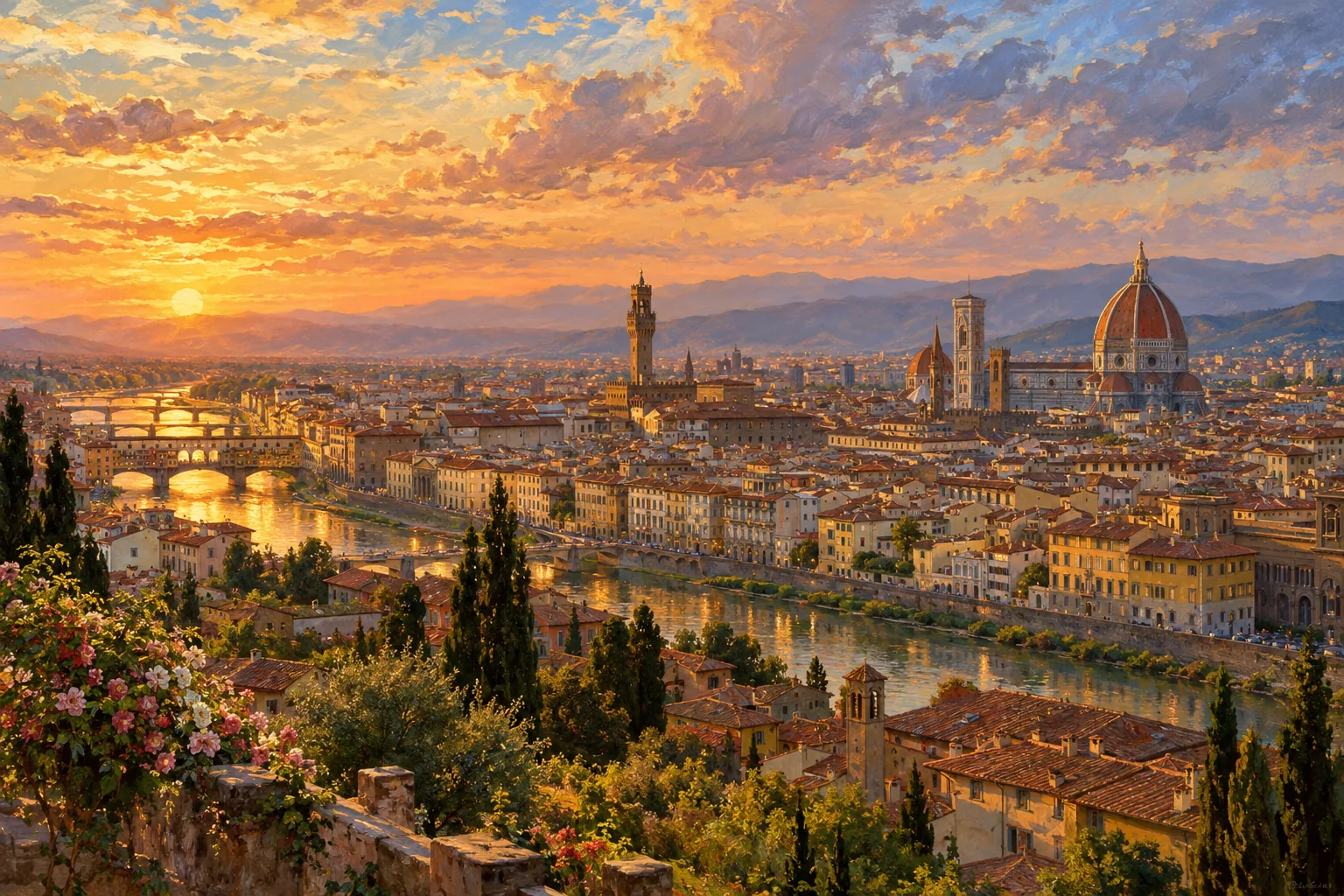
- 17Piazzale MichelangeloA memorial to Michelangelo with no original Michelangelo on it, built for a capital that left after six years, below the hill he fortified in 152913 min
The free introduction covers the city — the florin, the wool guilds, the Roman grid still visible around Piazza della Repubblica, and why the Medici are credited with rather more of this than they built.
The walk
Start at Santa Maria Novella, across the square from the railway station. Walk a few minutes east to San Lorenzo and the Medici Chapels, then about ten minutes north-east to the Accademia, with the David, and a couple of minutes further north to the convent of San Marco. Walk south to the Baptistery, the octagon in Piazza del Duomo, and turn round for the cathedral. Head south down Via del Proconsolo to the Bargello, then on to Piazza della Signoria and into the Palazzo Vecchio on its corner. Then down the Uffizi courtyard to the river and onto the Ponte Vecchio. Walk ten minutes east along the Arno to Santa Croce.
Then cross the river: over the Ponte alle Grazie and west through the Oltrarno to the Brancacci Chapel in Santa Maria del Carmine, then about ten minutes back east to the Pitti Palace, and through its courtyard into the Boboli Gardens. Finish by walking east through San Niccolò and up the Rampe to Piazzale Michelangelo, about half an hour, steep at the end — ideally in time for sunset.
The north bank is flat; the south bank is not. Done in one go it is a long day, and it splits naturally at the river: the first twelve stops in the morning, the Oltrarno after lunch. Several stops are told from somewhere free to stand — the Uffizi stop in its open courtyard, Santa Maria Novella's façade, the Pitti's square and the Piazzale. The Accademia stop is told in front of the David, and San Marco, the Bargello, the Palazzo Vecchio, the Medici Chapels, Santa Croce and Boboli need a ticket to follow inside, and the Brancacci Chapel takes timed tickets for small groups. The guide does not sell tickets and does not track opening hours; check those with the sites before you go.
Why the stops run fifteen minutes instead of ninety seconds
Each landmark begins as a written dossier — earliest history, construction, architecture, archaeology, the people, the myths, and what is actually known — researched and written out before a word is narrated.
Every claim in that dossier carries a confidence rating, and that rating survives into the guide. Florence needs this more than most cities. A great deal of what gets repeated here comes from Giorgio Vasari, who published the first history of Renaissance art in 1550, told it as a Florentine triumph, and was a Florentine court painter on the Medici payroll at the time. He is the foundational source and he is not a disinterested one. Where something is only a story, the guide says so.
Things this guide will tell you that the square will not
- The Baptistery doors are copies. The 1966 flood burst them open and tore five panels off the Gates of Paradise. Every original is now in the Museo dell'Opera del Duomo, a five-minute walk across the same square, and almost nobody makes it.
- The cathedral façade is Victorian. Arnolfo di Cambio's front was demolished in 1587 and the building stood with a bare brick face for nearly three hundred years. What you photograph was built between 1876 and 1887.
- That is not Michelangelo's David. The original was moved indoors in 1873 after 369 years outside. The copy went up in 1910.
- The Ponte Vecchio was a meat market. The butchers threw their waste into the Arno. The jewellers arrived by decree in the 1590s, and the decree has never been repealed.
How it works on the day
Download Florence over wi-fi before you go. After that the whole guide plays on aeroplane mode — in the queue, inside the Baptistery, and on roaming you would rather not pay for.
Start a stop, lock the phone and put it in your pocket. It keeps playing, and you can pause or skip from your headphones or the lock screen. The app can also show you an optional list of landmarks within about a kilometre, which in a centre this compact means most of them at once. Decline that permission and everything else still works.
Walking it
The sixteen are a route, and the order is deliberate: from the station north-east to the David, south through the centre, east along the river, then across it and up the hill. The Baptistery, the cathedral, the square and the bridge still run in the order Florence built them. Play them in any order you like, though — each stop stands on its own.
Take the whole city with you
Download the Florence guide over wi-fi and it plays with no signal at all — on the underground, on a plane, on a dead SIM. It keeps going with the screen off and the phone in your pocket, and it doesn't ask you to make an account.
Get it free on Google Play Android · intro and first three stops free in every city