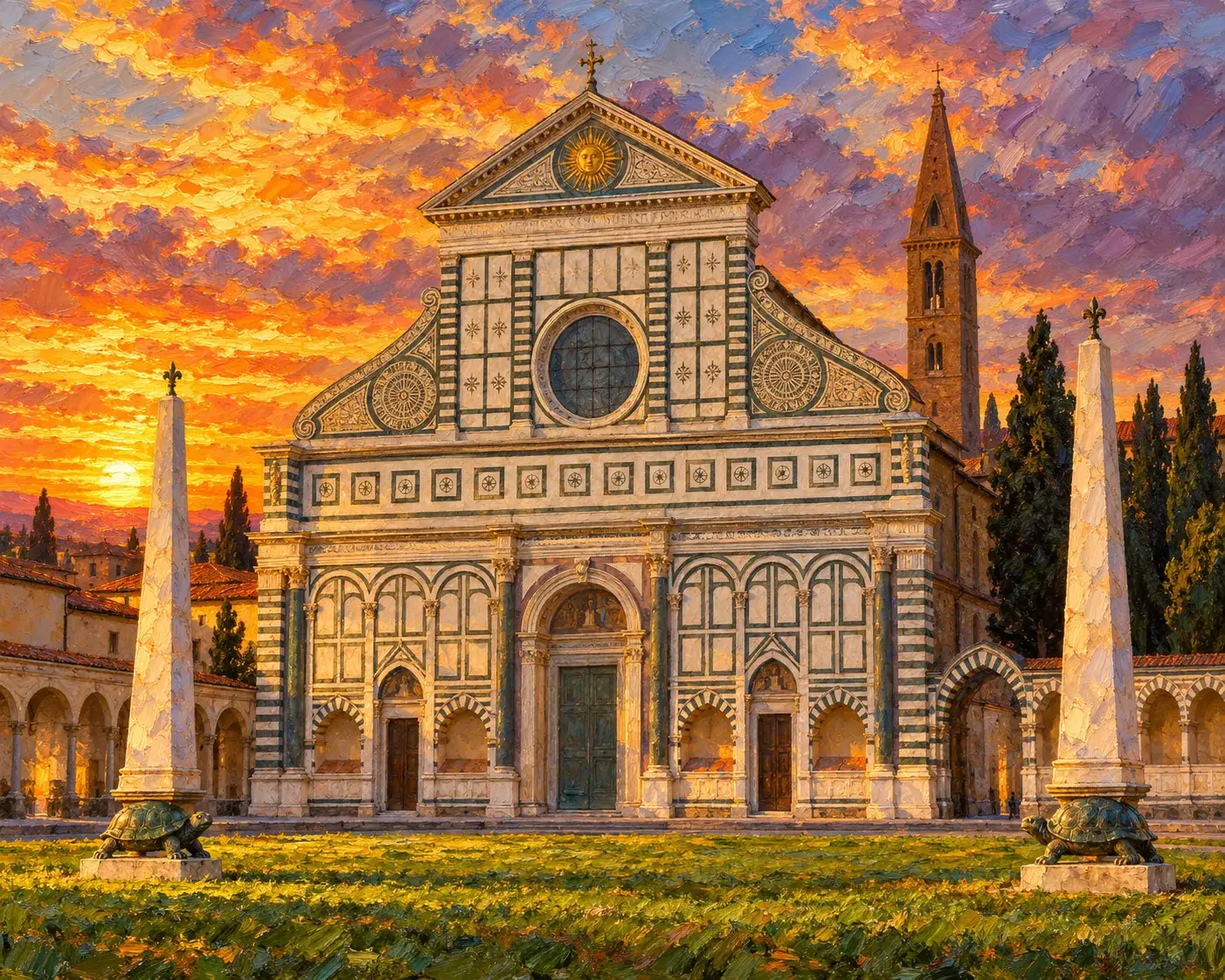
Most people who arrive in Florence by train read the name Santa Maria Novella on a platform sign and never think about it again. The station is named after the church across the square, which is about six hundred and fifty years older. This is where the walk starts.
Novella means new
The Dominican friars came to Florence in 1221 and were given a small church out here among the fields, Santa Maria delle Vigne — Saint Mary of the Vineyards. In 1279 they began a much bigger one. The new Santa Maria: Novella. It has nothing to do with Boccaccio's novelle, though Boccaccio does turn up later.
It was built as a preaching church, one long open hall for crowds to hear sermons. On the other side of the city, almost at the same moment, the Franciscans were building Santa Croce. The two churches are bookends to the old city, and to this walk.
A merchant signs a church
The lower half of the façade is fourteenth-century — striped arches, and a row of family tombs set into the wall. In the 1450s the merchant Giovanni Rucellai paid Leon Battista Alberti to finish it. Alberti wanted something classical and could not demolish anything, so he invented a way to join a wide Gothic ground floor to a narrow classical top: the two great scrolls that hide the sloping aisle roofs. Church fronts across Europe copied them for the next three centuries.
Read the frieze under the pediment: IOHANNES ORICELLARIUS PAULI F. AN. SAL. MCCCCLXX — Giovanni Rucellai, son of Paolo, in the year of salvation 1470. His emblem, a sail full of wind, runs along the band below. (The right-hand scroll was only clad in marble in 1920.)
Instruments for measuring the year
On the façade, left, a bronze ring; right, marble lines like a sundial. They are not ornaments. In 1572–1574 the Dominican astronomer Egnazio Danti fixed them here to observe the equinox. The calendar had drifted from the sun, and in 1582 it was reformed: in the countries that adopted it that year, 4 October was followed by 15 October. How much Danti's Florentine observations contributed is still argued over; that they were working instruments is not.
Inside: a cross, a wall, and a skeleton
Giotto's crucifix, painted around 1290, hangs about four and a half metres above the nave, where it went back in 2001 after twelve years of restoration.
Halfway down the left aisle is **Masaccio's Holy Trinity**, painted in the mid-1420s — one of the first paintings built on mathematically constructed perspective. From the right spot it is a chapel opening into the wall. At its foot lies a painted skeleton with a line in Italian: I was once what you are, and what I am, you also will be. Masaccio was dead at about twenty-seven.
In 1570 Giorgio Vasari built an altar in front of it. It was found again in 1860, and the skeleton was rediscovered under plaster and reunited with the fresco in 1952.
Florentines in their best clothes
Domenico Ghirlandaio painted the main chapel between 1485 and 1490 for the banker Giovanni Tornabuoni, and filled the Bible stories with real Florentines of the day. From 1488 a thirteen-year-old was apprenticed to his workshop: Michelangelo. Whether he painted any of it, nobody can say.
Next door, Filippino Lippi finished the Strozzi Chapel by about 1502; beside the high altar hangs Brunelleschi's only known wooden sculpture, a crucifix that Vasari says made Donatello drop the eggs he was carrying.
Where the Decameron begins
In the plague year of 1348, Boccaccio's hundred tales begin on a Tuesday morning inside this church, where seven young women meet after Mass and decide to leave the dying city.
Five things almost everyone believes that aren't true
| Claim | Verdict | What is actually the case |
|---|---|---|
| Santa Maria Novella is the name of the station | Partly false | The station, built 1932–35, is named after the church, which was begun in 1279 |
| Novella refers to Boccaccio's tales | False | It means "new": the new Santa Maria, replacing an older church |
| The whole façade is by Alberti | False | The lower storey is fourteenth-century; Alberti completed the top in 1470 |
| Masaccio's Trinity has always been on view | False | Vasari hid it behind an altar in 1570; it was found in 1860 |
| The bronze ring on the façade is decoration | False | It is an armillary sphere, installed in 1572–74 to observe the equinox |
Hear this one standing in front of it
Wanderlight's Florence guide covers 17 landmarks and runs 4 hr 29 min in total. It plays offline, keeps going with the screen off, and doesn't ask you to make an account.
Get it free on Google Play Android · intro and first three stops free in every cityWhere this comes from
Written from Wanderlight's research dossier for Santa Maria Novella — the same one the narration is written from. Where the evidence is thin, this page says so rather than rounding the uncertainty up.