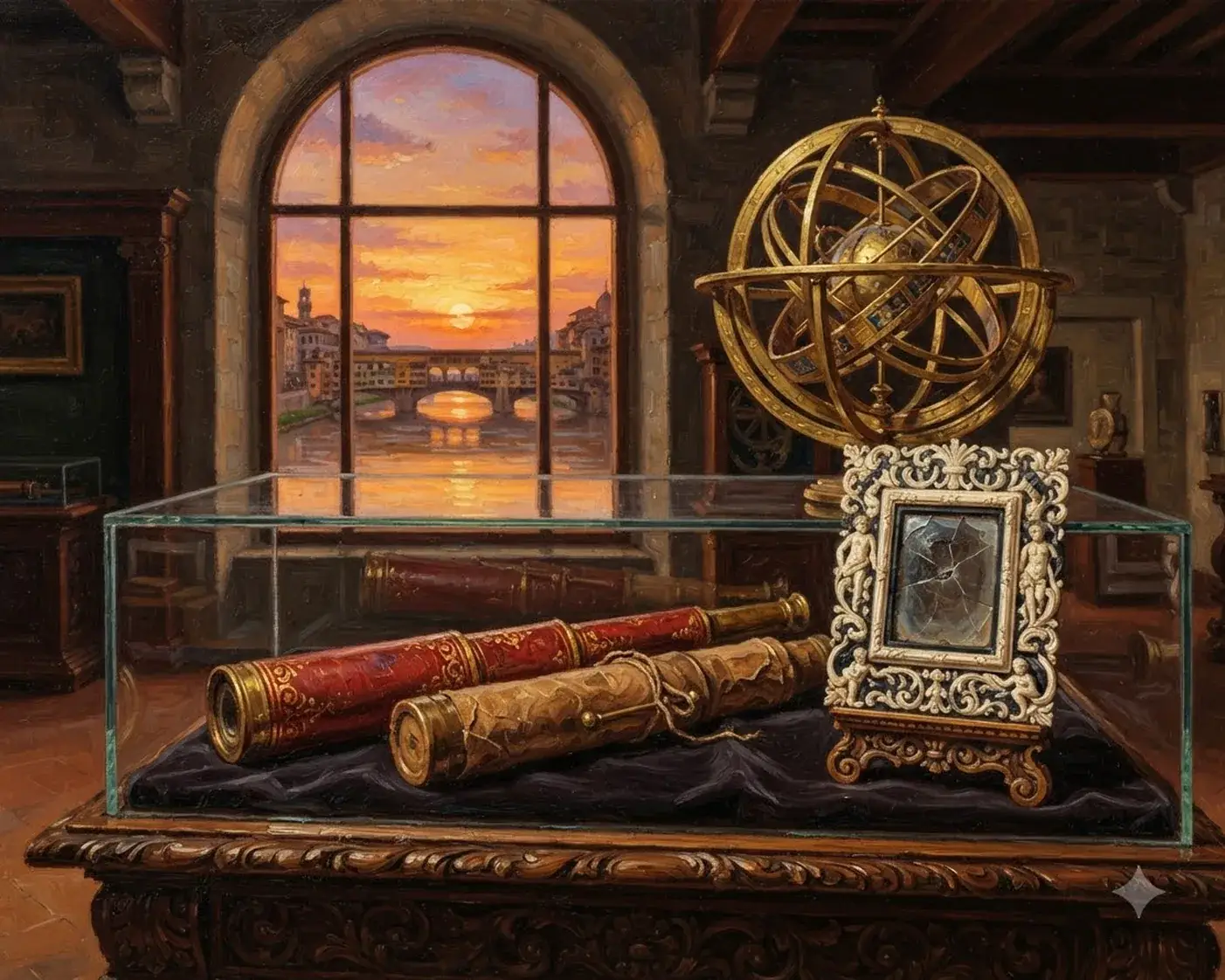
A minute east of the Uffizi, on Piazza dei Giudici, Florence keeps its science museum: the instruments collected by the Medici and the Lorraine grand dukes. In one room are Galileo Galilei's two surviving telescopes, the cracked lens of the telescope that found Jupiter's four largest moons in January 1610, and the middle finger of his right hand, taken from his body in 1737.
Four moons for the Medici
Galileo did not invent the telescope, but in 1609 he made it about twenty times stronger and turned it on the sky. On 7 January 1610 he saw "stars" beside Jupiter that moved. They were moons. He named them the Medicean Stars after Grand Duke Cosimo II, and was rewarded with the post of court mathematician and philosopher in Florence.
The trial and the tomb
In 1633 the Inquisition condemned him for "vehement suspicion of heresy" and sentenced him to house arrest at Arcetri, where he went blind and died in 1642. The Pope opposed a monument, so he was buried in a side room at Santa Croce for 95 years. On 12 March 1737 his remains were moved to a proper tomb, and admirers took relics: three fingers, a tooth and a vertebra. The antiquarian Anton Francesco Gori kept the middle finger.
Lost and found
The finger went on show at the Laurentian Library, then in an 1841 shrine to Galileo, and came to this building in 1927. The other two fingers and the tooth were lost after 1905 and turned up at an auction in 2009. Since 2010 all three fingers are on display.
4 things almost everyone believes that aren't true
| Claim | Verdict | What is actually the case |
|---|---|---|
| Galileo invented the telescope. | False | Dutch lens makers had one by 1608. Galileo improved it and pointed it at the sky. |
| He muttered "And yet it moves" at his trial. | Unattested | The line first appears in print more than a century later. |
| He was tortured and jailed in a dungeon. | False | He was threatened with torture, as procedure required, and kept under house arrest. |
| The finger was mounted as a rude gesture to the Church. | False | It was mounted as a relic pointing to the heavens. A Latin verse on its base says so. |
Where to stand
In front of the framed lens, then the finger a few cases away: the glass that found the moons and the hand that held it up.
Hear this one standing in front of it
Wanderlight's Florence guide covers 17 landmarks and runs 4 hr 29 min in total. It plays offline, keeps going with the screen off, and doesn't ask you to make an account.
Get it free on Google Play Android · intro and first three stops free in every cityWhere this comes from
Written from Wanderlight's research dossier for Museo Galileo — the same one the narration is written from. Where the evidence is thin, this page says so rather than rounding the uncertainty up.