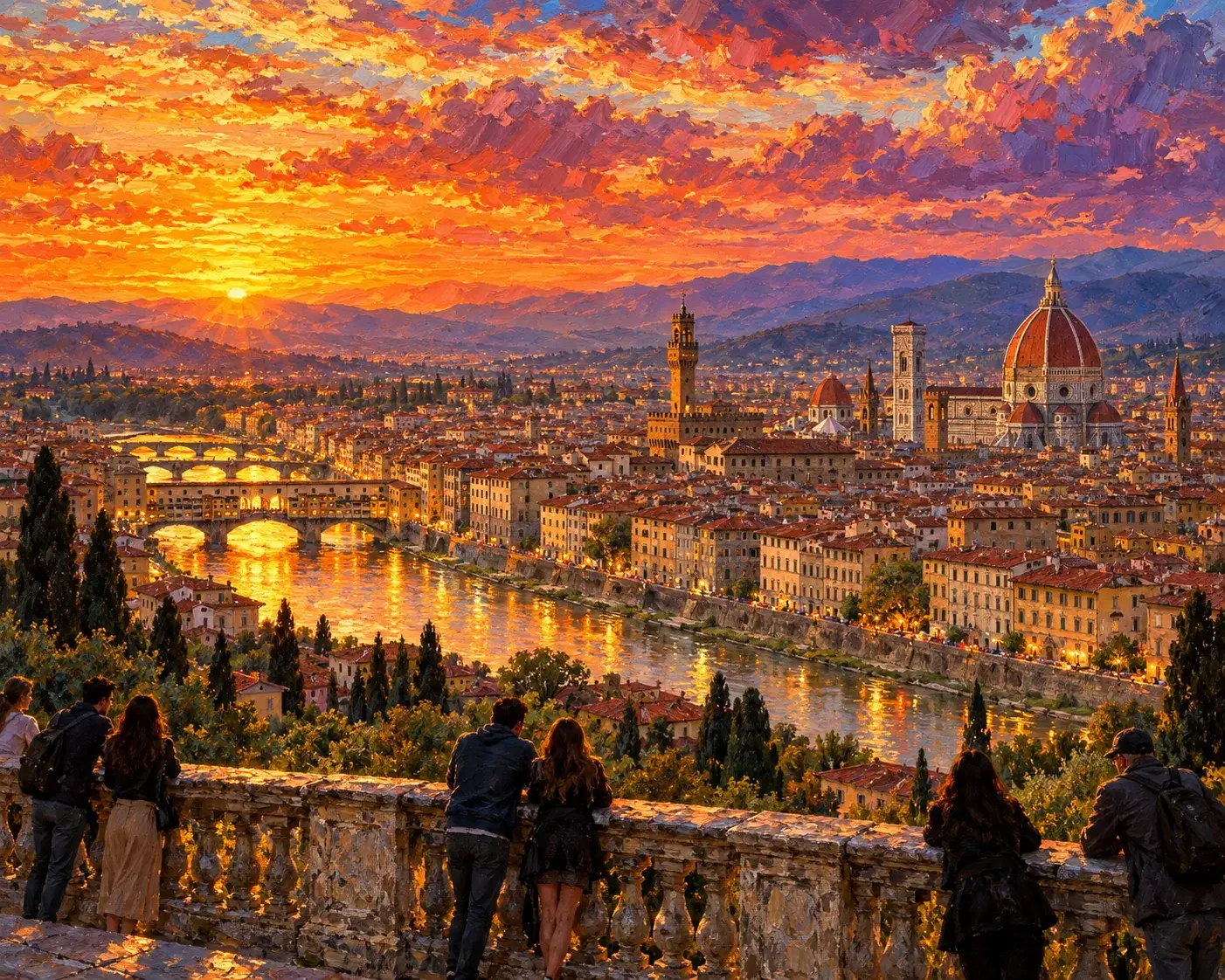
From the balustrade you can see almost every stop on the walk: the dome, the town hall tower, the Uffizi running down to the river, the bridge with houses on it, Santa Croce upstream, the Boboli hillside to your left. The terrace is dedicated to Michelangelo, and there is no original Michelangelo on it.
Built for a capital that left
In 1865 the new Kingdom of Italy moved its capital to Florence, and the city hired the architect Giuseppe Poggi to make it look like one. On the north bank the medieval walls came down for boulevards. On this side he built the Viale dei Colli, about eight kilometres of tree-lined road climbing the hills, with this terrace, begun in 1869, at its high point, and the Rampe, the stairs with fountains and grottoes, from the river at San Niccolò up to it.
The loggia at the back was meant to be a museum of Michelangelo's works. In 1871 the capital moved to Rome, and the museum never happened. It is a café.
A plaque at the loggia, from 1911, reads: Giuseppe Poggi, Florentine architect. Look around you: here is his monument.
Two Davids, one year
The bronze David in the middle was cast from moulds of the original, with bronze copies of Night, Day, Dawn and Dusk from the Medici tombs around its base. It was inaugurated in the 1870s, usually given as 1873; the chronicles say nine pairs of oxen hauled it up. In 1873 the marble original was taken out of the weather in Piazza della Signoria and into the Accademia.
The hill he defended
Up the steps behind the terrace is San Miniato al Monte, begun in the early eleventh century and still a monastery. In the siege of 1529–1530, with the republic fighting the army sent to restore the Medici, Michelangelo was in charge of the city's fortifications, and this hill was the weak point. He fortified it; cannon on San Miniato's bell tower fired on the imperial army, and the tower, the story goes, was hung with mattresses and bales of wool against the enemy's guns.
So the man the terrace celebrates once stood on this hill defending the view.
At sunset
The sun goes down to the west, beyond the bridges. Stay for it if you can.
Five things almost everyone believes that aren't true
| Claim | Verdict | What is actually the case |
|---|---|---|
| Michelangelo designed Piazzale Michelangelo | False | Giuseppe Poggi designed it, from 1869, three centuries after Michelangelo died |
| The David here is the original | False | It is a bronze copy; the marble original is in the Accademia |
| The square is Renaissance | False | It was built while Florence was capital of Italy, 1865–71 |
| The loggia was built as a restaurant | False | It was designed as a Michelangelo museum that was never created |
| Michelangelo had no connection to this hill | False | He fortified San Miniato during the siege of 1529–30 |
Hear this one standing in front of it
Wanderlight's Florence guide covers 17 landmarks and runs 4 hr 29 min in total. It plays offline, keeps going with the screen off, and doesn't ask you to make an account.
Get it free on Google Play Android · intro and first three stops free in every cityWhere this comes from
Written from Wanderlight's research dossier for Piazzale Michelangelo — the same one the narration is written from. Where the evidence is thin, this page says so rather than rounding the uncertainty up.