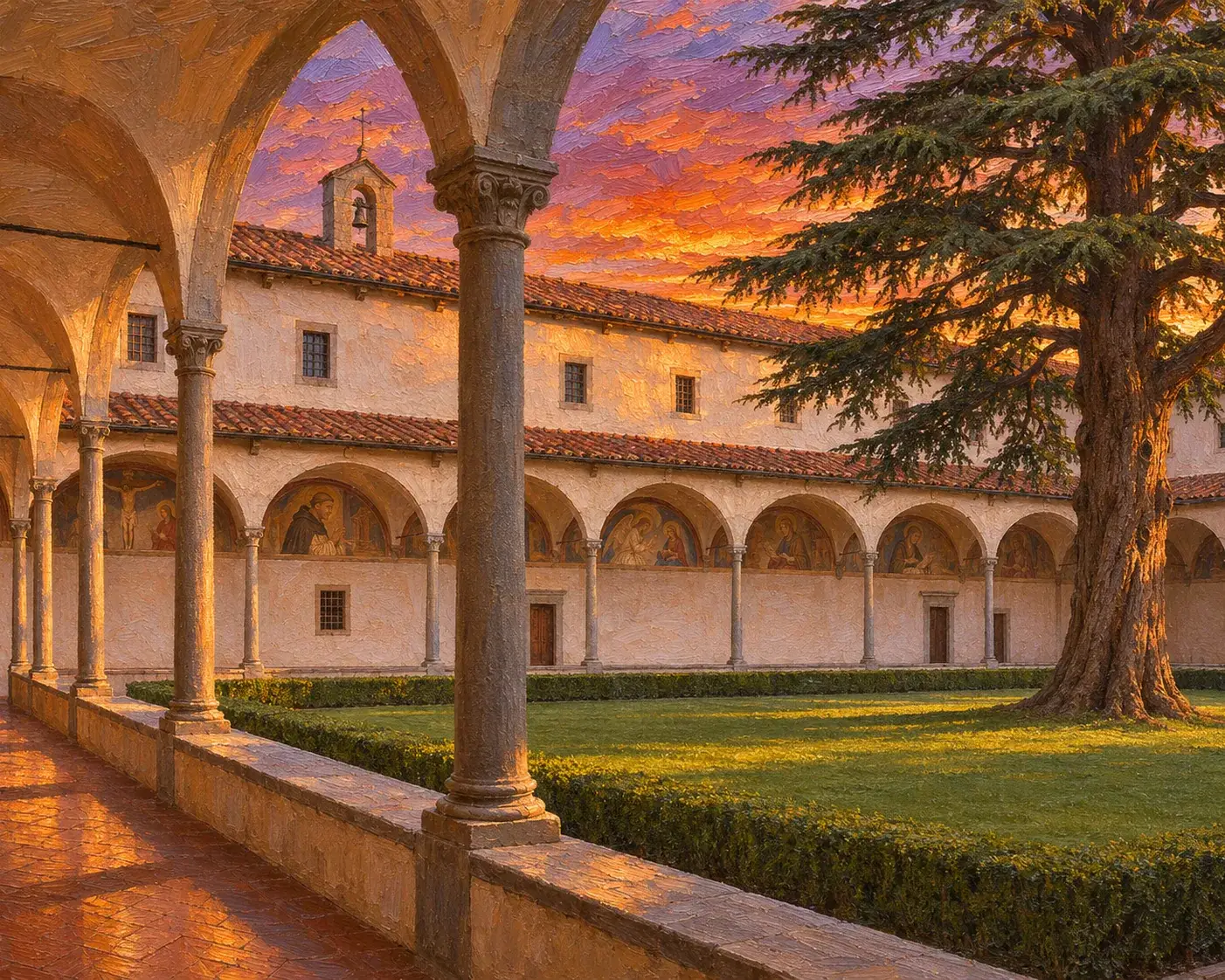
The richest banker in Europe paid to rebuild a convent for friars who owned nothing, and kept two small rooms upstairs for himself. Fifty years later, a few doors down the same corridor, lived the friar who drove his family out of Florence.
A convent paid for by the Medici
In 1437 a community of strict, reformed Dominican friars from Fiesole took over a run-down monastery a couple of minutes north of the Accademia. Cosimo de' Medici, back from exile since 1434, paid to rebuild it, and his architect Michelozzo gave it a plain, measured cloister, a chapter house and, upstairs, three corridors of small cells. Vasari put the cost at about 40,000 florins. On the night of Epiphany 1443, Pope Eugene IV consecrated the church.
A painting in every cell
Between about 1439 and 1443, the friar-painter Fra Angelico, born Guido di Pietro, painted a fresco in nearly every one of about forty-four cells, with assistants. Each was for one friar's private prayer: few figures, plain backgrounds, one window. At the top of the stairs his Annunciation asks everyone who passes to say a Hail Mary. In cell 7, the Mocking of Christ shows only the hands that struck him and the face that spat. The novices' cells all show Saint Dominic at the cross, each praying in a different posture.
Cosimo's cell and the library
At the end of the guests' corridor are the two rooms Cosimo kept for retreat, painted with the Adoration of the Magi: kings bringing their gifts. Nearby he paid for a long, bright library, opened in 1444 with over 400 books from the humanist Niccolò Niccoli and open to scholars. It is often called the first public library of the Renaissance.
Savonarola
The Dominican preacher Girolamo Savonarola came here in 1490 and was prior from 1491. After the Medici were expelled in 1494, his voice ruled the city. On Palm Sunday, 8 April 1498, a mob besieged the convent while its bell, La Piagnona, rang through the night. He was arrested, tortured, and executed in Piazza della Signoria on 23 May. Tradition says the bell was whipped through the streets and sent away; it is back in the museum. His cells hold his cloak, his crucifix and Fra Bartolomeo's portrait of him.
Four things almost everyone believes that aren't true
| Claim | Verdict | What is actually the case |
|---|---|---|
| Fra Angelico was his name | False | He was born Guido di Pietro; "Angelico" was an epithet given after his death |
| Fra Angelico painted every cell alone | False | Assistants helped, especially in the later corridors |
| Savonarola was executed at San Marco | False | He was arrested here and executed in Piazza della Signoria |
| Monks still live here | False | The museum has held most of the convent since 1869; the last friars left in 2014 |
Hear this one standing in front of it
Wanderlight's Florence guide covers 17 landmarks and runs 4 hr 29 min in total. It plays offline, keeps going with the screen off, and doesn't ask you to make an account.
Get it free on Google Play Android · intro and first three stops free in every cityWhere this comes from
Written from Wanderlight's research dossier for Museum of San Marco — the same one the narration is written from. Where the evidence is thin, this page says so rather than rounding the uncertainty up.