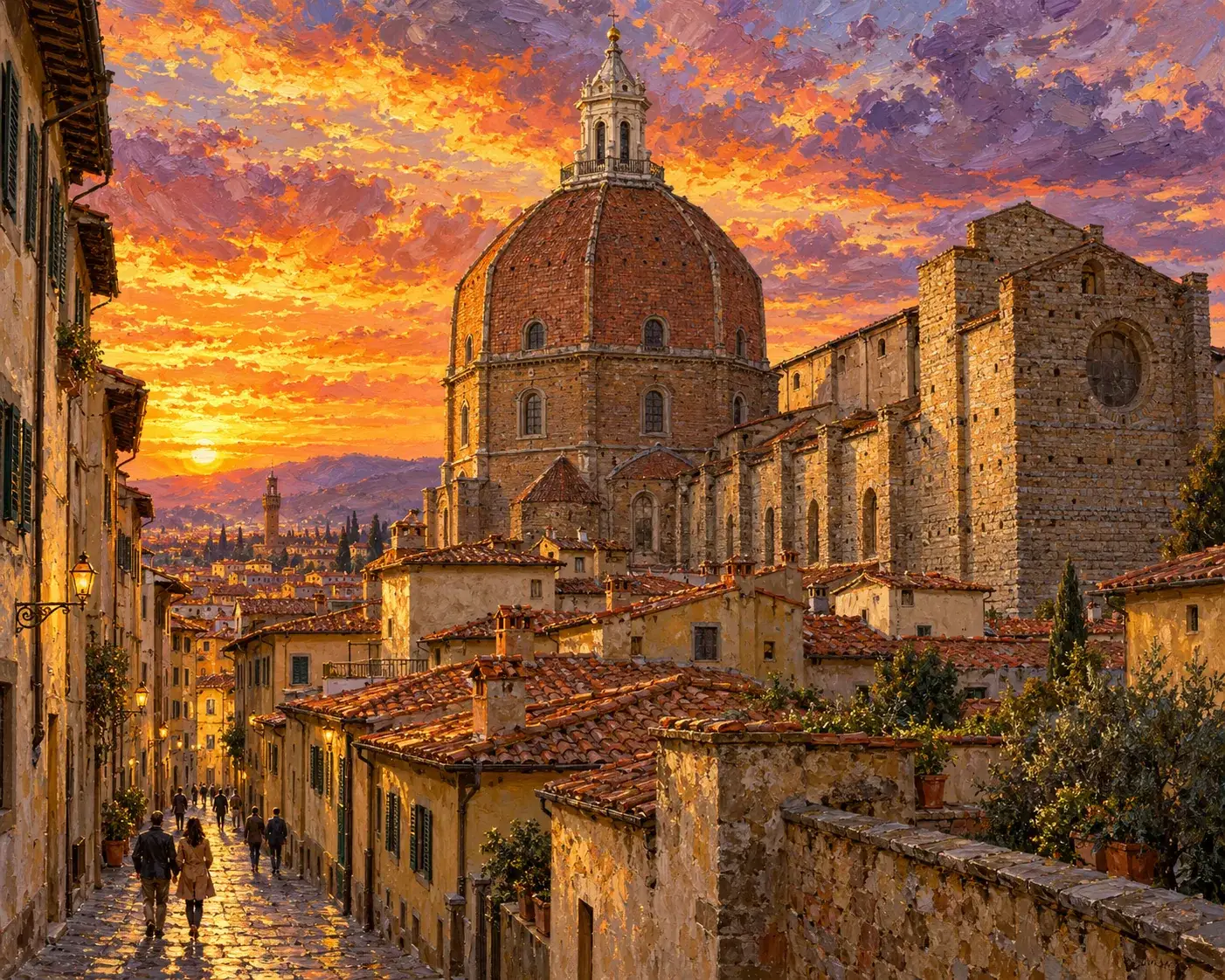
The man who carved the tombs in this building spent the best part of a year building gun platforms to keep this family out of Florence. When they won, he went into hiding. They forgave him, because nobody else could finish the job.
The family church with no front
San Lorenzo was the Medici parish church, a block from their palace. Tradition says it was consecrated in 393 by Saint Ambrose. From the 1420s the founder of the Medici bank, Giovanni di Bicci, helped pay for Brunelleschi to rebuild it, and his son Cosimo the Elder lies under the crossing beneath the words Pater Patriae, Father of his Country.
Its front is still bare brick. Pope Leo X gave Michelangelo the façade in 1516; the contract was cancelled in 1520. The chapels are entered from the back, in Piazza Madonna degli Aldobrandini.
The Chapel of the Princes
Begun in 1604, this octagon under a dome about 59 metres high — second in Florence only to the cathedral's — was the grand dukes' mausoleum. The walls are not painted. They are pietre dure: jasper, chalcedony, lapis, coral and marbles, cut and fitted by a workshop Ferdinando I founded for the purpose in 1588, the Opificio delle Pietre Dure, which survives as a leading restoration institute.
Around the base, the arms of sixteen Tuscan towns the Medici ruled. Of the six niches, two hold statues. The great sarcophagi are empty; about fifty Medici lie in the crypt below. The family died out in 1737 with the chapel unfinished; its dome was painted in the 1820s and 1830s.
The New Sacristy
Two young Medici died in quick succession — Giuliano, Duke of Nemours (1516) and Lorenzo, Duke of Urbino (1519) — and the family's two churchmen, Pope Leo X and Cardinal Giulio, later Clement VII, gave Michelangelo their funeral chapel in 1520. It was his first building, with walls, windows and statues designed together.
Giuliano sits in armour above Night and Day; Lorenzo, chin on hand, above Dawn and Dusk. Told the dukes did not look like the dukes, Michelangelo is reported to have said that in a thousand years nobody would know. Lorenzo the Magnificent — the famous one — lies with his murdered brother in the plainest tomb in the room, under Michelangelo's Madonna.
"Speak softly"
A Florentine wrote a verse praising Night: wake her, and she will speak. Michelangelo answered in her voice: Sleep is dear to me, and dearer to be stone, while harm and shame endure… so do not wake me — please, speak softly. Many read it as being about Florence.
In 1527 the Medici were thrown out and the republic restored. In 1529 it put Michelangelo in charge of its fortifications against the army sent to restore them. Florence surrendered in August 1530, and he disappeared. He was pardoned, went back to the tombs, and in 1534 left for Rome, leaving them unfinished. He came back to Florence only after his death, to Santa Croce.
The room under the floor
In 1975 the museum's director, Paolo Dal Poggetto, found a trapdoor under a wardrobe leading to a small room whose walls were covered in charcoal and red-chalk drawings. Many are attributed to Michelangelo, and the story that he hid there in 1530 is widely told. It cannot be proved. Since 2023 the room has been opened to very small groups.
Five things almost everyone believes that aren't true
| Claim | Verdict | What is actually the case |
|---|---|---|
| Michelangelo's great tombs are for Lorenzo the Magnificent | False | They are for two younger dukes; Lorenzo the Magnificent lies in a plain tomb under the Madonna |
| The dukes' statues are portraits | False | They are idealised; they do not resemble the men |
| Michelangelo was loyal to the Medici | False | In 1529 he directed the republic's fortifications against them |
| It is proven Michelangelo hid in the secret room | Unproven | It is a hypothesis from the 1975 discovery, with no documents |
| The Chapel of the Princes is painted to look like stone | False | It is real semi-precious stone, cut and inlaid |
Hear this one standing in front of it
Wanderlight's Florence guide covers 17 landmarks and runs 4 hr 29 min in total. It plays offline, keeps going with the screen off, and doesn't ask you to make an account.
Get it free on Google Play Android · intro and first three stops free in every cityWhere this comes from
Written from Wanderlight's research dossier for Medici Chapels — the same one the narration is written from. Where the evidence is thin, this page says so rather than rounding the uncertainty up.