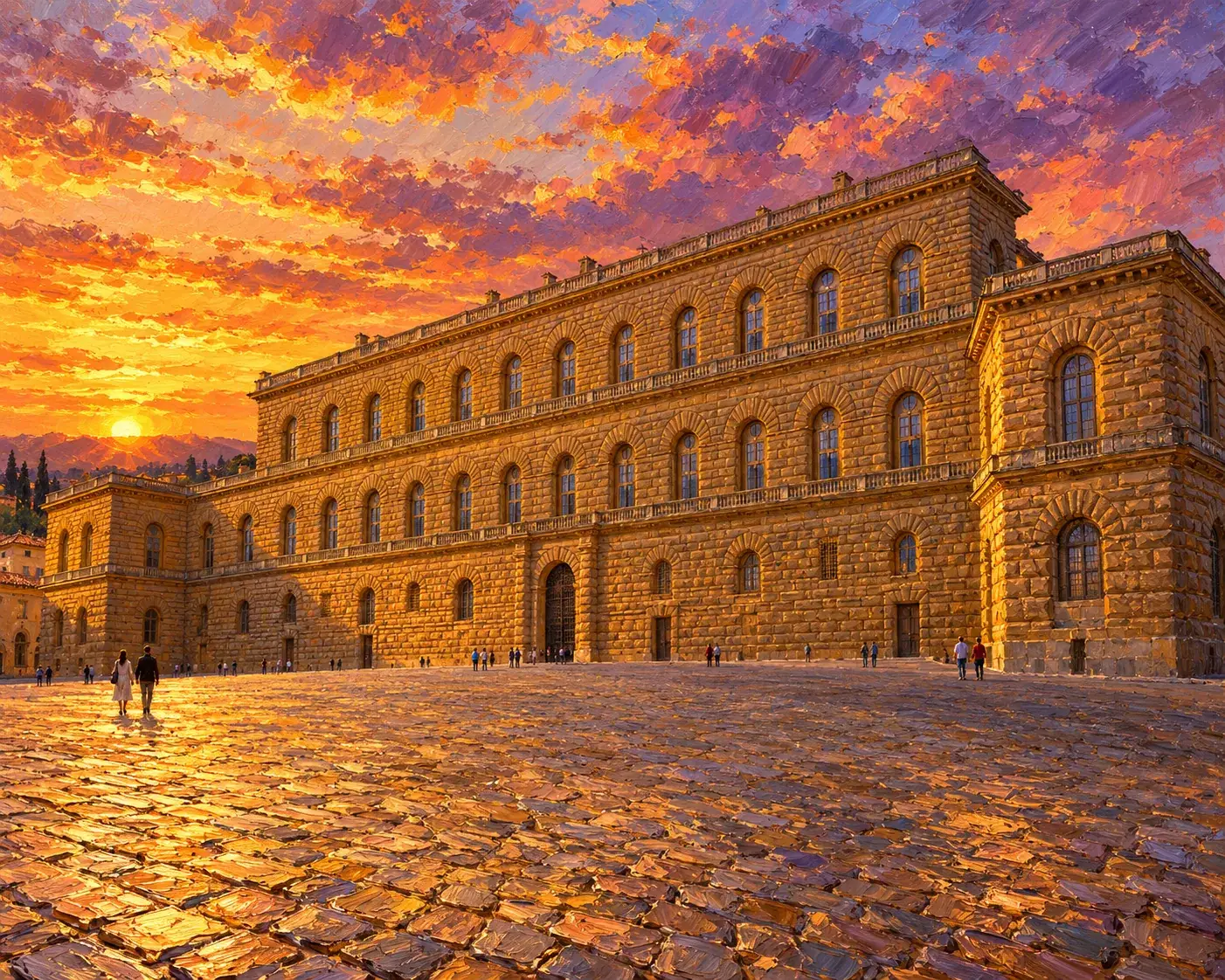
Across the river in the Oltrarno, a wall of rough brown stone about two hundred metres long rises at the top of a sloping square. It was built to outdo the Medici. Within a century the Medici were living in it.
Luca Pitti's revenge
The banker Luca Pitti, an ally of Cosimo de' Medici, began the palace in 1458. Florentines say he wanted its windows bigger than the Medici palace's front door; nobody can show he said it.
After Cosimo died, a group of leading families plotted in 1466 against his son Piero. Pitti was part of it and, by the chroniclers' account, changed sides when it failed. He survived, his standing did not, and he died in 1472 with the palace unfinished. His palace is the middle: the seven arched bays at the centre of each floor.
Vasari credited Brunelleschi, who had been dead twelve years when building began. The architect was most probably Luca Fancelli.
Sold to the Medici
In 1549 Pitti's descendants sold it to Eleonora of Toledo, wife of Duke Cosimo I, who wanted space, gardens and fresh air away from the cramped Palazzo Vecchio. Ammannati more than doubled it and built the courtyard that opens onto the Boboli Gardens. In 1565 Vasari's corridor connected it to the town hall, through the Uffizi and over the Ponte Vecchio.
The stone, rusticated so it looks hewn from a cliff, is said to have been quarried from the hill behind — the hill that became the garden.
Opera at a wedding
The Medici used spectacle as politics. For the wedding of Ferdinando I and Christine of Lorraine in 1589, accounts describe the courtyard flooded for a mock sea battle. On 6 October 1600, for the wedding of Maria de' Medici to Henri IV of France, **Jacopo Peri's Euridice** was performed here, Peri himself singing Orpheus. It is the earliest opera whose music survives.
In 1610 Galileo named the moons of Jupiter the Medicean Stars for Cosimo II, and became his court mathematician and philosopher.
A palace that kept changing hands
The Habsburg-Lorraine grand dukes followed the Medici in 1737; Napoleon's sister Elisa lived here as Grand Duchess; and while Florence was capital of Italy, from 1865 to 1871, King Victor Emmanuel II. In 1919 Victor Emmanuel III gave it to the nation. Today it holds several museums run by the Uffizi Galleries, including the Palatine Gallery, where Raphael, Titian and Rubens hang frame to frame as a prince hung them.
Summer 1944
On 29 July 1944 the German command ordered everyone along the Arno to leave their homes. More than five thousand Florentines sheltered in this palace and its gardens, camping under the courtyard arcades and washing in the fountains. On the night of 3–4 August every bridge in the city but the Ponte Vecchio was blown up.
Five things almost everyone believes that aren't true
| Claim | Verdict | What is actually the case |
|---|---|---|
| The Medici built the Pitti Palace | False | Luca Pitti began it in 1458; the Medici bought it in 1549 |
| Brunelleschi designed it | False | He died in 1446; the architect was probably Luca Fancelli |
| Pitti made his windows bigger than the Medici door | Unproven | A well-known tradition with no document behind it |
| Opera was born in Venice | False | The earliest surviving opera, Peri's Euridice, premiered here in 1600 |
| The palace has always been a museum | False | It was a royal residence until 1871 and was given to the state in 1919 |
Hear this one standing in front of it
Wanderlight's Florence guide covers 17 landmarks and runs 4 hr 29 min in total. It plays offline, keeps going with the screen off, and doesn't ask you to make an account.
Get it free on Google Play Android · intro and first three stops free in every cityWhere this comes from
Written from Wanderlight's research dossier for Palazzo Pitti — the same one the narration is written from. Where the evidence is thin, this page says so rather than rounding the uncertainty up.