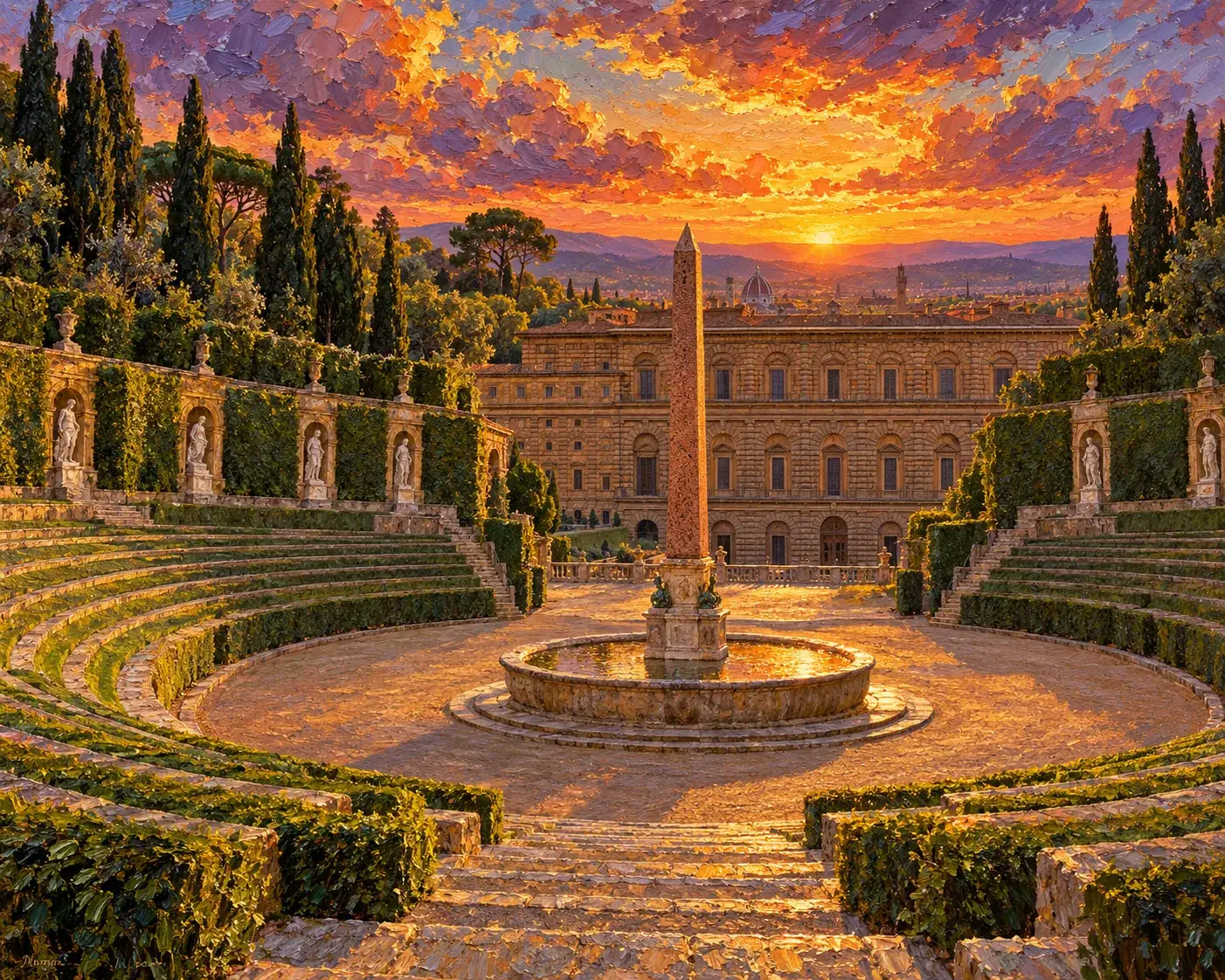
Walk out of the back of the Pitti Palace and you are standing in a stone horseshoe with an Egyptian obelisk in the middle. It is a theatre now. It began as the hole the palace's stone was cut from.
A garden built by a committee of a century
The Medici bought the Pitti and its hillside in 1549. Niccolò Tribolo, who had laid out their gardens at Castello, drew the first plan in 1550 — and died the same year. Ammannati, Vasari and Buontalenti carried it on, and in the seventeenth century Giulio and Alfonso Parigi stretched it down the slope with a cypress avenue, the Viottolone, to an island garden, the Isolotto.
Water was the luxury. Cosimo I paid for aqueducts in the 1550s and another in 1565 to feed the fountains.
The amphitheatre
The hollow behind the palace courtyard is where the palace stone is said to have been quarried. Its stone tiers came in the 1630s, and it opened with a court wedding in 1637. The obelisk is Egyptian, usually attributed to Ramesses II; the Romans took it to Rome, the Medici kept it at their villa there, and it was set up here in 1790. It is on its third city.
From the amphitheatre the main axis climbs past Neptune — nicknamed il Forcone, the big fork — to the statue of Abundance, finished by Pietro Tacca in 1636, and a view of the whole city.
The Grotta Grande
Near the palace end of the garden, close to where Vasari's corridor arrives, is a building that seems to be melting. Begun by Vasari in 1557 and transformed by Buontalenti in 1583–1593 for Francesco I, it is three chambers of dripping artificial rock with shepherds and animals half emerging from the walls, and Giambologna's Venus in the last room.
From 1585 its corners held **Michelangelo's four unfinished Prisoners, carved for a pope's tomb and set into the fake rock as if struggling out of the mountain. In 1908–09** they moved to the Accademia, where they now line the corridor to the David. Those in the grotto are copies.
Morgante on his tortoise
Nearby, a naked, pot-bellied man rides a tortoise. He is called the Bacchino, the little Bacchus, but he is Morgante, a dwarf at Cosimo I's court, carved by Valerio Cioli around 1560.
Opened, and needed
The Lorraine grand dukes opened the garden to the public in the 1760s and added a rococo coffee house in 1775. In the summer of 1944, more than five thousand Florentines sheltered in the Pitti and these gardens while the bridges were blown up, and washed in the fountains. In 2013 the garden was inscribed by UNESCO with the Medici villas and gardens of Tuscany.
Five things almost everyone believes that aren't true
| Claim | Verdict | What is actually the case |
|---|---|---|
| The Prisoners in the grotto are Michelangelo's originals | False | The originals moved to the Accademia in 1908–09; these are copies |
| The little Bacchus on the tortoise is a god | False | It is Morgante, a real dwarf at Cosimo I's court |
| Boboli was always a public park | False | It was a private Medici garden, opened to the public in the 1760s |
| The amphitheatre was dug as a theatre | Partly false | The hollow is the quarry the palace stone came from |
| The obelisk was made for Florence | False | It is Egyptian, and came here from Rome in the 1780s |
Hear this one standing in front of it
Wanderlight's Florence guide covers 17 landmarks and runs 4 hr 29 min in total. It plays offline, keeps going with the screen off, and doesn't ask you to make an account.
Get it free on Google Play Android · intro and first three stops free in every cityWhere this comes from
Written from Wanderlight's research dossier for Boboli Gardens — the same one the narration is written from. Where the evidence is thin, this page says so rather than rounding the uncertainty up.