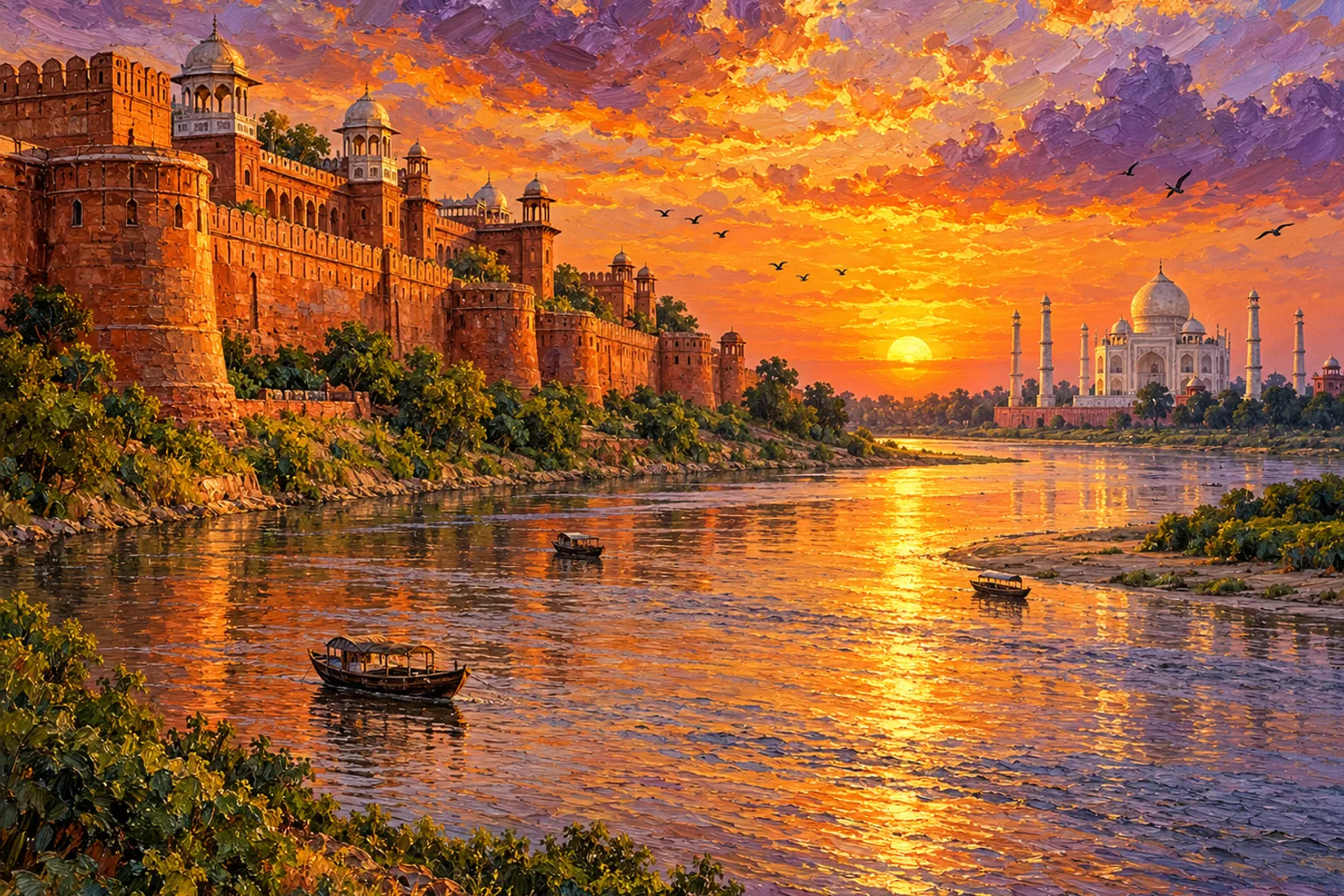
Start with the first 4, free
The introduction to Agra and the Taj Mahal and the Agra Fort and the Jama Masjid, Agra, and Kinari Bazaar, in full: 47 min of narration. No app, no account. The other 10 stops are in the app.
-
Introduction to Agra In 1585 an English merchant called Ralph Fitch wrote home that Agra was much greater than London.Up next, also free
Taj Mahal · 13 min
-
Taj Mahal Everything in the garden lines up on Mumtaz Mahal. The one thing out of balance is the emperor who built it, put there by the son who took his throneUp next, also free
Agra Fort · 14 min
-
Agra Fort In 1666 this fort held two famous prisoners. Shah Jahan died here looking at the Taj; months later the Maratha king Shivaji was held here, and got outUp next, also free
Jama Masjid, Agra, and Kinari Bazaar · 10 min
-
Jama Masjid, Agra, and Kinari Bazaar Agra's great mosque was paid for by a princess from her own allowance, the daughter who shared her father's captivity. Around it, Kinari Bazaar sells wedding trimNext on the walk
Akbar's Tomb, Sikandra · 10 min
That was the free part of Agra. The other 10 stops, 1 hr 25 min of them, continue in the app — download the city once and it plays offline, with the screen off.
Get it free on Google Play Android · intro and first three stops free in every city · unlock the rest of a city once, no subscription
Synthesised voices, written from our research dossiers. Plays in this page; keep reading while you listen.
Wanderlight's Agra guide is 13 stops and runs 2 hr 2 min. They are one day along the Yamuna, in the order the day suggests: the Taj Mahal at sunrise, Agra Fort upriver, the old city's great mosque and bazaar, the tombs of Akbar and his Rajput queen at Sikandra, then across the water and down the quiet east bank, from the first Mughal garden in India to the small white tomb where the Taj was rehearsed, ending at the garden opposite the Taj for sunset. A second day takes you to Akbar's abandoned capital, Fatehpur Sikri. The introduction and the Taj Mahal are free, in full, and you can play them on this page. In the app it plays with no signal and never asks you to make an account.
What's inside
- 01Taj MahalEverything in the garden lines up on Mumtaz Mahal. The one thing out of balance is the emperor who built it, put there by the son who took his throne13 min
- 02Agra FortIn 1666 this fort held two famous prisoners. Shah Jahan died here looking at the Taj; months later the Maratha king Shivaji was held here, and got out14 min
- 03Jama Masjid, Agra, and Kinari BazaarAgra's great mosque was paid for by a princess from her own allowance, the daughter who shared her father's captivity. Around it, Kinari Bazaar sells wedding trim10 min
- 04Akbar's Tomb, SikandraAkbar began his own tomb; his son didn't like what he found and changed it, which is why the greatest Mughal emperor lies under the open sky10 min
- 05Tomb of Mariam-uz-ZamaniAkbar's Rajput queen, born Harkha Bai of Amber and mother of Jahangir, lies in a sultan's pavilion older than the Mughal empire9 min
- 06Ram BaghThe first Mughal emperor called Agra ugly the day he arrived. This garden was his answer, and the Marathas later gave it a Hindu name8 min
- 07Chini ka RauzaShah Jahan's prime minister lies in a tomb once covered in Persian glazed tiles; his brother wrote the Taj Mahal's inscriptions9 min
- 08Tomb of Itimad-ud-DaulahThe first Mughal tomb in white marble, built by an empress who was born on the road with nothing, for the man who was Mumtaz Mahal's grandfather12 min
- 09Mehtab BaghFor three hundred years people said a black Taj Mahal was meant to stand here. The excavation found a garden, and a pool built for a reflection11 min
- 10Royal Palace, Fatehpur SikriAt Fatehpur Sikri, Akbar filled a pool with coins to give away, and a single carved pillar holds up a platform where, tradition says, he sat7 min
- 11Mariam-uz-Zamani's Palace, Fatehpur SikriThe biggest palace in Akbar's capital belonged to his Hindu queen, built in her homeland's styles, with Birbal's house a few steps away7 min
- 12Tomb of Shaikh Salim ChishtiAn emperor built a city because of the saint in this white tomb, and people of every faith still tie threads to its screens with a wish7 min
- 13Buland DarwazaAkbar's great victory gate carries a warning: the world is a bridge, so build no houses on it. Within fifteen years his city was empty6 min
The free introduction covers the city: Agra in Krishna's country of Braj, the sultan who made it a capital in 1504, the Mughal emperor who first called it ugly, the Hindu general crowned king here in 1556, the Jat and Maratha rulers who took it after the Mughals left, and how a city bigger than London ended up famous for a single tomb.
There is also a story for the road: Fatehpur Sikri: The City Akbar Left. It's an episode for the hour's drive west of Agra to the red city Akbar built to give thanks for a son. He filled it with debates between faiths, with Tansen's music and Birbal's company, and left it within fifteen years. It is in the app, under Stories.
The walk
Start at the Taj Mahal, as close to sunrise as you can: the marble is pink, the light is soft and the crowds are thinner. Walk the central water channel, go up onto the platform and inside, then out onto the river terrace behind the tomb, which most visitors miss.
Then go about 2.5 kilometres upriver to Agra Fort, entering by the Amar Singh Gate. The stop runs from the red sandstone palaces of Akbar to the white marble rooms of Shah Jahan, and to the octagonal tower where you can still see what he saw: the Taj, small and white on the bend of the river.
From the fort, cross the road to the Jama Masjid, Jahanara's mosque, and the lanes of Kinari Bazaar around it. Then go north-west about 8 kilometres to Sikandra: Akbar's Tomb, with its four-minaret gate and deer in the garden, and a kilometre away the quiet Tomb of Mariam-uz-Zamani, his Rajput queen.
Then cross the Yamuna and work down the east bank from north to south: Ram Bagh, Babur's garden; Chini ka Rauza, the tiled tomb about half a kilometre south; and the Tomb of Itimad-ud-Daulah, the "Baby Taj", about a kilometre further. Finish at Mehtab Bagh, the Moonlight Garden, directly opposite the Taj, in time for sunset.
Fatehpur Sikri, on a second day
About 40 kilometres west of Agra, Akbar's capital of 1571–1585 has four stops of its own, in the order people usually walk it: the royal palace (the Diwan-i-Khas, the Anup Talao and the Panch Mahal), Mariam-uz-Zamani's palace and Birbal's house, the tomb of Shaikh Salim Chishti, and out through the Buland Darwaza. Play the Fatehpur Sikri story on the drive there.
Practicalities
Most are ticketed sites run by the Archaeological Survey of India, and the Taj Mahal is closed to visitors on Fridays, when its mosque is used for prayers. The guide does not sell tickets and does not track opening hours; check those with the sites before you go. The stops are too far apart to walk comfortably in the heat, so most people take a car or an auto-rickshaw between them.
Why the stops run twelve minutes instead of ninety seconds
Each landmark begins as a written dossier: the history, the construction, the architecture, the people, the myths, and what is actually known, researched and written out before a word is narrated.
Every claim in that dossier carries a confidence rating, and the rating survives into the guide. Agra needs this. A great deal of what gets repeated here comes from seventeenth-century European travellers, colonial-era theories, and stories told at the gate. Where something is a legend, the guide says so, and tells you what the evidence shows instead.
Things this guide will tell you that the gate will not
- The graves you queue to see are not the graves. The marble tombs in the Taj's main chamber are memorials. Mumtaz Mahal and Shah Jahan are buried in a plain crypt directly below.
- There is no evidence Shah Jahan cut off the builders' hands. Not one source from the time says so. Agra's inlay workshops are still at work.
- The Baby Taj came first. It was built in 1622–28, before the Taj Mahal was begun, by the empress Nur Jahan, Mumtaz Mahal's aunt.
- The black Taj was never begun. The legend goes back to a French gem merchant. When the garden across the river was excavated in the 1990s, it held a reflecting pool, not foundations.
How it works on the day
Download Agra over wi-fi before you go. After that the whole guide plays on aeroplane mode: in the security queue, inside the tomb, and on roaming you would rather not pay for.
Start a stop, lock the phone and put it in your pocket. It keeps playing, and you can pause or skip from your headphones or the lock screen. The app can also show you an optional list of landmarks within about a kilometre. Decline that permission and everything else still works.
Walking it
The nine Agra stops are a route, and the order is deliberate: the Taj in the morning, the fort that looks down the river at it, the princess's mosque across the road, the emperor who built the fort and his queen, the garden where the Mughal story in India began, the tombs that came before the Taj, and the garden that faces it at the end of the day. Play them in any order you like, though; each stop stands on its own.
Take the whole city with you
Download the Agra guide over wi-fi and it plays with no signal at all — on the underground, on a plane, on a dead SIM. It keeps going with the screen off and the phone in your pocket, and it doesn't ask you to make an account.
Get it free on Google Play Android · intro and first three stops free in every city