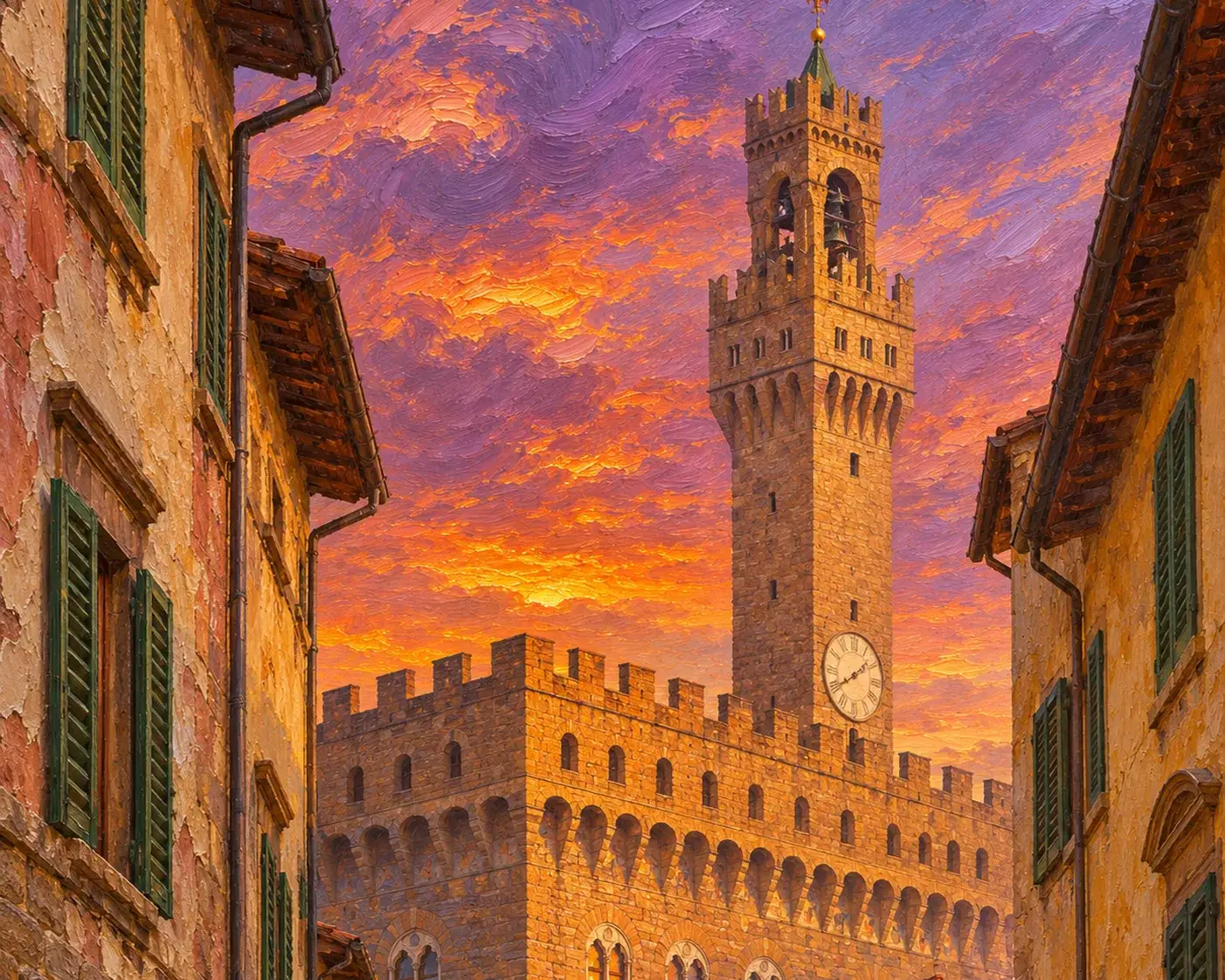
The nine Priors who governed the Florentine Republic moved into this building for their two-month terms and could leave only on official business. Two hundred and forty years later one family moved in for good, and the palace has been "old" ever since.
A town hall built like a castle
Construction began in 1299, traditionally to designs by Arnolfo di Cambio, on ground where the houses of the defeated Uberti family had been razed. Rough stone, battlements and a tower about 94 m high: the government needed a fortress to survive its own citizens. The chronicler Villani says the tower is off-centre because it was built on an older family tower. In 1342 the city gave power to Walter of Brienne, Duke of Athens; he fortified the palace against the people and was thrown out in July 1343. Since 1872 it has been Florence's town hall again.
The Hall of the Five Hundred
The great hall upstairs, about 52 m long, was built in 1494, the year the Medici were expelled, for the republic's Grand Council of five hundred citizens. Leonardo and Michelangelo were commissioned to paint its walls; neither finished. From 1555 Giorgio Vasari remade it for Duke Cosimo I, with battles against Pisa and Siena on the walls and 39 panels on the ceiling, centred on Cosimo's own glorification. Michelangelo's Genius of Victory stands at one end. From 1865 to 1871, when Florence was Italy's capital, the national parliament met here.
Who lived here
In May 1540 Cosimo I moved in with Eleonora of Toledo. Her chapel is painted by Bronzino, and a small door in her bedroom begins the Vasari Corridor, built in about five months in 1565, through the Uffizi and over the Ponte Vecchio. Their son Francesco I built the windowless Studiolo (1570–1575), whose painted panels are cupboard doors. The map room holds 53 painted maps by the friar Egnazio Danti. In the Old Chancery is the bust of Niccolò Machiavelli, who worked here for the republic from 1498 until the Medici returned in 1512. Donatello's original Judith and Holofernes, set at the door in 1495 as a warning to tyrants, is in the Hall of Lilies.
Why "old"
In 1549 Eleonora bought the Pitti palace across the river. Once the dukes lived there, this became the Old Palace, Palazzo Vecchio. Beneath it, the excavations show walls of the Roman theatre of Florentia.
Five things almost everyone believes that aren't true
| Claim | Verdict | What is actually the case |
|---|---|---|
| The David at the door is Michelangelo's original | False | The original moved to the Accademia in 1873; the copy dates from 1910 |
| It is called the Old Palace because it is the oldest | False | It became "old" when the Medici moved to Palazzo Pitti; the Bargello is older |
| The inscription over the door is Savonarola's | False | It dates from 1851 |
| Leonardo's Battle of Anghiari has been found behind Vasari's fresco | Unproven | Probes in 2011–2012 were inconclusive and the search was halted |
| The palace is only a museum | False | It is still Florence's town hall; the mayor's office is here |
Hear this one standing in front of it
Wanderlight's Florence guide covers 17 landmarks and runs 4 hr 29 min in total. It plays offline, keeps going with the screen off, and doesn't ask you to make an account.
Get it free on Google Play Android · intro and first three stops free in every cityWhere this comes from
Written from Wanderlight's research dossier for Palazzo Vecchio — the same one the narration is written from. Where the evidence is thin, this page says so rather than rounding the uncertainty up.