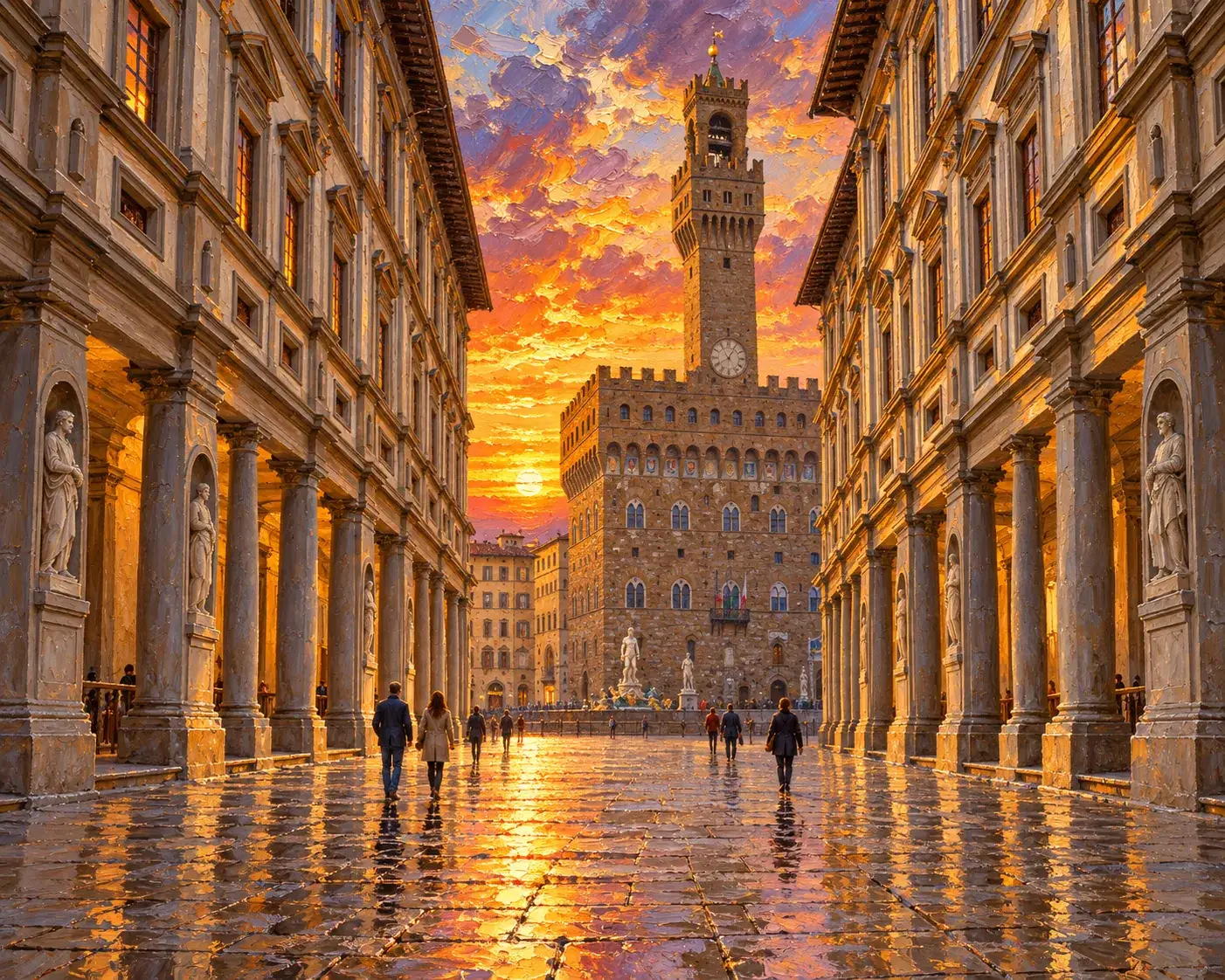
Uffizi means offices — desks, ledgers, clerks. Botticelli's Birth of Venus hangs upstairs in what was, quite literally, a government office block. The building makes no sense until you know who built it and why, and this stop is told in the courtyard, which anyone can walk through without a ticket.
A duke who wanted everyone where he could see them
Florence governed itself for centuries through committees, magistracies and guilds scattered across the city. In the 1530s the Medici turned it into a hereditary duchy; the first duke, Alessandro, was murdered, and Cosimo I took over in 1537, ruling a city that still remembered being a republic.
He had already moved into the old town hall, the Palazzo Vecchio. In 1560 he commissioned one long building beside it to house the old republican institutions under one roof. You do not have to abolish a republic's offices. You can simply move them next door to you.
The courtyard is a perspective drawing
The architect was Giorgio Vasari — better known as the author of the Lives of the Artists. Walk slowly from the Piazza della Signoria end towards the river and watch the lines: the cornices run the whole length without a break, and so do the three steps at the base. Everything pulls the eye to the arch at the far end and the Arno through it. Architectural historians call this the first regularised streetscape in Europe.
Vasari died in 1574. Buontalenti and Alfonso Parigi finished the building in 1581. At the river end, turn round: the whole courtyard frames the Palazzo Vecchio's tower.
A church swallowed into the walls
The site was houses, streets and a Romanesque church, San Pier Scheraggio, where the city's councils met before the town hall existed. It was partly demolished for the Uffizi and the rest was absorbed; its arches survive along Via della Ninna. Tradition says Dante spoke there.
The treasure room on top of the tax office
Cosimo's son Francesco I made the top floor a gallery, and in 1584 Buontalenti built him the Tribuna, an eight-sided domed room for the family's most precious things. For two centuries it was a fixed point of the Grand Tour, and its star was not a painting but an ancient statue, the Venus de' Medici.
In 1800 Florence shipped her to Palermo to hide her from the French. It did not help: she was sent to Paris in 1803, and Antonio Canova carved a Venus of his own to fill the gap. She came home on 27 December 1815.
One clause
By the 1730s the Medici were running out of heirs, and the powers of Europe had already assigned Tuscany to the house of Lorraine. The last of the family was Anna Maria Luisa de' Medici, widow of the Elector Palatine, whom her own brother had banished to a villa outside the city.
When he died in 1737 she inherited three centuries of Medici collecting. On 31 October 1737 she signed the Family Pact, leaving all of it to the Tuscan state on one condition: that nothing could ever be removed from Florence. Historians have argued that this one clause did more for the city's future than any building. She died in February 1743, the last of the Medici; a British diplomat wrote that Florentines believed she had gone off in a hurricane of wind. The gallery was officially opened to the public in 1769.
The statues are Victorian
The niches in the pillars look Renaissance. They stood empty for nearly three centuries. Between 1842 and 1856, twenty-eight statues of famous Tuscans were set into them — Giotto, Dante, Petrarch, Boccaccio, Machiavelli, Leonardo, Michelangelo, Lorenzo the Magnificent, Amerigo Vespucci, and Galileo, carved in 1851.
The corridor starts here
Above the river-side arcade runs the Vasari Corridor, built in 1565: a private passage of about a kilometre from the Palazzo Vecchio, through this building, along the river and over the Ponte Vecchio to the Pitti Palace. The next stop picks it up.
27 May 1993
Round the western side of the building is Via dei Georgofili. At 1.04 in the morning on 27 May 1993 a van packed with about 227 kg of explosives blew up there, beside the medieval Torre dei Pulci. It was planted by the Sicilian Mafia, part of a campaign against Italy's cultural heritage that year.
Five people were killed and forty-eight injured. The tower's custodian Angela Fiume, her husband Fabrizio Nencioni, and their daughters Nadia, nine, and Caterina, two months old, died when it collapsed; Dario Capolicchio, a 22-year-old student, died in the fire that followed. Frescoes were ruined and paintings destroyed. The shattered works that could be pieced back together were rehung, damaged, as a reminder. The bosses who ordered it were later sentenced to life imprisonment.
Six things almost everyone believes that aren't true
| Claim | Verdict | What is actually the case |
|---|---|---|
| The Uffizi was built as an art museum | False | It was built from 1560 as government offices. The gallery was the top floor |
| The Medici art stayed in Florence by chance | False | It stayed because Anna Maria Luisa made that a condition of her 1737 Family Pact |
| The courtyard statues are Renaissance | False | They were placed between 1842 and 1856 |
| Nothing in the collection has ever left Florence | False | The Venus de' Medici was in Paris from 1803 to 1815 |
| The Uffizi was always open to the public | Partly false | Visitors were admitted on request earlier; it officially opened to the public in 1769 |
| "Stendhal syndrome" is a medical diagnosis | False | A label coined in 1989 for visitors overwhelmed by art in Florence. It is not a recognised condition |
Hear this one standing in front of it
Wanderlight's Florence guide covers 17 landmarks and runs 4 hr 29 min in total. It plays offline, keeps going with the screen off, and doesn't ask you to make an account.
Get it free on Google Play Android · intro and first three stops free in every cityWhere this comes from
Written from Wanderlight's research dossier for Uffizi Gallery — the same one the narration is written from. Where the evidence is thin, this page says so rather than rounding the uncertainty up.