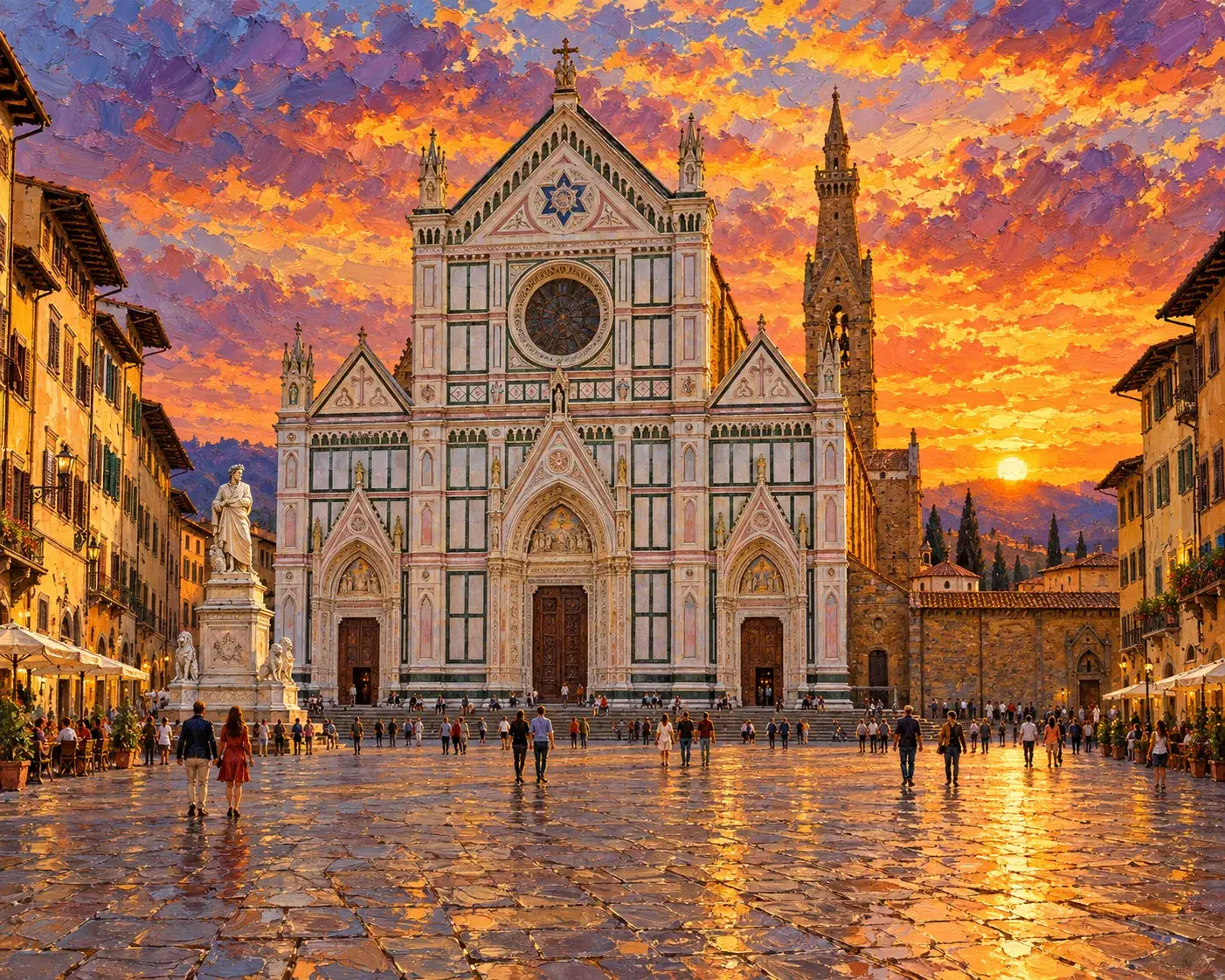
On the left of the church steps, Dante looks down at the square as if someone has just offended him. Inside there is a grand marble tomb with his name on it, and he is not in it. He has been in Ravenna since 1321, and Ravenna has never given him back.
The city that exiled its poet
In 1302, in the middle of a political feud, Florence exiled Dante and sentenced him to death if he returned. He wrote the Divine Comedy in exile and died in Ravenna.
In 1519 a Medici pope, Leo X, gave Florence permission to bring the bones home. The delegation opened the tomb and found it empty: the Franciscans of Ravenna had broken in through the back wall and hidden them. In 1829 Florence built its monument inside Santa Croce, with no one in it. In 1865, for the six hundredth anniversary of his birth, it put up the statue outside — and that same year a mason working in Ravenna knocked through a wall and found a wooden box marked Dantis ossa. Dante's bones.
A Victorian façade, and a star at the top
The church was begun on 12 May 1294 and stood with a bare, rough front for more than five and a half centuries. The marble façade was built 1857–63 by Niccolò Matas, an architect from Ancona. He was Jewish, and he put a Star of David into the gable. He is said to be buried at the threshold, as close as he was allowed to come.
The church of the poor, paid for by bankers
Santa Croce is the largest Franciscan church in the world: 115 metres long, laid out as a T — the Tau cross St Francis used — with an open timber roof and a wide floor for preaching to a crowd. It was built on marshland outside the old walls, among the poorest workers of the wool trade.
And its sixteen chapels were bought by the richest families in the city. The Bardi and Peruzzi, then among the greatest banks in Europe, hired Giotto to paint theirs, to the right of the high altar. The Pazzi paid for the chapter house in the cloister — the family who tried to murder Lorenzo and Giuliano de' Medici in the cathedral in 1478.
Michelangelo came home as merchandise
He died in Rome on 18 February 1564, aged 88, and Rome had already buried him. His nephew Leonardo took the body out of the city in secret, disguised as a bale of goods. It reached Florence on 11 March, and the church filled so fast that the coffin could barely be carried through the crowd into the sacristy. His tomb, designed by Vasari and finished in 1576, has three mourning figures: Painting, Sculpture and Architecture.
Galileo, opposite him
Turn round. Across the nave is Galileo — born in 1564, the year Michelangelo died. Condemned by the Inquisition in 1633, he died under house arrest at Arcetri in 1642, and was buried almost in secret in a small room near the novices' chapel. His pupil Vincenzo Viviani spent his life trying to get him a proper tomb and left money for it.
On 12 March 1737 Galileo was moved into this monument, and Viviani lies with him. While the coffin was open, some of those present took a tooth, a vertebra, and three fingers of his right hand. His middle finger is on display in the Museo Galileo in Florence, raised upright.
Machiavelli, Rossini, Ghiberti
Machiavelli's tomb carries the Latin Tanto nomini nullum par elogium — no praise is equal to so great a name — for a man the returning Medici imprisoned and tortured. Rossini is here, and Lorenzo Ghiberti, who made the Baptistery's bronze doors. In 1807 the poet Ugo Foscolo wrote about these tombs, and Santa Croce became Italy's Temple of the Italian Glories.
In 1817 the French novelist Stendhal wrote of his heart racing here, "the fear of falling." In 1989 an Italian psychiatrist gave a name to what some visitors feel in Florence: Stendhal syndrome. It is not a recognised diagnosis.
4 November 1966
This is one of the lowest parts of Florence, and in the 1966 flood Santa Croce was among the worst hit: water, mud, sewage and heating oil came into the church, several metres deep. Cimabue's great thirteenth-century Crucifix, more than four metres tall, lost about sixty per cent of its paint. It became the world's image of what Florence lost that winter. The volunteers who came to dig the city out of the mud are still called the angeli del fango — the mud angels.
Six things almost everyone believes that aren't true
| Claim | Verdict | What is actually the case |
|---|---|---|
| Dante is buried in Santa Croce | False | The 1829 monument is empty. He is buried in Ravenna, where he died in exile in 1321 |
| The façade is medieval | False | It was built 1857–63 by Niccolò Matas. The church had a bare front for over five centuries |
| Michelangelo died in Florence | False | He died in Rome in 1564. His nephew brought the body home in secret |
| Galileo was buried here with honours when he died | False | He was put in a side room for 95 years because of his condemnation; the monument dates from 1737 |
| St Francis founded Santa Croce | Legend | The present church was begun in 1294, 68 years after his death |
| Brunelleschi certainly designed the Pazzi Chapel | Unproven | The plan is usually credited to him, but the first written attribution dates from the 1490s |
Hear this one standing in front of it
Wanderlight's Florence guide covers 17 landmarks and runs 4 hr 29 min in total. It plays offline, keeps going with the screen off, and doesn't ask you to make an account.
Get it free on Google Play Android · intro and first three stops free in every cityWhere this comes from
Written from Wanderlight's research dossier for Basilica of Santa Croce — the same one the narration is written from. Where the evidence is thin, this page says so rather than rounding the uncertainty up.