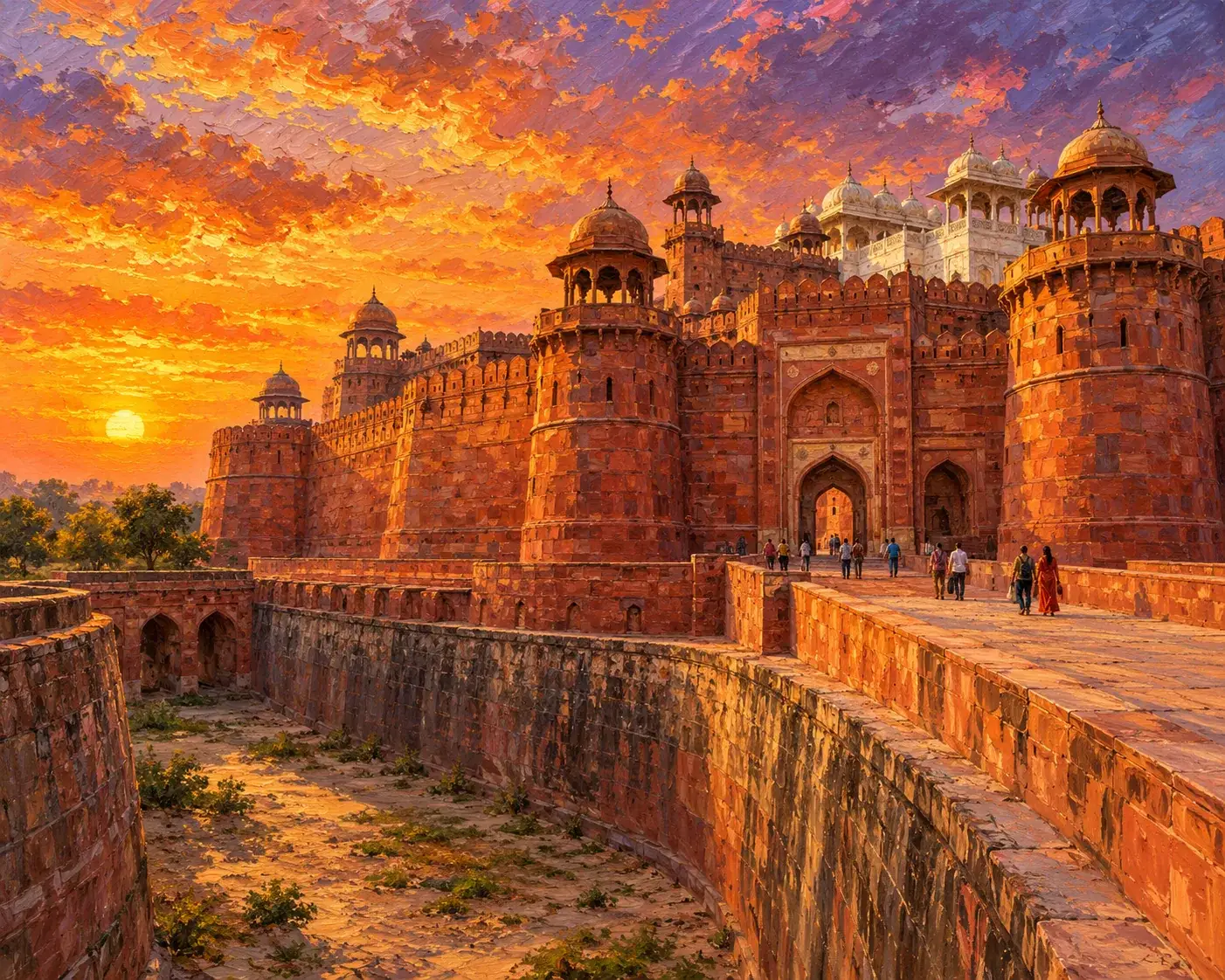
In 1666 this fort held two of the most famous prisoners in Indian history. One was Shah Jahan, who built the Taj Mahal; he died here in January, by tradition looking at it. The other was Shivaji, the Maratha king, held here from May. In August he got out, and the emperor never got him back.
A gate built against elephants
You come in by the Amar Singh Gate, through red sandstone walls about 21 metres high, two rings of them. The road bends sharply just inside. That is deliberate: the way to break a fortress gate in India was to drive a war elephant into it at a run, and a right-angle turn means there is no run-up.
The fort was rebuilt by Akbar, the third Mughal emperor, between 1565 and 1573, on the site of an older brick fort. His historian Abul Fazl says about four thousand men a day worked on it for eight years.
Red grandfather, white grandson
The first great palace you reach, the Jahangiri Mahal, is Akbar's: red sandstone, carved stone brackets under the balconies, pillared halls, the way builders in Gujarat and Rajasthan had always worked. Akbar ruled in partnership with the Rajput kings and married into their royal houses; his chief Rajput queen, Mariam-uz-Zamani of Amber, was the mother of the next emperor, and this palace housed the women of the household.
Further in, the stone turns white. From 1628 Shah Jahan pulled down much of his grandfather's work and built marble palaces along the river. Abul Fazl counted around five hundred buildings in the fort. Fewer than thirty Mughal buildings survive: Shah Jahan demolished many, and the British, who took the fort in 1803, cleared most of the rest for barracks. The northern part is still used by the Indian Army and is closed to visitors.
The view from the tower
Go to the octagonal tower on the riverside, the Musamman Burj, and look downriver. The white dome on the bend is the Taj Mahal.
In 1658 Shah Jahan fell ill and his sons fought over the throne. The winner, Aurangzeb, did not kill his father. He confined him here, in the marble apartments, for the last eight years of his life, with his eldest daughter Jahanara at his side. Shah Jahan died in January 1666. Tradition says he died in this tower, looking at the Taj. His body was taken by boat down the river to be buried beside his wife.
The same tower had a daily ritual. Akbar showed himself here at sunrise to people gathered on the riverbank: jharokha darshan, being seen at the window, an Indian royal custom the Mughals took up.
The king who would not stand at the back
Shivaji built the Maratha kingdom in the hills of the western Deccan with hill forts and fast cavalry. After a war with the Mughal general Raja Jai Singh of Amber, he agreed to the Treaty of Purandar in 1665, under which he came to Agra, with Jai Singh's promise of his safety.
On 12 May 1666 he attended Aurangzeb's court with his son Sambhaji, aged nine, and was placed among nobles of lower rank. He protested and walked out of the audience. He was put under house arrest in the custody of Jai Singh's son, Ram Singh, who held to his father's promise.
In August 1666 Shivaji escaped Agra with his son and made his way home. The escape is certain; how he got out is told in different ways. The account India has told for three and a half centuries, in songs and in schoolbooks, is that he reported himself ill, sent out great covered baskets of sweets each day for holy men and the poor until the guards stopped checking them, and left hidden in two of them, while a companion lay in his bed with Shivaji's ring showing on his hand.
In 1674 he was crowned Chhatrapati. The Maratha state he founded became the dominant Indian power of the next century, and in 1785 a Maratha army under Mahadji Shinde took this fort.
A fort that kept changing hands
In 1556 the Hindu general Hemu took Agra and Delhi and was crowned king as Raja Vikramaditya, before Akbar's victory at Panipat. In 1761 Maharaja Suraj Mal, the Jat ruler of Bharatpur, took the fort after a month's siege. Then came the Marathas, and in 1803 the British.
Six things almost everyone believes that aren't true
| Claim | Verdict | What is actually the case |
|---|---|---|
| Shah Jahan was kept in a dungeon | False | He lived in the marble palace apartments, with his daughter Jahanara |
| He could see the Taj from his prison | True | The Musamman Burj looks straight down the river to it |
| Shivaji escaped in a basket of sweets | Traditional | The escape is certain; the baskets are the account told in Maratha chronicles and Indian textbooks |
| The whole fort is open to visitors | False | The northern part is still Indian Army land |
| The white hall of public audience is marble | Mostly false | It is sandstone covered in polished white shell-lime plaster |
| Agra Fort and Delhi's Red Fort are the same | False | Different cities and builders: Akbar rebuilt this one, Shah Jahan built Delhi's |
Where to stand
At the riverside railing of the Musamman Burj, looking right, down the Yamuna. It is the view of Shah Jahan's last eight years, and it has not much changed.
Hear this one standing in front of it
Wanderlight's Agra guide covers 13 landmarks and runs 2 hr 2 min in total. It plays offline, keeps going with the screen off, and doesn't ask you to make an account.
Get it free on Google Play Android · intro and first three stops free in every cityWhere this comes from
Written from Wanderlight's research dossier for Agra Fort — the same one the narration is written from. Where the evidence is thin, this page says so rather than rounding the uncertainty up.