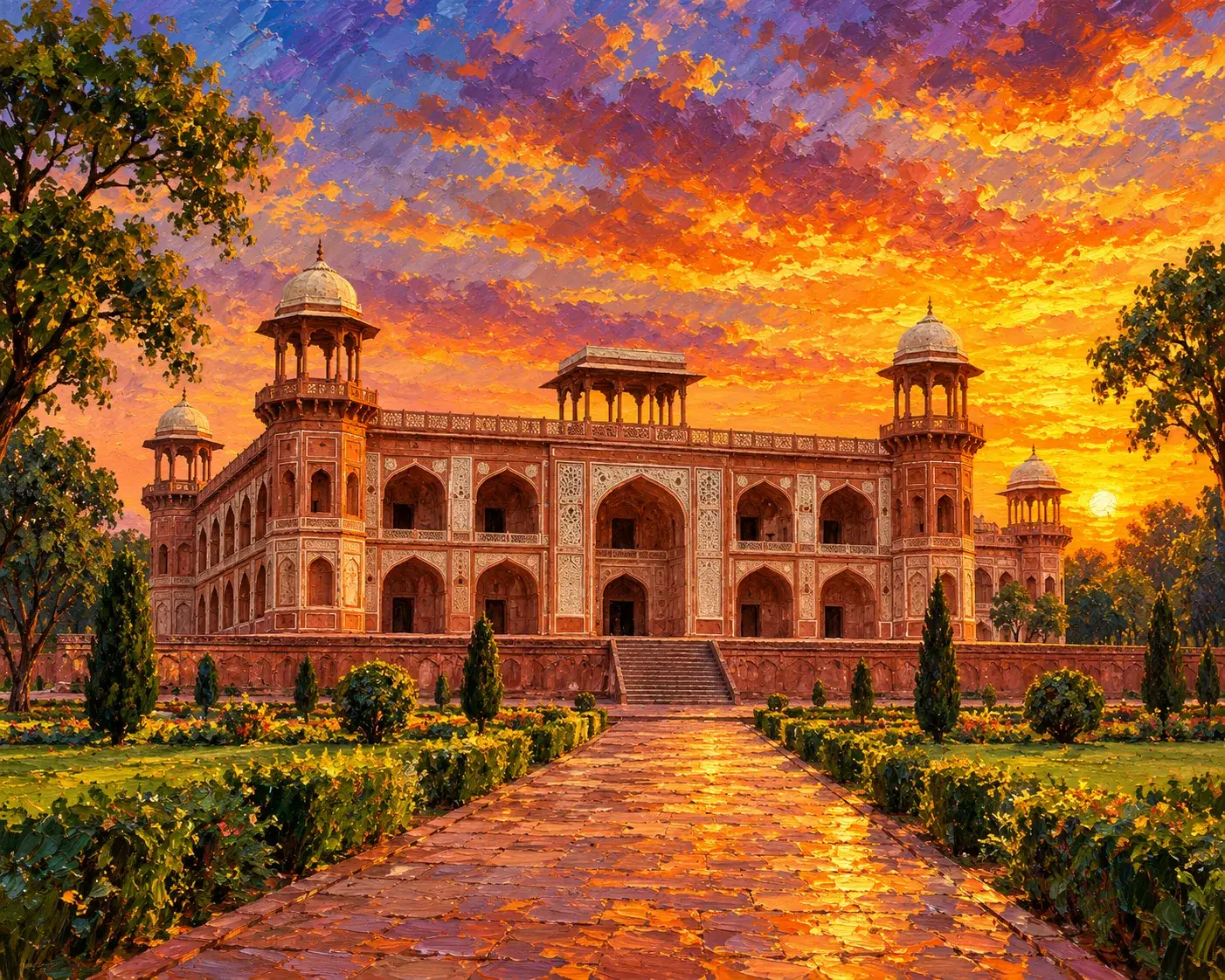
The mother of a Mughal emperor was a Hindu princess from Rajasthan. She lies here, about a kilometre from Akbar's tomb, in a building that is older than the Mughal empire itself. It is one of the quietest places in Agra.
The princess of Amber
She was born Harkha Bai in about 1545, the eldest daughter of Raja Bharmal of Amber, the Rajput kingdom near today's Jaipur. Under pressure from a Mughal governor who was Akbar's own brother-in-law, Raja Bharmal made an alliance with Akbar, and in 1562 his daughter married the emperor at Sambhar in Rajasthan.
She kept her Hindu faith inside the Mughal palace. Her father and brother became some of the highest-ranking nobles of the empire, and her nephew Man Singh one of Akbar's greatest generals.
In 1569, at Sikri, she gave birth to Salim, who became the emperor Jahangir. She was given the title Mariam-uz-Zamani, "Mary of the Age". Mary is honoured in Islam, and the title was an honour, not a change of faith.
A tomb older than the empire
In 1495, about thirty years before the first Mughal emperor reached India, Sultan Sikandar Lodi built an open garden pavilion here; the whole district, Sikandra, is named after him. After Akbar died, Mariam-uz-Zamani laid out a garden near his tomb. She died in Agra in May 1623, and Jahangir turned the old Lodi pavilion into her tomb: a burial chamber below, new red sandstone facades, four corner chhatris with white domes and lotus tops, and painted plaster inside.
Unusually, the back door is a real entrance, identical to the front. She is the only one of Akbar's wives buried near him.
What happened to it later
Under British rule the building was used as a government printing press; later it was partitioned for workshops; after 1947 it sheltered refugees from Sindh. Each use stripped away more of the paint and plaster. Faint traces of painted flowers survive in its forty or so ground-floor rooms.
Four things almost everyone believes that aren't true
| Claim | Verdict | What is actually the case |
|---|---|---|
| Her name was Jodha Bai | Misnomer | That name is not in the chronicles of her time. She was born Harkha Bai; her title was Mariam-uz-Zamani |
| She was Christian | False | Mughal chronicles name her as Raja Bharmal's daughter; the crypt was opened in the 1800s and showed no sign of it |
| The building was built as her tomb | False | It began as Sikandar Lodi's pavilion of 1495 |
| She is buried with Akbar | False | About a kilometre away; the only wife buried near him |
Where to stand
In the garden, facing the north stairs: a sultan's pavilion of 1495, remade by an emperor for his mother.
Hear this one standing in front of it
Wanderlight's Agra guide covers 13 landmarks and runs 2 hr 2 min in total. It plays offline, keeps going with the screen off, and doesn't ask you to make an account.
Get it free on Google Play Android · intro and first three stops free in every cityWhere this comes from
Written from Wanderlight's research dossier for Tomb of Mariam-uz-Zamani — the same one the narration is written from. Where the evidence is thin, this page says so rather than rounding the uncertainty up.