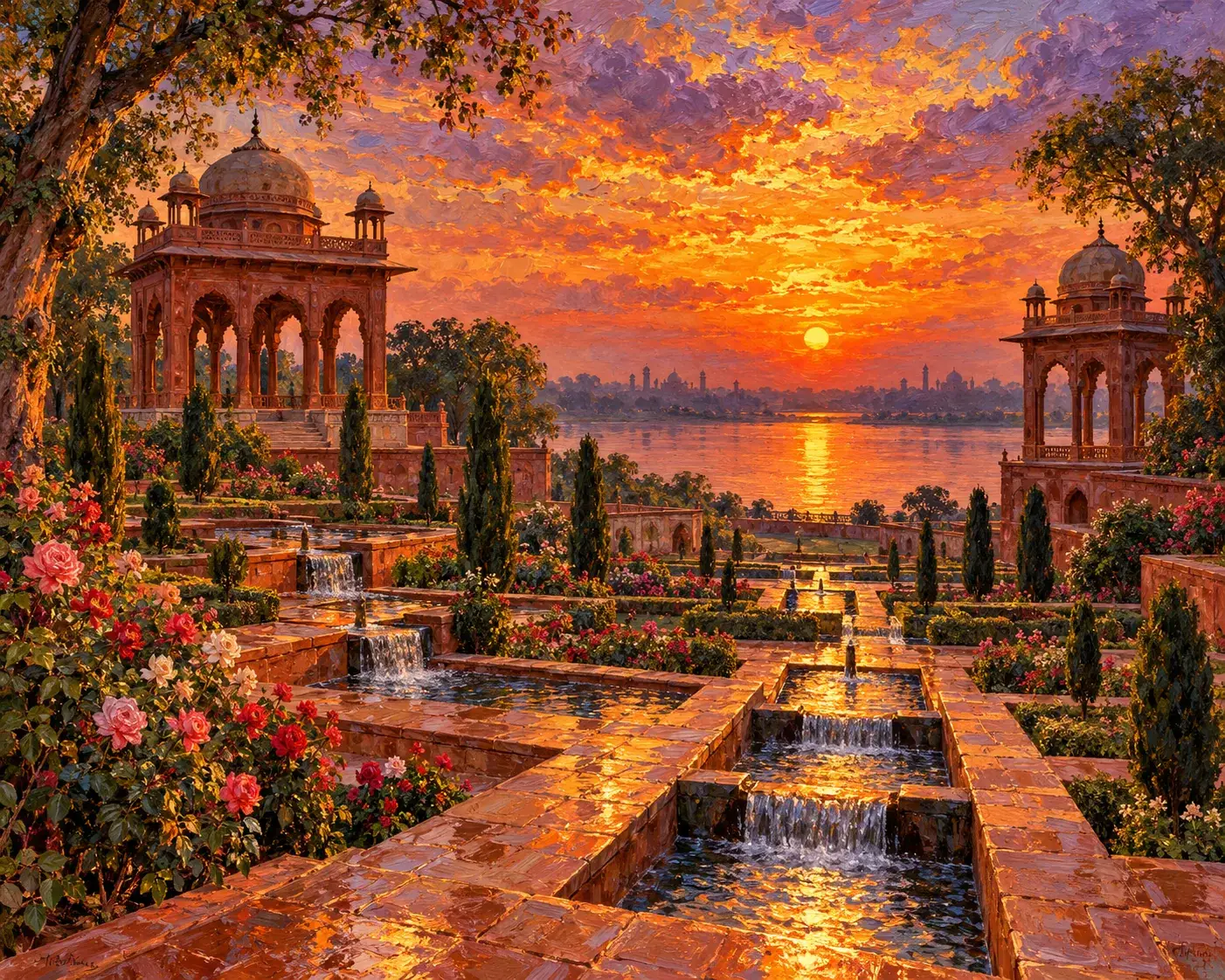
The first Mughal emperor arrived in Agra, looked around, and called the place ugly. This garden on the east bank of the Yamuna is what he did about it. It is generally regarded as the oldest Mughal garden in India.
"Ugly and detestable"
Babur came from Central Asia, ruled Kabul, and in 1526 won the First Battle of Panipat, which began the Mughal dynasty. In his memoir he describes crossing the river at Agra to look for a garden site and finding the land so "ugly and detestable" that he went back, disgusted. One of the great faults of Hindustan, he wrote, was that it had no running water.
Finding nowhere better, he made gardens here anyway, with roses and narcissus in careful beds, and he called this one the flower-scattering garden.
A staircase of water
Water was lifted from the Yamuna and sent down through the garden in narrow stone channels and small cascades, terrace by terrace toward the river. The walkways are raised, so the flower beds sit beside you rather than below you.
The two pavilions on the river front date mostly from the reign of Babur's great-grandson Jahangir, and the garden is linked with the empress Nur Jahan. Beneath them is a tahkhana, an underground room kept cool in the summer heat. In March 1621 Jahangir waited here for the lucky hour his astrologers had chosen before entering Agra.
Where the Taj's garden began
Babur's walled gardens with flowing water started a fashion along the Yamuna. A century later the bank was lined with them, and historians see the Taj Mahal as the grandest of these riverside gardens.
Babur died in Agra in 1530 and was buried in Kabul. Tradition says his body rested here first.
A Hindu name
In the late 1700s the Marathas held Agra, and the garden became Ram Bagh, the garden of Ram. The name stuck.
Four things almost everyone believes that aren't true
| Claim | Verdict | What is actually the case |
|---|---|---|
| It has always been called Ram Bagh | False | Babur's flower-scattering garden, later Aram Bagh; Ram Bagh under the Marathas |
| Babur is buried here | False | He is buried in Kabul; tradition says his body rested here first |
| The pavilions are Babur's | Mostly false | The surviving pavilions are mainly from Jahangir's reign |
| Akbar proposed to a gardener here by lying idle for six days | Legend | A story with no source behind it |
Where to stand
At the river pavilions, looking out at the Yamuna: the water Babur wanted so badly.
Hear this one standing in front of it
Wanderlight's Agra guide covers 13 landmarks and runs 2 hr 2 min in total. It plays offline, keeps going with the screen off, and doesn't ask you to make an account.
Get it free on Google Play Android · intro and first three stops free in every cityWhere this comes from
Written from Wanderlight's research dossier for Ram Bagh — the same one the narration is written from. Where the evidence is thin, this page says so rather than rounding the uncertainty up.