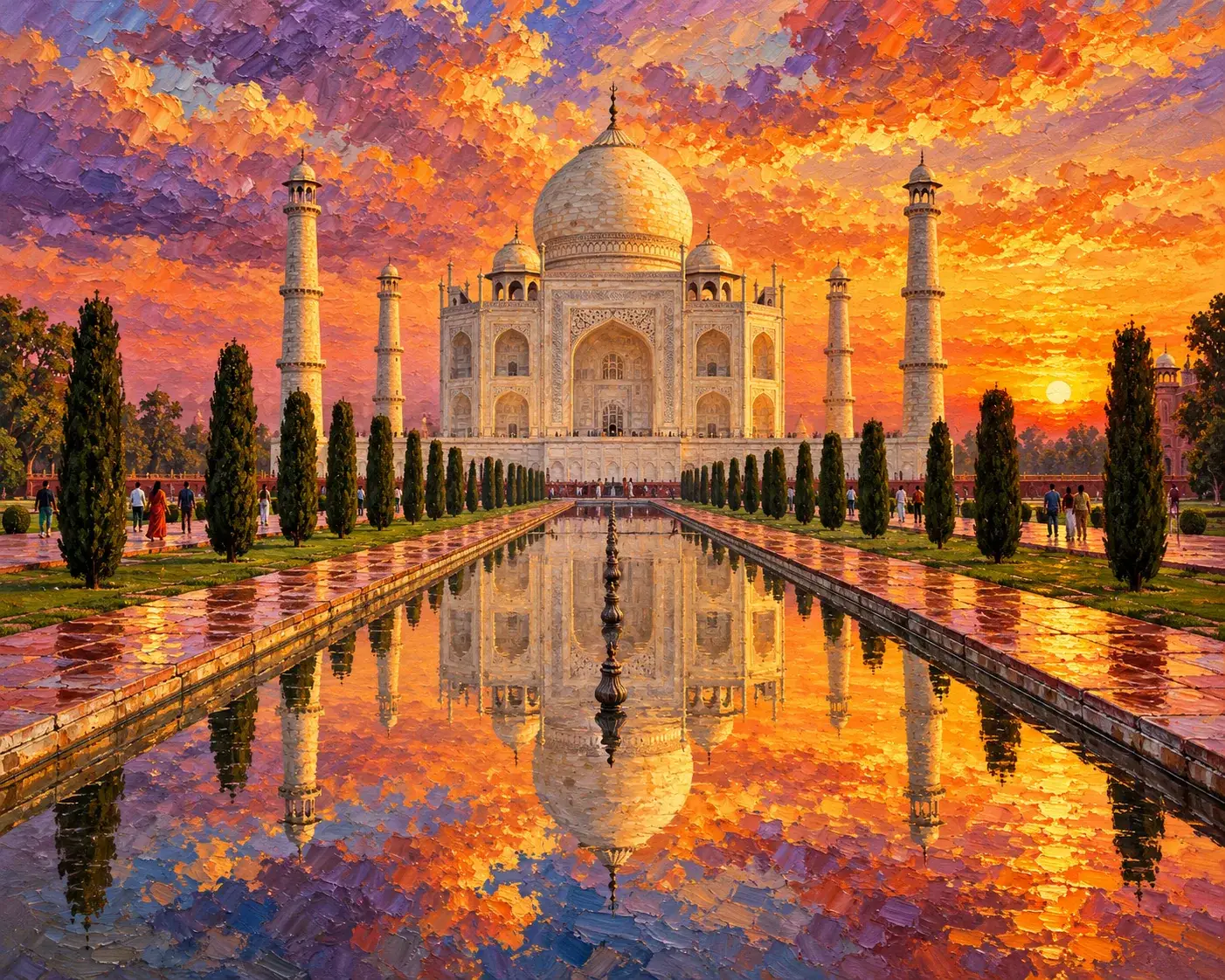
Stand in the great gateway and look through the arch. Everything in front of you was built to line up, left against right: the water channel, the raised pool, the cypress walks, the red building on each side, the four minarets. Everything except one thing. And the one thing out of place is the emperor who built it.
Who she was
Mumtaz Mahal was born Arjumand Banu in 1593. She married Prince Khurram, the future emperor Shah Jahan, in 1612, and she did not stay in the palace. She travelled with him constantly, including on military campaigns, and bore him fourteen children. On 17 June 1631, in a camp at Burhanpur in the Deccan, she died after the birth of the fourteenth, a daughter called Gauhara Begum.
His own court historians recorded what came next: a week in which he would not attend to the business of the empire, and two years without music or fine clothes. Later tellings add that his hair turned white. That part is tradition.
A Rajput prince's land
The riverbank was the most prized land in the capital, and the plot he wanted held the mansion of Raja Jai Singh of Amber, from the Rajput royal house now associated with Jaipur. Shah Jahan gave him a palace in the centre of Agra in exchange. The Taj Mahal stands on what was a Rajput prince's land, and it is built of Indian stone: white marble from Makrana in Rajasthan over a brick core, with red sandstone for the buildings around it.
Work began in 1632. The mausoleum was finished in 1648 and the whole complex around 1653. Accounts from the time put the workforce at around twenty thousand.
Why the tomb is not in the middle
In almost every Mughal tomb garden, the tomb stands at the centre. Here it stands at the far end, raised over the Yamuna. Agra was a city of riverside gardens, and the river is part of this design: directly across the water is a garden on exactly the same line and the same width, Mehtab Bagh. The Taj was never meant to be seen from one bank only.
The building that faces nowhere
The red sandstone building on the west of the tomb is a mosque. It faces Mecca and is still used for Friday prayers, which is why the Taj is closed to visitors on Fridays. The identical building on the east is not a mosque. It has no prayer niche, because it faces the wrong way. It is called the jawab, the answer, and it exists so that the view balances.
Letters that grow
Look up at the black inlaid lettering framing the great arches: verses from the Quran in black stone set into white marble. From the ground the letters look the same size all the way up. They are not. They get larger the higher they go, so that the eye reads them as even.
The calligrapher was Amanat Khan, from Shiraz in Persia, and inside the tomb, at the base of the dome, he signed his work. The architect usually credited with the design, Ustad Ahmad Lahauri, did not. Of everyone who made the Taj Mahal, Amanat Khan is the only one whose name is in it.
The flowers are stone
The flowers in the marble are not painted. They are semi-precious stones cut into tiny shapes and set flush into the marble, a technique called parchin kari in Agra, where workshops still practise it. Some single flowers are made of dozens of separate pieces.
The one thing out of place
Inside, behind a screen of pierced marble, are two marble cenotaphs. They are memorials; the graves are in a plain crypt below.
Mumtaz Mahal's cenotaph sits at the exact centre of the chamber, on the axis of the entire complex: gateway, channel, pool and door all point at it. Shah Jahan's, larger, sits beside hers to the west, marked with a small carved pen box, the old sign of a man's grave. It is the only thing in the Taj Mahal that breaks the symmetry.
The building was made for her alone. In 1658 Shah Jahan fell ill and his sons fought for the throne. The winner, Aurangzeb, confined his father in Agra Fort, within sight of the tomb, for the last eight years of his life. When Shah Jahan died in January 1666, his body was carried by boat down the river and buried beside her, in the only place there was: next to the centre.
Rabindranath Tagore, in a poem addressed to Shah Jahan, called the Taj a teardrop on the cheek of time.
Seven things almost everyone believes that aren't true
| Claim | Verdict | What is actually the case |
|---|---|---|
| Shah Jahan cut off the builders' hands | False | No source from the time says so. It is a legend; Agra's inlay craft carried on |
| The graves you see are the real graves | False | They are cenotaphs. The burials are in the crypt below |
| The Taj is perfectly symmetrical | Almost | Everything except Shah Jahan's cenotaph, added beside hers after 1666 |
| Shah Jahan began a black Taj across the river | Unsupported | The story goes back to the traveller Tavernier; excavation found a garden and a reflecting pool |
| A European designed it | False | A colonial-era theory. It was designed by Shah Jahan's own architects |
| The 22 small domes on the gateway stand for 22 years of building | Legend | The tomb took about sixteen years and the complex about twenty-one |
| The minarets lean outward on purpose | Unproven | They lean very slightly. That it was done so they would fall away from the tomb is often said, never documented |
Where to stand
Walk round to the back terrace, on the river side. Most visitors never do. You get the Yamuna, the garden on the far bank, and upriver to the left the red walls of Agra Fort, where Shah Jahan spent those last eight years looking back at this.
Hear this one standing in front of it
Wanderlight's Agra guide covers 13 landmarks and runs 2 hr 2 min in total. It plays offline, keeps going with the screen off, and doesn't ask you to make an account.
Get it free on Google Play Android · intro and first three stops free in every cityWhere this comes from
Written from Wanderlight's research dossier for Taj Mahal — the same one the narration is written from. Where the evidence is thin, this page says so rather than rounding the uncertainty up.