A son came to see his father's tomb, decided he did not like what he found, and had it changed. The father was Akbar, the greatest of the Mughal emperors. The son was Jahangir. The tomb they made between them stands at Sikandra, about eight kilometres north-west of central Agra, and it has no dome.
The gate came before the Taj
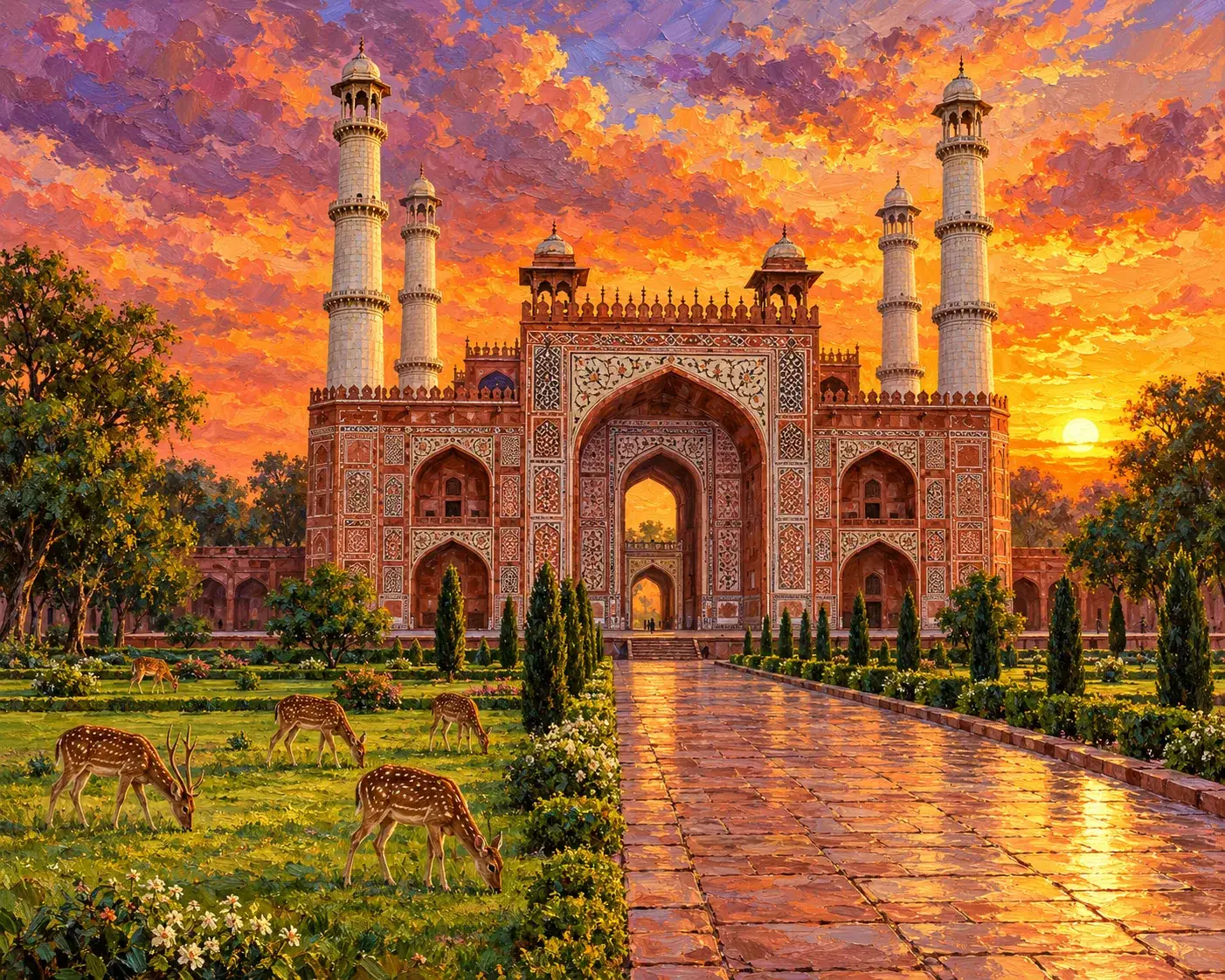
The great south gate is covered in bold patterns: white marble and black stone cut and set into red sandstone. At its four corners stand four white marble minarets, built decades before the Taj Mahal's.
The long Persian inscriptions were written out by a calligrapher from Shiraz called Abd al-Haqq, later given the title Amanat Khan. He is the same man who wrote the inscriptions on the Taj Mahal, and here he signed his work three times.
Deer in the emperor's garden
The garden covers about 119 acres, and blackbuck and other deer live in it. Walk the raised path from the gate to the tomb and you will usually see them grazing.
Two emperors in one building
Akbar became emperor at thirteen and reigned for almost fifty years. He is said to have begun this tomb himself; he died in Agra in October 1605. Jahangir later wrote in his memoirs that when he first came to see the work as emperor, he was not happy with it, and he had parts redone. The tomb was finished in 1613.
Historians read both men in the result. The shape is Akbar's: a stepped pyramid of open red sandstone pavilions and small domed kiosks, very like his buildings at Fatehpur Sikri. The top is in the son's style: a white marble courtyard, open to the sky and surrounded by carved marble screens, with a carved marble cenotaph at its centre. There is no dome; the emperor's memorial stands under the sky. Nobody recorded why it was designed that way.
The real grave
As in every great Mughal tomb, the memorial on top is not the grave. A long passage slopes down from the ground floor into a high, plain, vaulted room where Akbar is buried.
Five things almost everyone believes that aren't true
| Claim | Verdict | What is actually the case |
|---|---|---|
| Akbar designed his tomb exactly as built | False | Jahangir's memoir records that he changed the work |
| The marble cenotaph on top is the grave | False | The grave is in a chamber at the end of a sloping passage below |
| Every great Mughal tomb has a dome | False | This one has none |
| Sikandra is named after Alexander the Great | False | It is named after Sultan Sikandar Lodi; Sikandar is the Persian form of Alexander |
| The Taj Mahal was first with a four-minaret gateway | False | Sikandra's south gate has four minarets decades earlier |
Where to stand
On the causeway halfway between the gate and the tomb, with the deer on the lawn: the father's red pavilions below, the son's white marble on top.
Hear this one standing in front of it
Wanderlight's Agra guide covers 13 landmarks and runs 2 hr 2 min in total. It plays offline, keeps going with the screen off, and doesn't ask you to make an account.
Get it free on Google Play Android · intro and first three stops free in every cityWhere this comes from
Written from Wanderlight's research dossier for Akbar's Tomb, Sikandra — the same one the narration is written from. Where the evidence is thin, this page says so rather than rounding the uncertainty up.