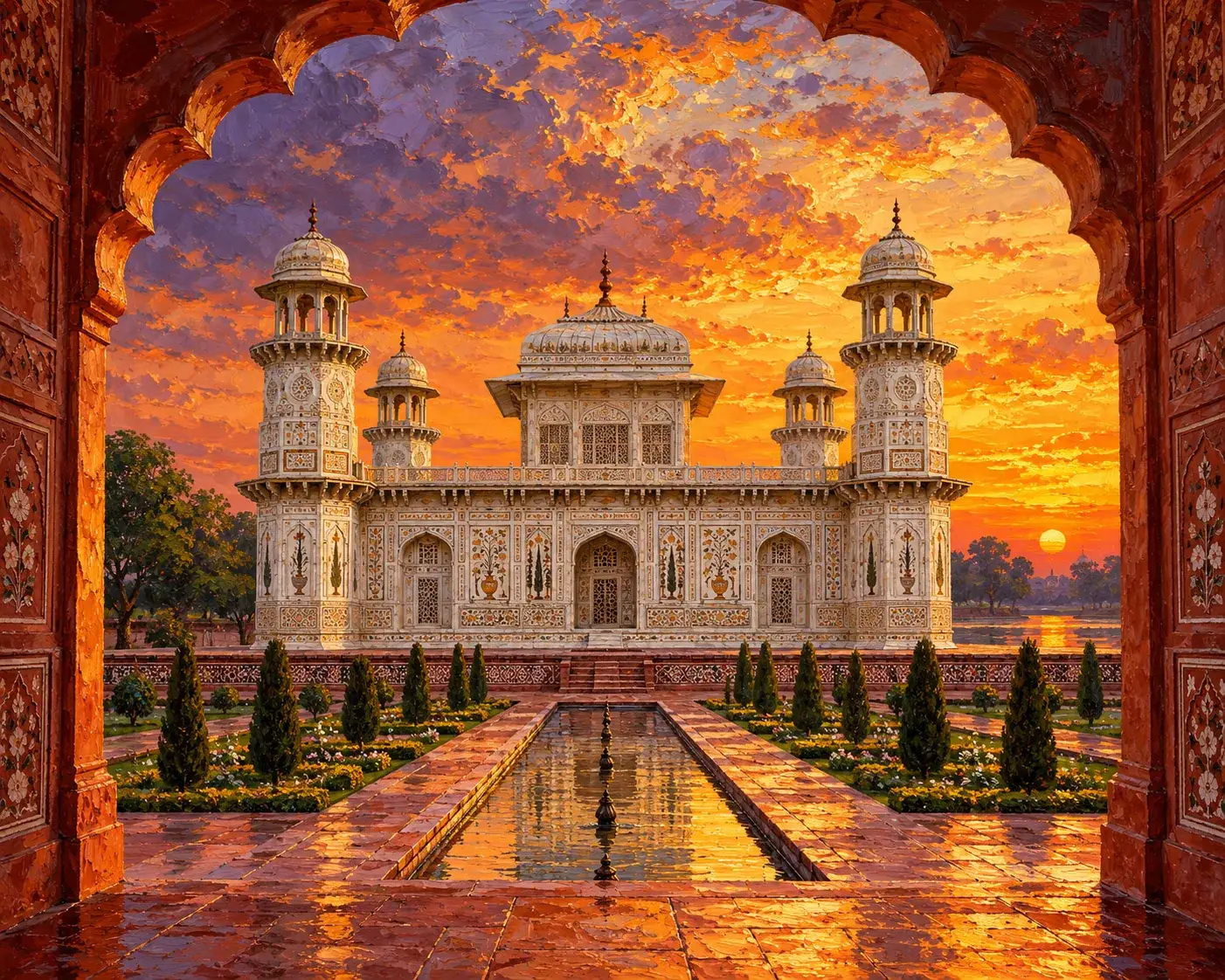
Before the Taj Mahal was begun, its look was tried out here, on the quiet east bank of the Yamuna. A woman built this small white tomb for her parents. And the man inside turns out to be the Taj Mahal's own family.
Every pattern is stone
Lean in, without touching. The dark cypress trees, the little jugs and cups, the bowls of fruit and vases of flowers are not painted. They are cut from coloured stone (carnelian, jasper, lapis lazuli, onyx, topaz) and set flush into white Makrana marble from Rajasthan.
The wine vessels and cypresses are Persian images of gardens and paradise, and they fit the family buried here, because they had come from Persia. Art historians link some of the flower designs to the plant studies of Ustad Mansur, the court painter of the emperor Jahangir.
This is the first Mughal tomb faced entirely in white marble. Before it, the great Mughal tombs were red sandstone with white as trim. After it came the Taj.
A family robbed on the road
Mirza Ghiyas Beg was a Persian official whose fortunes collapsed after his father's death in 1576. He set out for the court of the emperor Akbar with his pregnant wife, Asmat Begum, and three children. On the way they were robbed; the family story says they were left with two mules. At Kandahar his wife gave birth to a daughter, Mihr-un-Nissa, "sun among women". A merchant's caravan took them in, and its leader helped Ghiyas Beg reach Akbar's service.
He was very good with money. He rose to treasurer of a province, and after the emperor Jahangir married his daughter in 1611 he became prime minister, with the title Itimad-ud-Daulah, "Pillar of the State". That title is the name on this tomb.
The empress
Jahangir renamed her Nur Jahan, "Light of the World", and in his later years she ran much of the empire. She issued orders in her own name, and coins were struck bearing it, which no other Mughal empress achieved. She wrote poetry, designed gardens and hunted: Jahangir wrote in his memoir that on one hunt she killed four tigers with six shots.
Her mother died in 1621 and her father months later, while travelling with the court. She built this tomb in his own riverside garden between 1622 and 1628.
A jewel box with no dome
Instead of a dome the roof carries a square pavilion with a curved canopy roof, with four short octagonal towers at the corners. It is a platform tomb, a form the court favoured under Jahangir, and it is often called the jewel box. Inside, light falls through carved marble screens onto two yellow cenotaphs, side by side: her father and her mother.
The four-part garden around it was turned to English lawn under British rule and its water channels ran dry. In the 2010s the Archaeological Survey of India and the World Monuments Fund spent four years restoring it, and the water runs again.
The family tree
Ghiyas Beg had a son, Asaf Khan, who became one of the most powerful men at court. Asaf Khan's daughter was Arjumand Banu, who in 1612 married Prince Khurram. Khurram became the emperor Shah Jahan, and Arjumand Banu became Mumtaz Mahal.
So the man buried here was Mumtaz Mahal's grandfather, and the woman who built his tomb was her aunt. A few years after it was finished, Shah Jahan began the Taj Mahal, in the same white marble with the same stone flowers, on a far larger scale.
Nur Jahan is not buried here. After Jahangir died in 1627 she backed the losing side in the succession, and her stepson Shah Jahan took the throne. She lived out her life in Lahore and is buried there, near her husband.
Six things almost everyone believes that aren't true
| Claim | Verdict | What is actually the case |
|---|---|---|
| It's a copy of the Taj Mahal | False | It was built in 1622–28, before the Taj was begun |
| It's called the Baby Taj because a child is buried here | False | Ghiyas Beg, Asmat Begum and their family are buried here; the name is about its size and look |
| Shah Jahan built it | False | The empress Nur Jahan built it for her parents |
| Nur Jahan is buried here | False | Her tomb is in Lahore |
| Nur Jahan was abandoned by the road as a baby | Legend | The family accounts record hardship, not abandonment |
| It is a UNESCO World Heritage Site | False | It is protected nationally by the Archaeological Survey of India |
Where to stand
On the river side, at the pavilion on the water. Look downriver: the white dome on the bend is the Taj Mahal, the much larger building this one made possible.
Hear this one standing in front of it
Wanderlight's Agra guide covers 13 landmarks and runs 2 hr 2 min in total. It plays offline, keeps going with the screen off, and doesn't ask you to make an account.
Get it free on Google Play Android · intro and first three stops free in every cityWhere this comes from
Written from Wanderlight's research dossier for Tomb of Itimad-ud-Daulah — the same one the narration is written from. Where the evidence is thin, this page says so rather than rounding the uncertainty up.