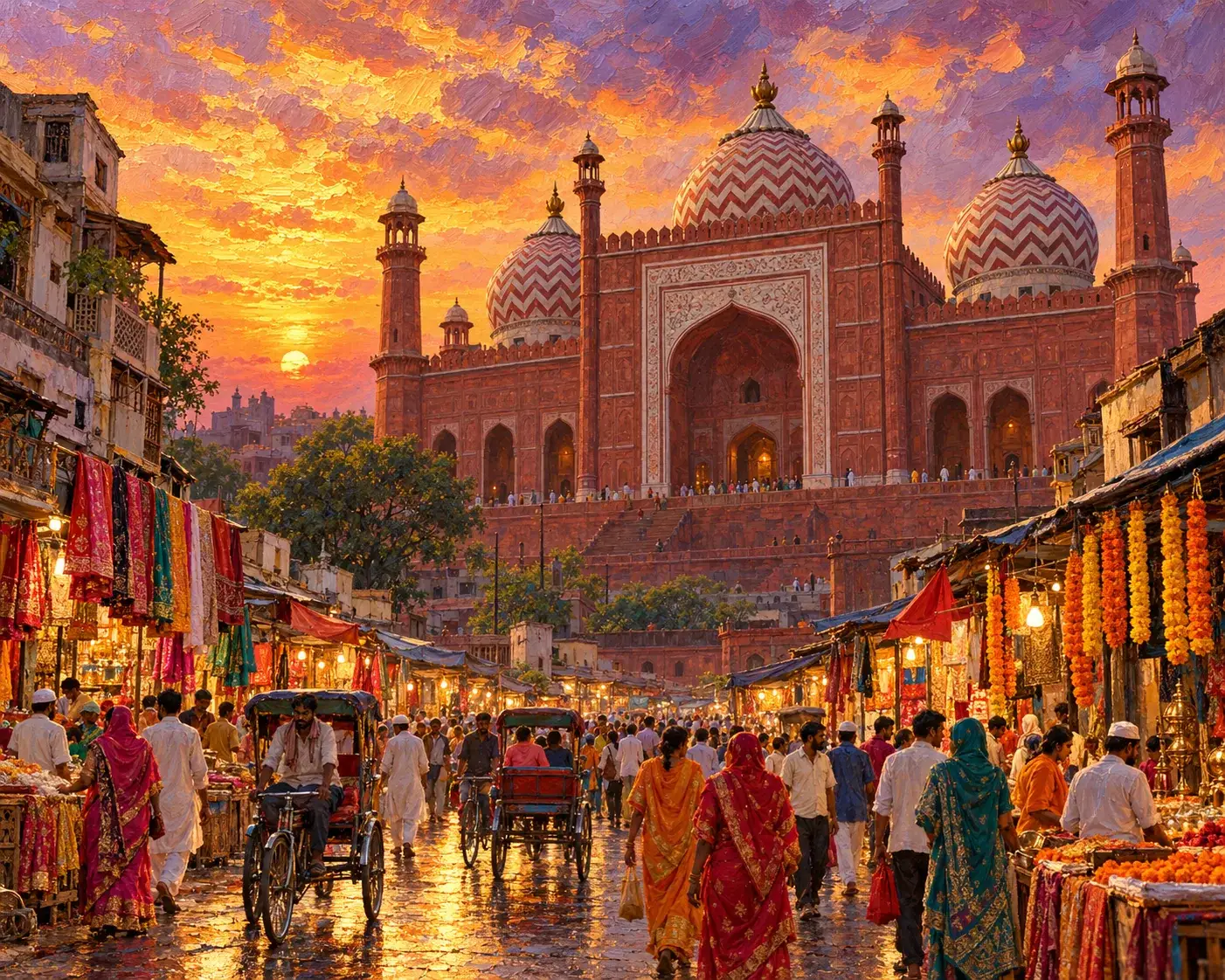
The greatest mosque in Agra was not paid for by an emperor. It was paid for by his daughter, out of her own allowance. It stands just across the road and railway from Agra Fort, and around it the old city's bazaar still sells the trimmings for Agra's weddings.
Visiting
This is an active mosque. Dress modestly, remove your shoes where asked, and avoid prayer times, especially on Fridays.
The princess who paid for it
Jahanara Begum (1614–1681) was the eldest surviving child of Shah Jahan and Mumtaz Mahal. When her mother died in 1631, the seventeen-year-old was given the royal seal and the title Padshah Begum, First Lady of the empire. She ran the imperial household, issued orders, listened to councils of state from behind a curtain, owned trading ships, and held her own court in her own palace. She was also a Sufi, and wrote a well-regarded life of the saint Moinuddin Chishti.
In 1637 Shah Jahan ordered a new great mosque on a new square in front of the fort's western gate. Jahanara asked to pay for it herself. It was built between 1643 and 1648 at a cost of about five lakh rupees.
In 1658, when her brother Aurangzeb took the throne and confined their father in the fort, she chose to share his captivity, and looked after him until his death in 1666. She and Aurangzeb later reconciled, and he restored her titles.
Zigzag domes
The prayer hall has five arches; the central one is framed with Persian inscriptions in black stone on white marble, praising Shah Jahan. Above rise three domes in zigzag bands of red and white stone, crowned with lotus finials. Inside, the pulpit is carved with a picture of the mosque's own front.
Why the mosque and the fort are strangers
The mosque was built facing a great square, the Tripolia, which joined it to the fort. In 1857 the British garrison in the fort demolished the mosque's main gate and eastern buildings for a clear line of fire, and mined the mosque. By 1875 the square was gone, cleared for the railway.
Kinari Bazaar
Kinari is the Hindi word for a border or edging: the gold and silver trim sewn onto wedding saris and clothes. The lanes around the mosque sell wedding clothes, trim, bangles, jewellery, cloth, spices and sweets, including petha, Agra's candied ash gourd.
Four things almost everyone believes that aren't true
| Claim | Verdict | What is actually the case |
|---|---|---|
| Shah Jahan paid for the mosque | False | He ordered it; Jahanara paid for it from her own allowance |
| The mosque always stood apart from the fort | False | A great square, the Tripolia, joined them until the 1870s |
| Petha was invented to feed the Taj Mahal's builders | Legend | It is not in the record of Shah Jahan's recipes, and food historians doubt it |
| It is the same as Delhi's Jama Masjid | False | A different mosque in a different city |
Where to stand
At the top of the steps, looking back across the road and the railway at the fort's walls: the line where the princess's square used to be.
Hear this one standing in front of it
Wanderlight's Agra guide covers 13 landmarks and runs 2 hr 2 min in total. It plays offline, keeps going with the screen off, and doesn't ask you to make an account.
Get it free on Google Play Android · intro and first three stops free in every cityWhere this comes from
Written from Wanderlight's research dossier for Jama Masjid, Agra, and Kinari Bazaar — the same one the narration is written from. Where the evidence is thin, this page says so rather than rounding the uncertainty up.