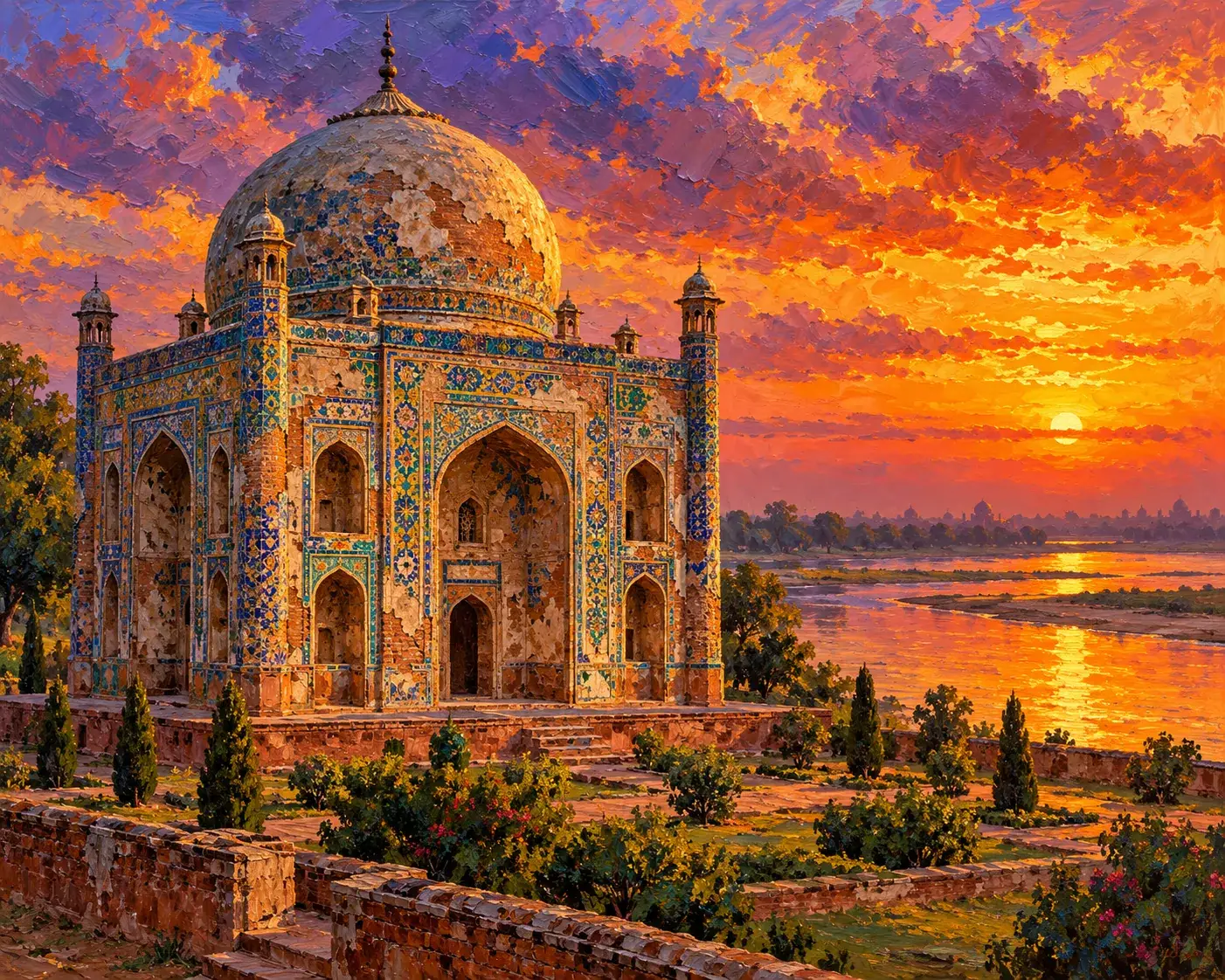
The man buried here ran Shah Jahan's empire. His brother signed the Taj Mahal. And the walls of his tomb, now mostly bare brick, were once covered in glazed tiles of blue, turquoise, green and gold.
From wandering scholar to prime minister
Afzal Khan was born in 1570 in Shiraz, in Persia, the son of a minor tax collector. He trained in handwriting, accounts and prose. His first patron in Persia was executed in 1598, and for years he studied and wandered. Around 1608 he came to India, landing at Cambay, and found a place with the great noble and poet Abdul Rahim, who kept recommending him to the emperor Jahangir.
He was posted to Prince Khurram, stayed loyal through the prince's rebellion and the succession struggle of 1627, and when Khurram became Shah Jahan in 1628, Afzal Khan became his wazir, his prime minister. He is remembered for wanting the people to be more productive and more prosperous. He died in office, in Lahore, in 1639, and was brought here to be buried with his wife.
The brother who signed the Taj
His brother was Amanat Khan, the calligrapher who wrote the great inscriptions on the Taj Mahal and signed his name inside it. The inscriptions in this tomb are unsigned, but the historian Catherine Asher concludes they are Amanat Khan's work.
Why tiles
Rauza means tomb, and chini, from "China", is used for glazed ware. Glazed tile mosaic, kashi-kari, was the great art of Persia: small cut pieces of coloured tile fitted together and set into plaster. Mughal Agra mostly used stone inlay; this Persian's tomb was dressed in his homeland's tradition. Weather has taken most of it. The painted rooms inside keep some of their colour.
Three things almost everyone believes that aren't true
| Claim | Verdict | What is actually the case |
|---|---|---|
| The tiles came from China | False | "Chini" means glazed ware; this is Persian-style tilework |
| Someone Chinese is buried here | False | It is the tomb of Afzal Khan of Shiraz and his wife |
| The calligraphy is signed by Amanat Khan | False | It is unsigned; the attribution is a historian's judgement |
Where to stand
Close to one of the surviving patches of blue, then step back and imagine the whole tomb shining like that beside the river.
Hear this one standing in front of it
Wanderlight's Agra guide covers 13 landmarks and runs 2 hr 2 min in total. It plays offline, keeps going with the screen off, and doesn't ask you to make an account.
Get it free on Google Play Android · intro and first three stops free in every cityWhere this comes from
Written from Wanderlight's research dossier for Chini ka Rauza — the same one the narration is written from. Where the evidence is thin, this page says so rather than rounding the uncertainty up.