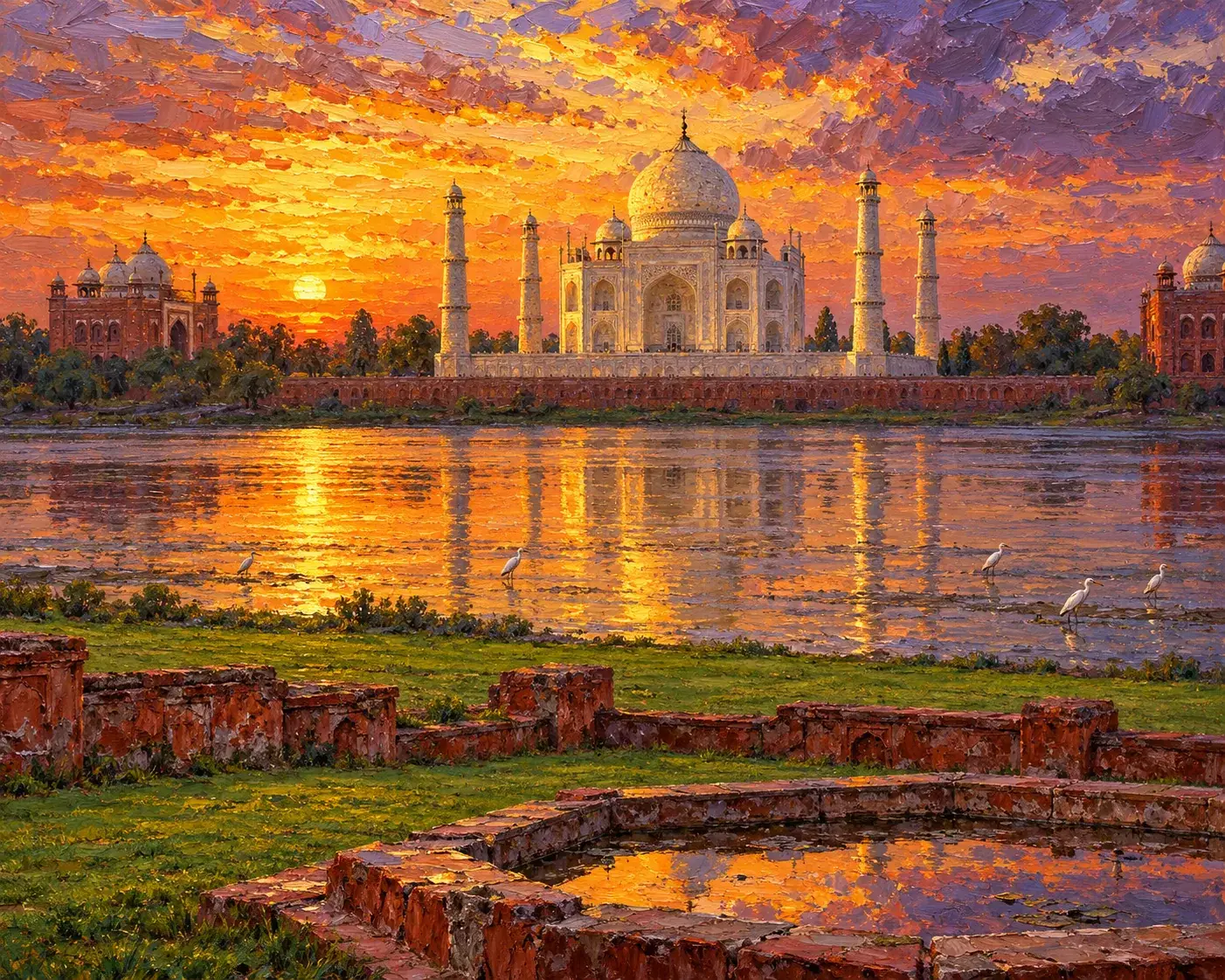
For three hundred years people said a second Taj Mahal, a black one, was meant to rise on this spot: Shah Jahan's own tomb, facing his wife's across the river. His son seized the throne, the story went, and it was never built. Then archaeologists dug, and found something else.
Where the legend came from
From a Frenchman. Jean-Baptiste Tavernier, a gem merchant who visited Agra in 1665, wrote that Shah Jahan had begun to build his own tomb on this side of the river. Retellings turned that into a black marble twin.
Two centuries later it seemed to be confirmed. In 1871 the British archaeologist A. C. L. Carlleyle found the remains of a pool here, its stones blackened, and linked them to the legend.
A garden on the Taj's own line
Mehtab Bagh, the Moonlight Garden, is a square about 300 metres on each side. It lies on exactly the same north–south axis as the Taj Mahal across the river, and it is exactly the same width as the Taj complex. Put the two together and the river runs through the middle of one design.
This bank was once lined with Mughal gardens, eleven of them, walled, with pavilions and fountains. Mehtab Bagh is the last in the line. Its corners had octagonal red sandstone towers; only the one at the south-east still stands.
Lost to the river
In December 1652 Prince Aurangzeb wrote to his father that a flood had damaged the garden. The river kept coming. Floods, silt, and people carrying off brick and stone reduced it, by the 1990s, to a great mound of sand and scrub.
What the dig found
In the 1990s the Archaeological Survey of India excavated it, with an American team led by the historian of Mughal gardens Elizabeth Moynihan. They moved about 90,000 cubic metres of silt and studied pollen and plant remains to learn what had grown here. They found walls, pavilions, water channels and a four-part garden, and no foundations of a second tomb. The blackened stones Carlleyle saw were white stone, stained dark over time.
At the southern edge, facing the Taj, they found a great octagonal pool with twenty-five fountains, on the Taj's line. On a still evening the whole tomb would have been reflected in it.
One theory, and the loveliest: a white dome, upside down in still dark water at dusk, looks dark. When part of the pool was reconstructed, archaeologists saw exactly that. The black Taj may have been the white one's reflection.
The planting
When the garden was replanted, the archaeologists used only species the Mughals grew, about eighty of them, including guava, citrus, neem, jamun and hibiscus, some chosen for pale flowers that show in moonlight. An environmental institute had proposed pollution-fighting trees instead. The Supreme Court of India sided with the archaeologists.
Five things almost everyone believes that aren't true
| Claim | Verdict | What is actually the case |
|---|---|---|
| Shah Jahan began a black Taj Mahal here | False | The excavation found a garden and a pool, and no tomb foundations |
| The black stones found here were black marble | False | White stone, discoloured over time |
| Mehtab Bagh has nothing to do with the Taj | False | It is on the same axis and the same width |
| It was always a ruin | False | Aurangzeb described the garden in 1652; floods and neglect destroyed it later |
| It's just a modern park | Partly | It is an excavated Mughal garden, replanted with Mughal species |
Where to stand
At the river wall, beside the outline of the octagonal pool, facing the Taj at sunset. From this side you cannot see the two cenotaphs, or which one is off-centre. You see what Shah Jahan meant: a white dome, and its reflection.
Hear this one standing in front of it
Wanderlight's Agra guide covers 13 landmarks and runs 2 hr 2 min in total. It plays offline, keeps going with the screen off, and doesn't ask you to make an account.
Get it free on Google Play Android · intro and first three stops free in every cityWhere this comes from
Written from Wanderlight's research dossier for Mehtab Bagh — the same one the narration is written from. Where the evidence is thin, this page says so rather than rounding the uncertainty up.