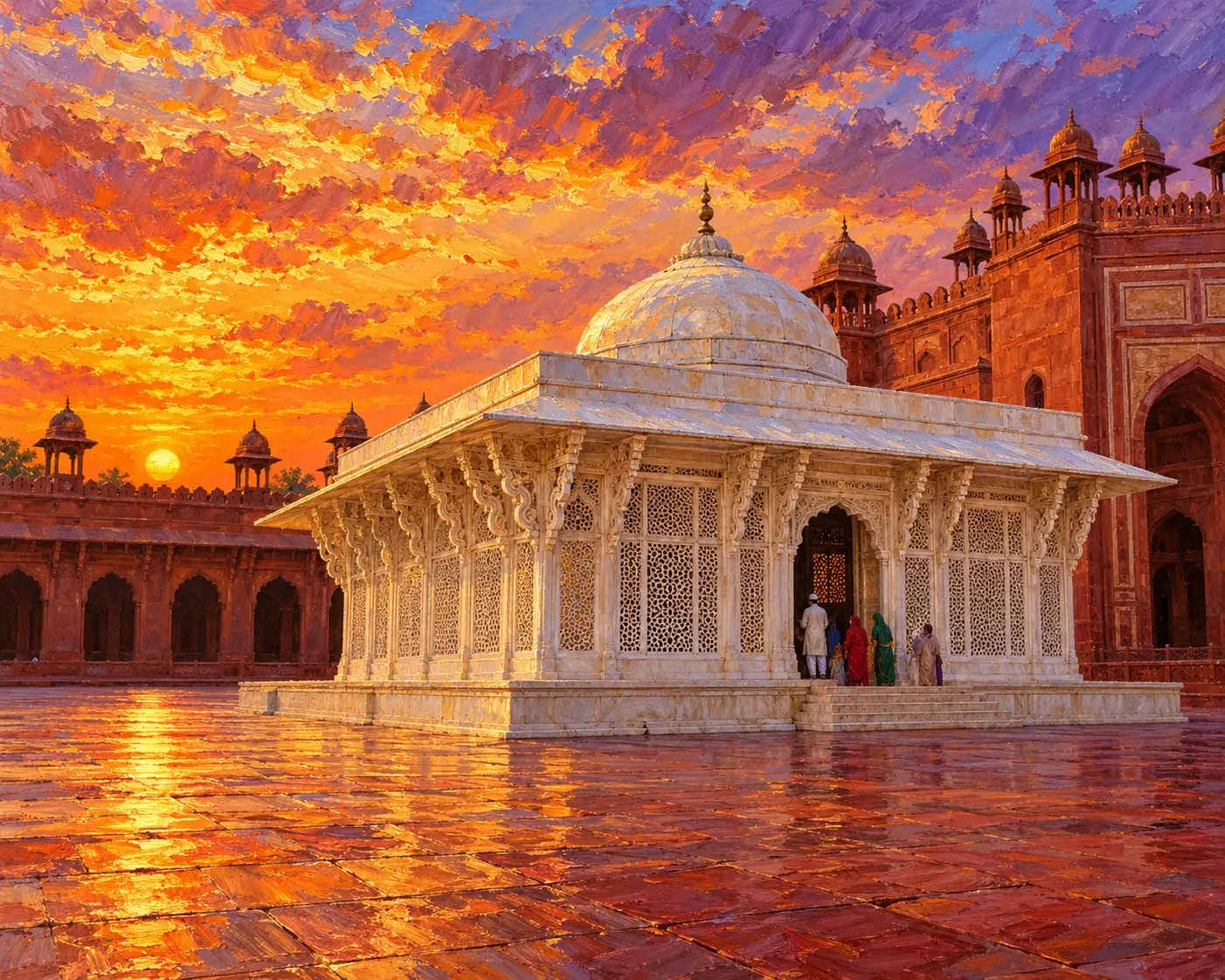
An emperor built an entire city because of the man buried in this small white tomb, in the red courtyard of Fatehpur Sikri's great mosque. People still come to ask him for the same thing that Akbar once did.
The saint and the son
Shaikh Salim Chishti (1478–1572) was a Sufi of the Chishti order who lived on the Sikri ridge. Akbar, who had no son who lived, came to him, and the Shaikh promised him sons. In 1569 Akbar's Rajput queen gave birth at Sikri to a boy, named Salim after the saint: the future emperor Jahangir. The Shaikh's daughter became the prince's foster mother. Akbar built his capital here, and in 1580–81 built this tomb.
Lace in marble
Deep eaves rest on white marble serpentine brackets in the Gujarati style. The walls are jalis, marble screens pierced into geometric patterns, around a passage for walking round the grave, which lies beneath a canopy inlaid with mother-of-pearl.
The threads
People of every faith tie threads to the screens as they make a wish, very often for a child. Many say they come back to untie it when the wish comes true. Qawwali, Sufi devotional song, is often heard in the courtyard.
When the court left in 1585, the palaces emptied. The saint's tomb never did.
Two things almost everyone believes that aren't true
| Claim | Verdict | What is actually the case |
|---|---|---|
| Only Muslims visit | False | People of every faith come to the shrine |
| The whole city died when Akbar left | Not quite | The palaces emptied; the shrine has been visited ever since |
Where to stand
Beside the screens, among the threads. Then look east to the red tomb of the saint's grandson, Islam Khan, with its thirty-six small kiosks.
Hear this one standing in front of it
Wanderlight's Agra guide covers 13 landmarks and runs 2 hr 2 min in total. It plays offline, keeps going with the screen off, and doesn't ask you to make an account.
Get it free on Google Play Android · intro and first three stops free in every cityWhere this comes from
Written from Wanderlight's research dossier for Tomb of Shaikh Salim Chishti — the same one the narration is written from. Where the evidence is thin, this page says so rather than rounding the uncertainty up.