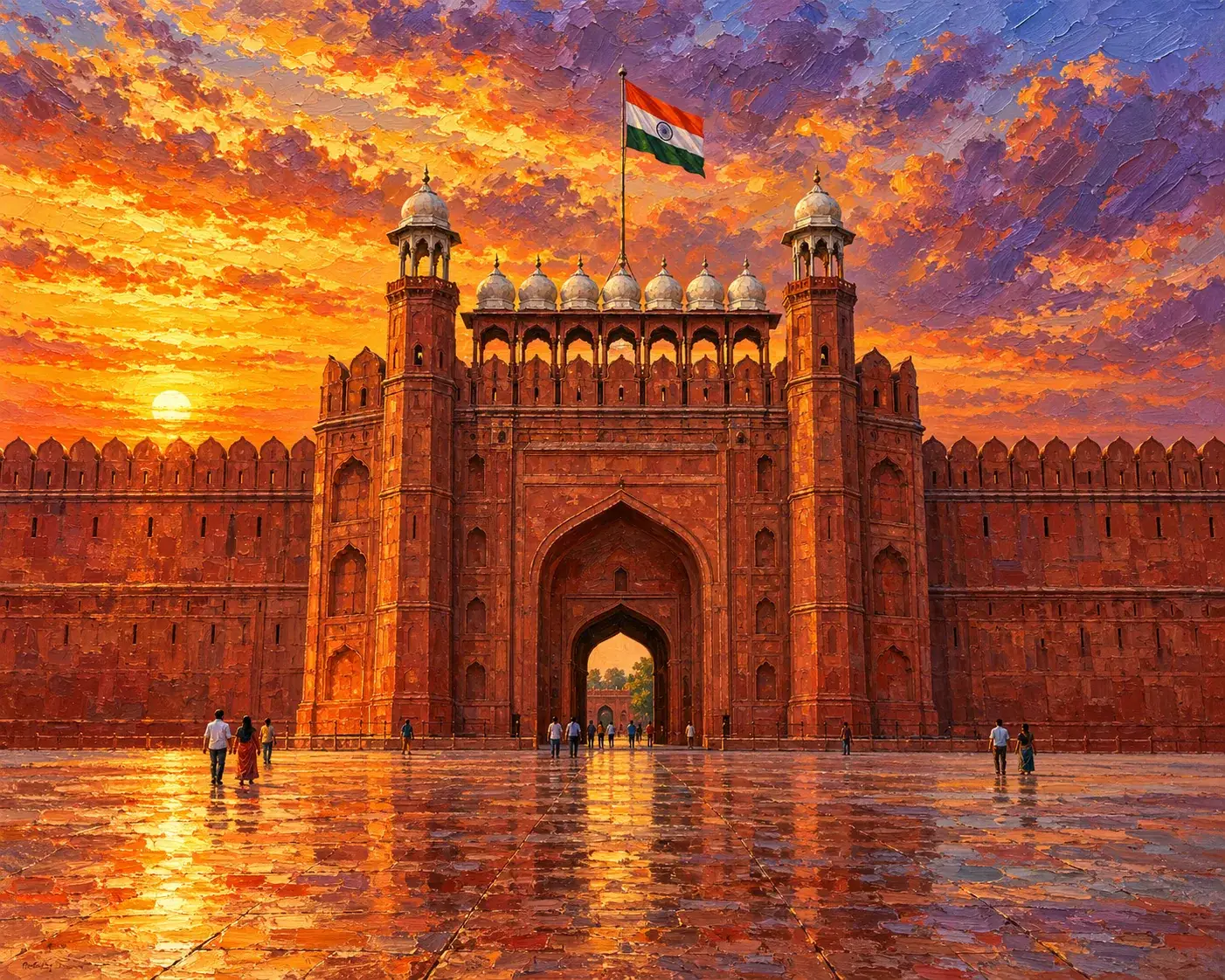
In 1858 the last Mughal emperor, Bahadur Shah Zafar, was put on trial in the white marble hall where his family had once received kings. Ninety years later, the Prime Minister of independent India raised the national flag over the fort's main gate, and every Prime Minister since has gone back there each Independence Day.
Built 1639 to 1648
The emperor Shah Jahan, who built the Taj Mahal, built this fort at the heart of his new capital, Shahjahanabad. He called it Qila-i-Mubarak, the Blessed Fort. The design is credited to Ustad Ahmad Lahori. Its red sandstone walls run about 2.4 kilometres around and rise 18 to 33 metres, and the river Yamuna once flowed along the eastern side.
From the bazaar to the throne
You enter by the Lahori Gate, which faces towards Lahore, into the Chhatta Chowk, a covered bazaar that sold silks and jewellery to the court. Past the drum house is the Diwan-i-Am, the Hall of Public Audience, where the emperor sat under a marble canopy above the crowd. Beyond it, the Diwan-i-Khas, the Hall of Private Audience, carries the Persian verse: If there is a paradise on the face of the earth, it is this, it is this, it is this. A water channel, the Nahr-i-Bihisht, the Stream of Paradise, ran through the private palaces along the river.
1739, 1857, 1947
In 1739 the Persian ruler Nader Shah took Delhi and carried off the Peacock Throne and the Koh-i-Noor diamond. In 1857 rebel soldiers made the elderly emperor Bahadur Shah Zafar the leader of their uprising; when the British retook the city he was tried here and exiled to Rangoon. The British then demolished most of the palace buildings. In 1945 the trial of three officers of the Indian National Army here became a rallying point for independence. In 1947 Jawaharlal Nehru raised the flag of free India over the Lahori Gate.
Three things almost everyone believes that aren't true
| Claim | Verdict | What is actually the case |
|---|---|---|
| Nehru raised the flag here on 15 August 1947 | Mostly false | Most detailed accounts date it to 16 August; the 15 August ceremony was near India Gate |
| You're seeing the palace the Mughals left | False | The British demolished most of the inner buildings after 1857 |
| The Peacock Throne is still in India | False | Nader Shah took it to Persia in 1739 |
Where to stand
Outside the Lahori Gate, looking up at the flagpole, then inside at the back of the Diwan-i-Am, under the emperor's canopy.
Hear this one standing in front of it
Wanderlight's Delhi guide covers 12 landmarks and runs 1 hr 38 min in total. It plays offline, keeps going with the screen off, and doesn't ask you to make an account.
Get it free on Google Play Android · intro and first three stops free in every cityWhere this comes from
Written from Wanderlight's research dossier for Red Fort — the same one the narration is written from. Where the evidence is thin, this page says so rather than rounding the uncertainty up.