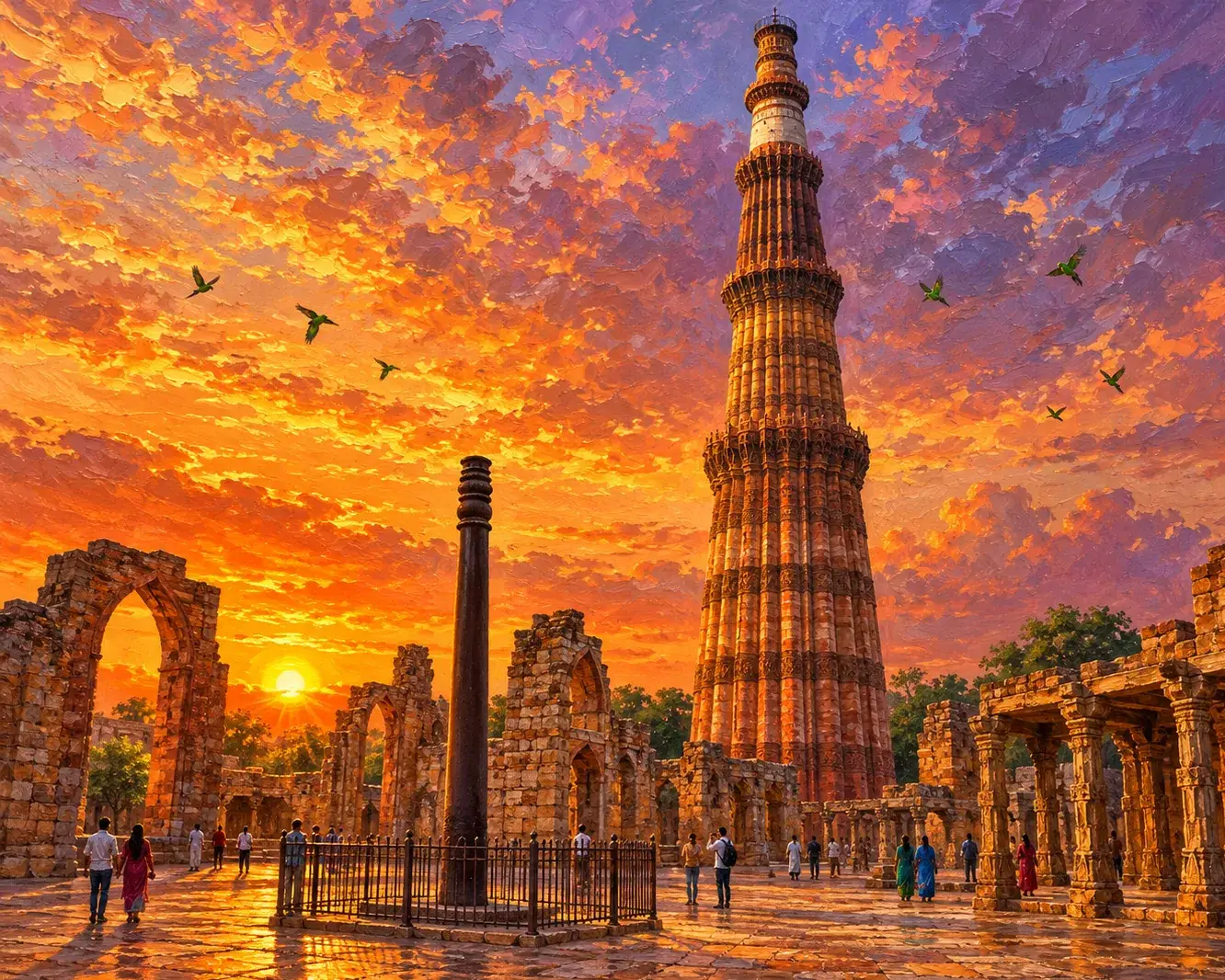
In the courtyard behind this tower stands a post of iron that has been out in the monsoon rain for sixteen hundred years and has barely rusted. The tower beside it was begun in 1199 and still carries the repair from a lightning strike in 1369.
The oldest Delhi
The Qutub Minar stands in Lal Kot, the walled city of the Tomara Rajputs, later held by Prithviraj Chauhan: the oldest of Delhi's cities. After Muhammad of Ghor's victory in 1192, his general Qutb ud-Din Aibak, a former slave-soldier who became the first Sultan of Delhi, began the tower around 1199 as a victory tower and minaret. Aibak finished only the first storey; his successor Iltutmish added three more. The mosque beside it, begun in 1193, was built with material from what stood here before: an inscription on its gateway says from twenty-seven temples, and carved temple pillars still stand in its colonnades. Whether it is named after Aibak or the Sufi saint Qutbuddin Bakhtiyar Kaki is not certain.
The tower
It is 72.5 metres high, tapering from 14.3 metres across at the base to 2.7 at the top, with fluted storeys and bands of carved Arabic and Nagari inscriptions worked by Indian craftsmen. In 1369 lightning struck the top; Firoz Shah Tughlaq rebuilt it in two storeys with white marble, which is why the top looks different. A cupola added by Major Robert Smith in the 1820s was taken down in 1848 and sits on the lawn as "Smith's Folly". After a stampede on the dark staircase killed 45 people, most of them children, on 4 December 1981, the tower was closed to climbers.
The Iron Pillar
About 7.2 metres of forge-welded iron, more than six tonnes, made around 400 CE under the Gupta kings. Its Sanskrit inscription praises a king called Chandra, usually identified as Chandragupta II, and says it was raised as a standard of Vishnu on a hill called Vishnupada; where that was, and when it came to Delhi, is still argued over. The iron's high phosphorus content has let a thin protective layer form, only about a twentieth of a millimetre in 1,600 years.
Also in the complex
The Alai Darwaza (1311), with the earliest true arches and dome in India, and the stump of the Alai Minar, the tower Alauddin Khalji meant to be twice as tall, abandoned at about 25 metres when he died. The complex has been a UNESCO World Heritage Site since 1993.
Three things almost everyone believes that aren't true
| Claim | Verdict | What is actually the case |
|---|---|---|
| The Iron Pillar's rust resistance is a lost secret | False | The high phosphorus in its iron forms a thin protective layer |
| You can climb the Qutub Minar | False | The stairs have been closed since a stampede in 1981 |
| One sultan built the tower | False | Aibak began it, Iltutmish finished it, Firoz Shah Tughlaq rebuilt the top |
Where to stand
Far enough back to see the whole tower, then close to its base for the carving, then in the courtyard with the Iron Pillar and the tower in one view.
Hear this one standing in front of it
Wanderlight's Delhi guide covers 12 landmarks and runs 1 hr 38 min in total. It plays offline, keeps going with the screen off, and doesn't ask you to make an account.
Get it free on Google Play Android · intro and first three stops free in every cityWhere this comes from
Written from Wanderlight's research dossier for Qutub Minar and the Iron Pillar — the same one the narration is written from. Where the evidence is thin, this page says so rather than rounding the uncertainty up.