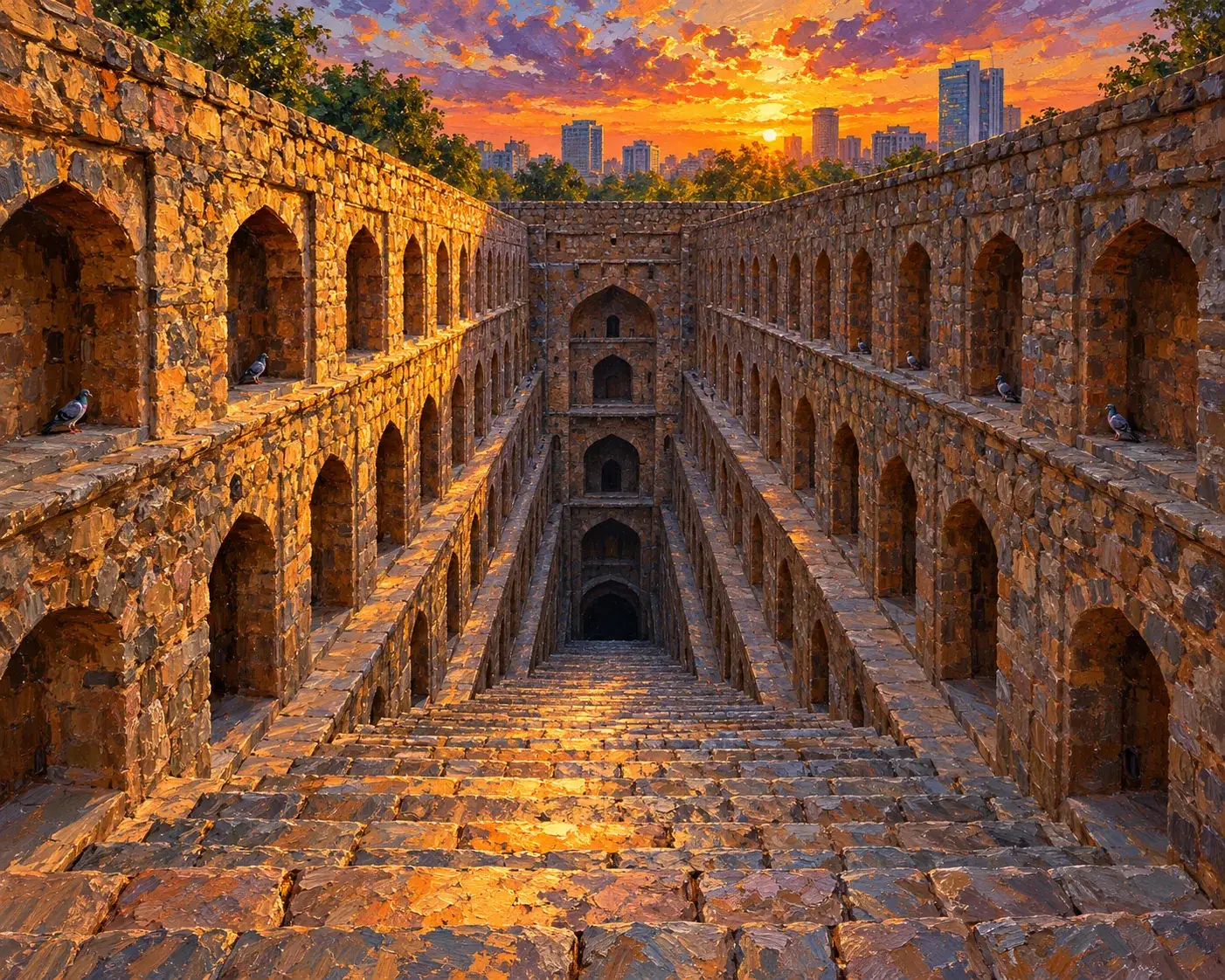
In 1971 the photographer Raghu Rai photographed boys diving into this stepwell. Today you can walk more than a hundred steps to the bottom and stay dry. Nobody knows for certain who built it.
How a stepwell works
At the north end is a round well shaft, seven or eight metres across. Rain and groundwater filled the well and the water rose up the long stepped trench, high in a wet year and low in a dry one, so people simply walked down until they reached it. The arched niches along the walls were shaded places to sit out the heat. The deeper you go, the cooler it gets.
Who built it
There is no inscription and no record. Tradition credits Maharaja Agrasen, the legendary king honoured as the forefather of the Agrawal community, and says the community built or rebuilt it in his name. The stone itself, with its rubble masonry, arched niches and "whale-back" roof, looks like the Delhi Sultanate of the 14th or 15th century, the time of the Tughlaq or Lodi sultans.
What you see
A straight flight of more than a hundred steps, about 60 metres long and 15 wide, between walls of arches. A small mosque stands on the west side. Bats roost in the dark chambers by the well. A little way down, the office towers of central Delhi disappear and only a strip of sky is left.
Where the water went
The baoli was full in 1971. As Delhi grew and more water was pumped from under the city, the water table fell and the well stopped filling. The stepwell is protected by the Archaeological Survey of India, and has since become a film location, in PK and Sultan among others.
Three things almost everyone believes that aren't true
| Claim | Verdict | What is actually the case |
|---|---|---|
| It dates from the age of the Mahabharata | Unproven | That is a legend; the structure looks 14th–15th century |
| It is haunted | False | Modern ghost stories, with no evidence behind them |
| It has always been dry | False | It was still full of water in 1971 |
Where to stand
At the top of the steps, to see the whole trench, and then at the very bottom, looking back up at the strip of sky.
Hear this one standing in front of it
Wanderlight's Delhi guide covers 12 landmarks and runs 1 hr 38 min in total. It plays offline, keeps going with the screen off, and doesn't ask you to make an account.
Get it free on Google Play Android · intro and first three stops free in every cityWhere this comes from
Written from Wanderlight's research dossier for Agrasen ki Baoli — the same one the narration is written from. Where the evidence is thin, this page says so rather than rounding the uncertainty up.