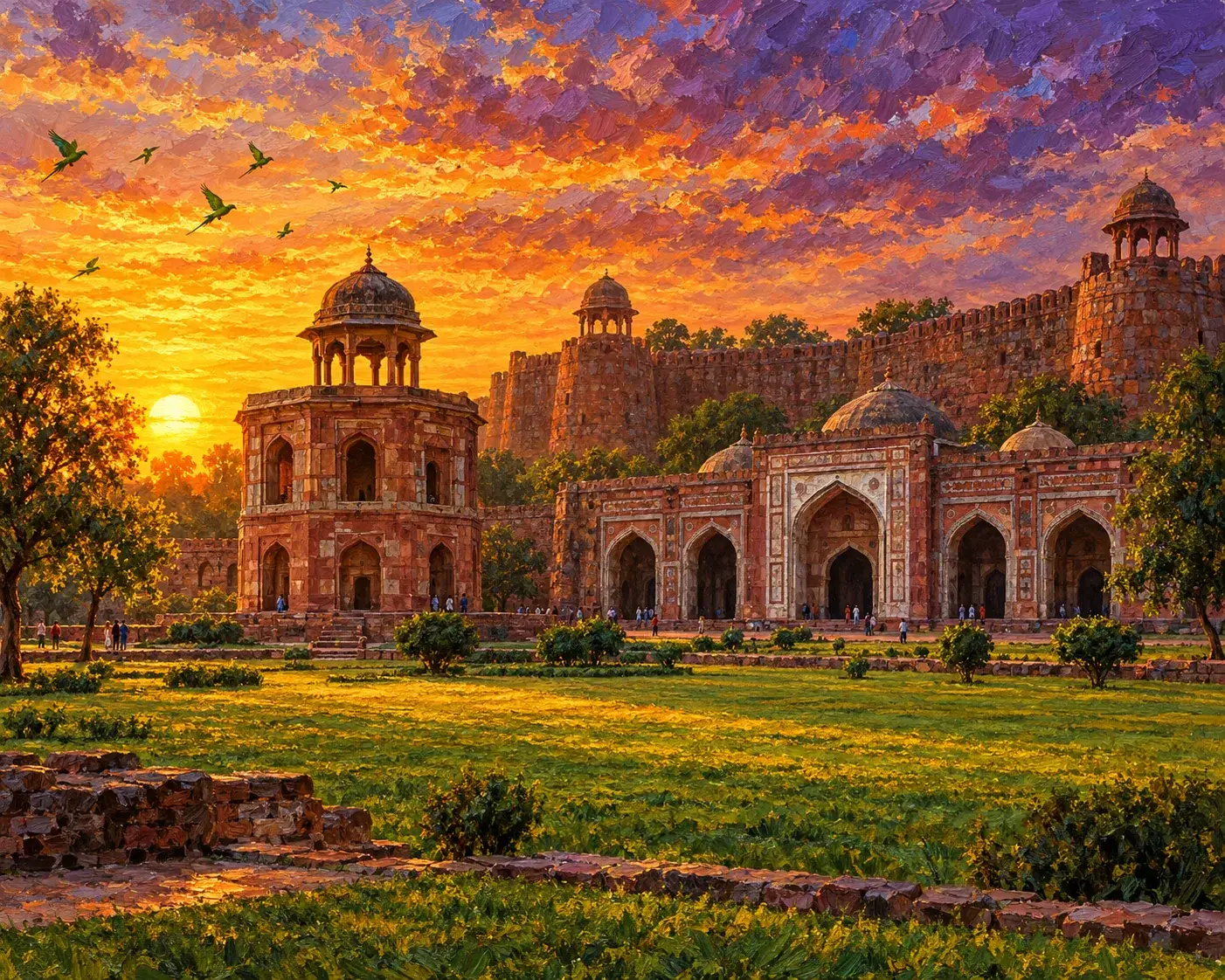
Humayun began this fort around 1533, lost it to the man who chased him out of India, and came back fifteen years later to take it again. Six months after that he fell on the stairs of its library tower. The ground under it had been lived on for two thousand years before either of them arrived.
Two rivals, one fort
Humayun, the second Mughal emperor, founded a city here called Dinpanah, "refuge of the faith", from about 1533. In 1539 and 1540 the Afghan general Sher Shah Suri defeated him at Chausa and Kannauj, took Delhi and rebuilt the citadel as Shergarh. Most of the walls you see, about 18 metres high, are Sher Shah's. He also gave north India the silver rupiya, the word behind the rupee, before he died at the siege of Kalinjar in 1545.
The mosque and the library
Sher Shah's Qila-i-Kuhna Mosque (1541) has five arches of red sandstone framed in white marble and black slate, a bridge between Sultanate and Mughal building. Nearby stands the Sher Mandal, a small two-storey octagon with steep stairs. Humayun, back in Delhi in 1555, made it his library. In January 1556 he fell on those stairs and died a few days later. In October 1556 the general Hemu was crowned here as Vikramaditya; a month later he was killed at Panipat.
The layers underneath
Excavations since the 1950s, by B. B. Lal and later by the Archaeological Survey of India, have found Mughal, Sultanate, Rajput, Gupta, Kushan, Shunga and Mauryan layers, and Painted Grey Ware pottery at the bottom: about 2,500 years of people. Tradition says this was Indraprastha, the city of the Pandavas, and a village called Indrapat stood inside the walls until about 1913. Archaeologists are still looking for stratified proof.
1947
During Partition the fort became a camp for Muslim refugees from Delhi waiting to leave for Pakistan. At least ten thousand people were sheltering here at one point.
Four things almost everyone believes that aren't true
| Claim | Verdict | What is actually the case |
|---|---|---|
| Humayun built the Old Fort | Partly false | He began it; Sher Shah Suri built most of what stands |
| It is the oldest fort in Delhi | False | Its walls are 16th century; Lal Kot is older, though the ground here is older still |
| Archaeology has proved it is Indraprastha | Unproven | It is tradition; the finds fit, but there is no stratified proof yet |
| Humayun died in battle | False | He died after a fall on his library stairs |
Where to stand
Under the Bara Darwaza, the western gate, then on the lawn between the mosque and the Sher Mandal.
Hear this one standing in front of it
Wanderlight's Delhi guide covers 12 landmarks and runs 1 hr 38 min in total. It plays offline, keeps going with the screen off, and doesn't ask you to make an account.
Get it free on Google Play Android · intro and first three stops free in every cityWhere this comes from
Written from Wanderlight's research dossier for Purana Qila — the same one the narration is written from. Where the evidence is thin, this page says so rather than rounding the uncertainty up.