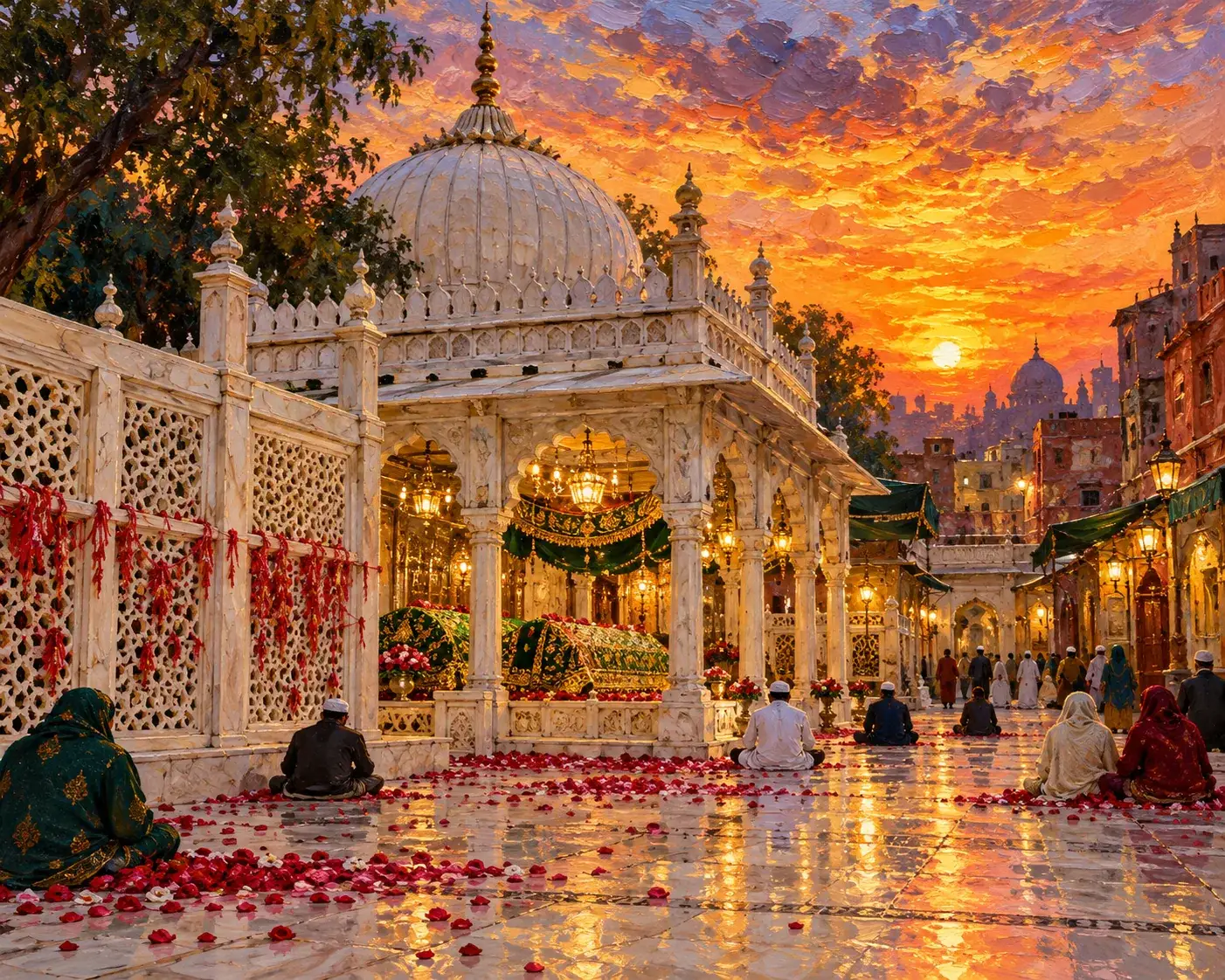
A Sufi saint who would not go to the sultan's court, a sultan who never made it home, a poet who died six months after his master, and a princess who asked for nothing but grass on her grave. People of every faith have walked this lane with rose petals for seven centuries.
The saint
Nizamuddin Auliya (c. 1238–1325) was born in Badayun, became a disciple of Baba Farid of the Chishti order, and settled at Ghiyaspur, then a village on the Yamuna outside Delhi. He ran a kitchen that fed anyone who came, refused gifts of land, and kept away from the court. People called him Mehboob-e-Ilahi, the Beloved of God. He died on 3 April 1325. The dome over his tomb went up in 1562, in Akbar's reign.
"Delhi is still far away"
The story goes that Sultan Ghiyasuddin Tughlaq, building Tughlaqabad, forbade workers to dig the saint's stepwell, and threatened him on his way back from Bengal. The saint is said to have answered Hunuz Dilli dur ast: Delhi is still far away. What history records is that in 1325 a pavilion collapsed on the sultan at Afghanpur, outside Delhi. The stepwell still holds spring water; the Aga Khan Trust for Culture restored it after part of its wall fell in the late 2000s.
The people around him
Amir Khusrau, poet in Persian and Hindavi and often credited with shaping qawwali, died six months after his master and is buried facing him. Jahanara, Shah Jahan's eldest daughter, lies in a marble enclosure open to the sky; her headstone asks that only green grass cover her grave. The Mughal emperor Muhammad Shah is buried in the complex, and Mirza Ghalib a short walk away.
Visiting
Shoes off at the entrance; cover your head. Visitors of every faith are welcome. Women pray at the marble screens outside the inner chamber, which by the shrine's custom only men enter. Qawwali is sung in the courtyard on Thursday evenings after the sunset prayer.
Four things almost everyone believes that aren't true
| Claim | Verdict | What is actually the case |
|---|---|---|
| Only Muslims may visit | False | Visitors of all faiths come every day |
| The saint's curse killed the sultan | Tradition | The pavilion collapse in 1325 is recorded; the curse is a story |
| Qawwali here is put on for tourists | False | It is centuries-old devotional music |
| The tomb is the 1325 original | False | The dome dates from 1562 |
Where to stand
At the marble screens of the saint's tomb, then across the courtyard by Amir Khusrau's tomb, and at Jahanara's open grave.
Hear this one standing in front of it
Wanderlight's Delhi guide covers 12 landmarks and runs 1 hr 38 min in total. It plays offline, keeps going with the screen off, and doesn't ask you to make an account.
Get it free on Google Play Android · intro and first three stops free in every cityWhere this comes from
Written from Wanderlight's research dossier for Hazrat Nizamuddin Dargah — the same one the narration is written from. Where the evidence is thin, this page says so rather than rounding the uncertainty up.