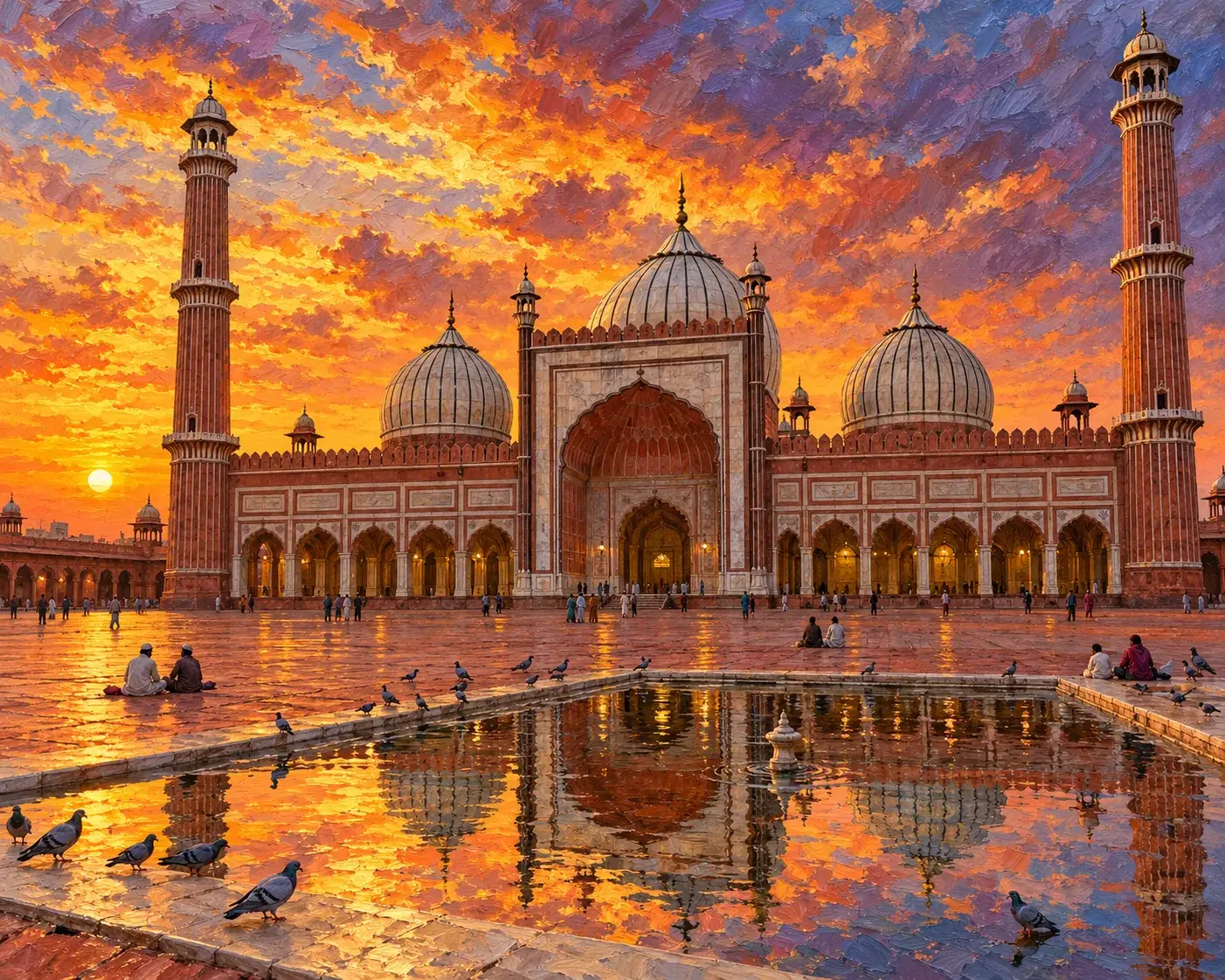
Old Delhi's busiest street was designed by a princess, and it is named after something that is no longer there: a pool in the middle of the road that reflected the moon. At the end of the walk stands her father's great mosque, whose courtyard holds about 25,000 people.
Moonlight Square
Jahanara Begum, the eldest daughter of Shah Jahan, laid out Chandni Chowk in 1650, running west from the Red Fort's Lahori Gate. Chandni Chowk means Moonlight Square, after the pool, which was filled in in the 1870s. Some say the name also remembers the street's silver traders.
A street of many faiths
Within about a kilometre and a half stand the Digambar Jain Lal Mandir (1656), the Gauri Shankar temple, the Gurdwara Sis Ganj Sahib, which marks where the ninth Sikh Guru, Guru Tegh Bahadur, was executed in 1675, a Baptist church (1814), and the Sunehri Masjid of 1721, where Nader Shah sat in 1739 as his army killed tens of thousands of the city's people. At the western end, Khari Baoli is one of the largest spice markets in Asia.
The Jama Masjid
Shah Jahan built the mosque between 1650 and 1656 on a rise of rock facing the Red Fort. Its original name is Masjid-i-Jahan-Numa, the mosque that reflects the world. About 5,000 people built it in red sandstone and white marble, with black marble stripes on the domes; the two minarets are about 41 metres high. After 1857 the British used it as barracks, and returned it to Delhi's Muslims in 1862.
Three things almost everyone believes that aren't true
| Claim | Verdict | What is actually the case |
|---|---|---|
| Chandni Chowk is named after silver | Partly | The usual explanation is a moonlit pool; silver traders are a second theory |
| A princess couldn't have planned a city street | False | Jahanara laid it out in 1650 and built an inn and a garden on it |
| The mosque has always been a mosque | False | The British used it as barracks from 1857 to 1862 |
Visiting
The Jama Masjid is a working mosque. Take off your shoes, cover your arms and legs, and wait outside during prayer times.
Hear this one standing in front of it
Wanderlight's Delhi guide covers 12 landmarks and runs 1 hr 38 min in total. It plays offline, keeps going with the screen off, and doesn't ask you to make an account.
Get it free on Google Play Android · intro and first three stops free in every cityWhere this comes from
Written from Wanderlight's research dossier for Jama Masjid and Chandni Chowk — the same one the narration is written from. Where the evidence is thin, this page says so rather than rounding the uncertainty up.