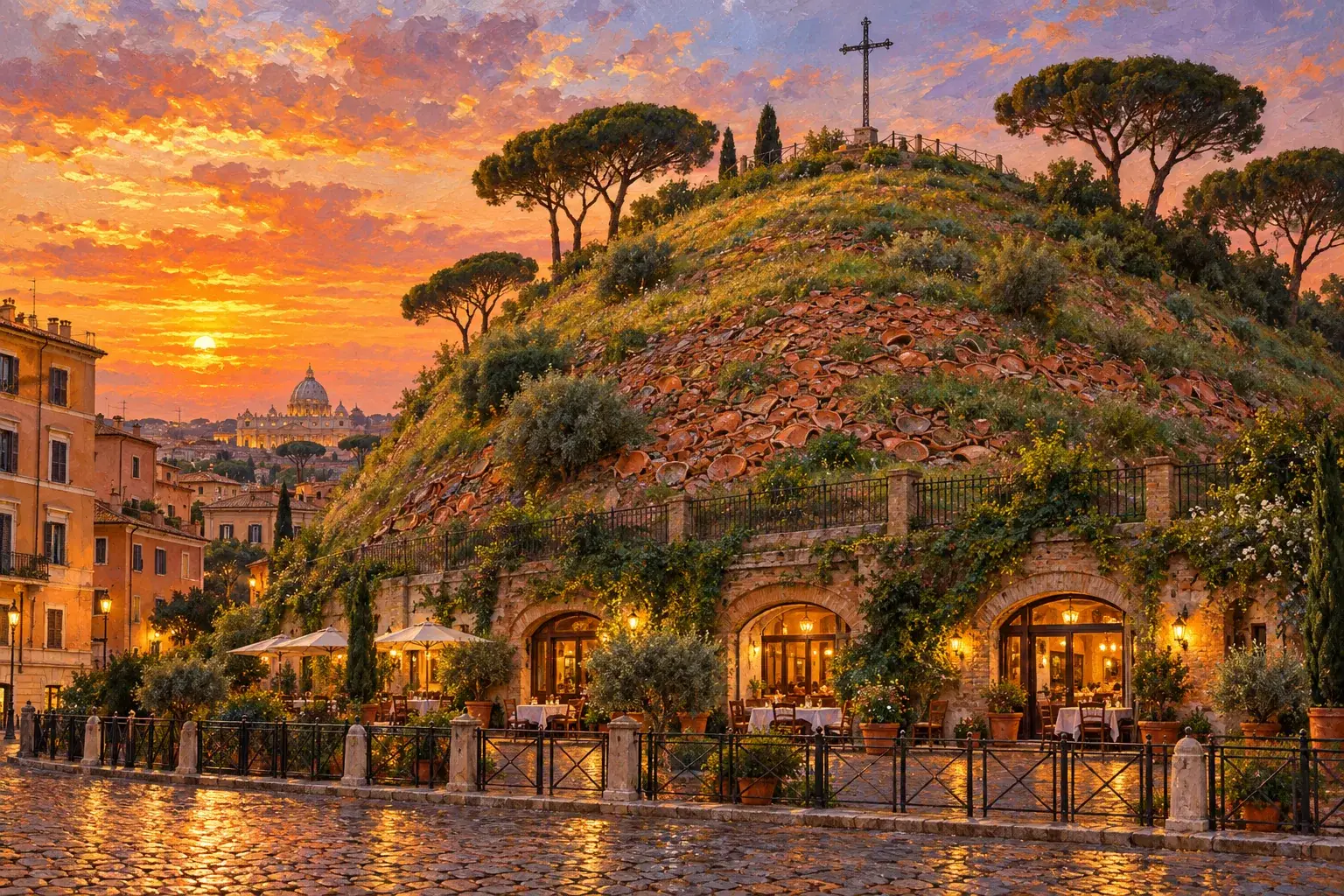
In a working neighbourhood south of the Aventine stands a green hill about 35 metres high and nearly a kilometre round. Look where the grass is thin and the ground is orange: it is made almost entirely of broken pottery — Roman olive-oil jars, smashed and stacked here between roughly the first and the mid-third century AD. The usual estimate is around 53 million of them.
A hill of shards
The Latin for shards is testae. This was the mons testaceus, the hill of shards, and the whole district, Testaccio, is named after it — the rione's coat of arms is an amphora.
The number of jars is an estimate, not a count. Fifty-three million is the figure most often quoted; published estimates run from about 25 million to over 80 million, depending on how tall the hill once was and how much has been dug away since.
Why oil, and why here
Imperial Rome, a city of perhaps a million people, cooked with olive oil, burned it in its lamps and washed with it. A great deal of it was shipped from Baetica — Andalusia, in southern Spain — in a round, thick-walled jar of about 70 litres that archaeologists call the Dressel 20, with smaller numbers from what are now Libya and Tunisia.
Ships reached Ostia; barges were hauled up the Tiber to Rome's river port, the Emporium, founded on this flat ground in 193 BC and lined with warehouses. The oil was emptied there. The jars were the problem.
The jars nobody could reuse
Romans reused plenty of amphorae — as drainpipes, as flowerpots, crushed into building material. The Dressel 20 seems to have been the exception. It broke into big curved pieces that were hard to crush, and its unglazed clay was soaked with oil that went rancid; oil residue reacting with lime makes soap, which would have ruined concrete. Archaeologists think those reasons together explain why these jars were thrown away rather than reused.
Not a heap: a building
Excavations from the 1980s onward showed the hill was engineered. It rose as a series of level terraces, held by retaining walls made of almost-intact jars packed with shards. Lime was spread over the layers, apparently to suppress the smell. Such order points to management, probably by the state office that ran Rome's food supply, the annona.
Every jar a receipt
Many shards carry tituli picti, labels painted with a brush or reed pen: the weight of the empty jar, the exporter's name, the weight of the oil, a control note by the officials who checked it — often with the consular date — and a maker's stamp on the handle. Some exporters were family firms; one label seems to name a man and a woman of the same family, Melissus and Melissa.
The German archaeologist Heinrich Dressel began studying these inscriptions in 1872 and went on to classify Roman amphorae by type, which is why this jar is a "Dressel 20". The labels let historians follow Rome's oil trade almost year by year.
What Rome did with it afterwards
Dumping stopped around the middle of the third century. Once its purpose was forgotten, Romans told stories about it — rubble from Nero's fire, potters' rejects, old funeral urns — none of them true.
- Carnival. In the Middle Ages the hill hosted rough carnival games; accounts describe carts of live pigs sent rolling down the slope.
- Calvary. From the fifteenth century it stood in for Calvary at the end of the Good Friday Way of the Cross. A cross still stands on the summit.
- Cellars. The porous mass of shards stays cool, so cellars were dug into its base for wine; in the eighteenth and nineteenth centuries Romans came out every October for the ottobrate. Many of those cellars are restaurants and clubs now, some with the wall of shards behind glass.
- Guns. In 1849 a battery on the hill fired on the French army besieging the Roman Republic.
Six things almost everyone believes that aren't true
| Claim | Verdict | What is actually the case |
|---|---|---|
| It's a natural hill | False | It is an artificial mound, almost entirely broken amphorae |
| It's a random rubbish heap | False | It was built in terraces, with retaining walls of jars and layers of lime |
| It holds exactly 53 million jars | Misleading | 53 million is the most-quoted estimate; others range from about 25 to over 80 million |
| It's made of broken wine jars | False | Overwhelmingly olive-oil jars, mainly Dressel 20s from southern Spain |
| It's rubble from Nero's fire | False | A medieval legend. The dated labels belong to the second and third centuries AD |
| You can climb it any time | False | The hill is fenced. Visits are by booking only, and taking shards is forbidden |
How long you need
Half an hour around the base, longer with a booked visit to the top. The hill is about 1.5 km south of the Palatine, past the Circus Maximus, and pairs with an evening in Testaccio's trattorias — the district grew up around the Mattatoio slaughterhouse (1888–1891, closed 1975) and is known for quinto quarto cooking such as coda alla vaccinara. The Pyramid of Cestius is a few minutes' walk away.
Hear this one standing in front of it
Wanderlight's Rome guide covers 16 landmarks and runs 3 hr 33 min in total. It plays offline, keeps going with the screen off, and doesn't ask you to make an account.
Get it free on Google Play Android · intro and first three stops free in every cityWhere this comes from
Written from Wanderlight's research dossier for Monte Testaccio — the same one the narration is written from. Where the evidence is thin, this page says so rather than rounding the uncertainty up.