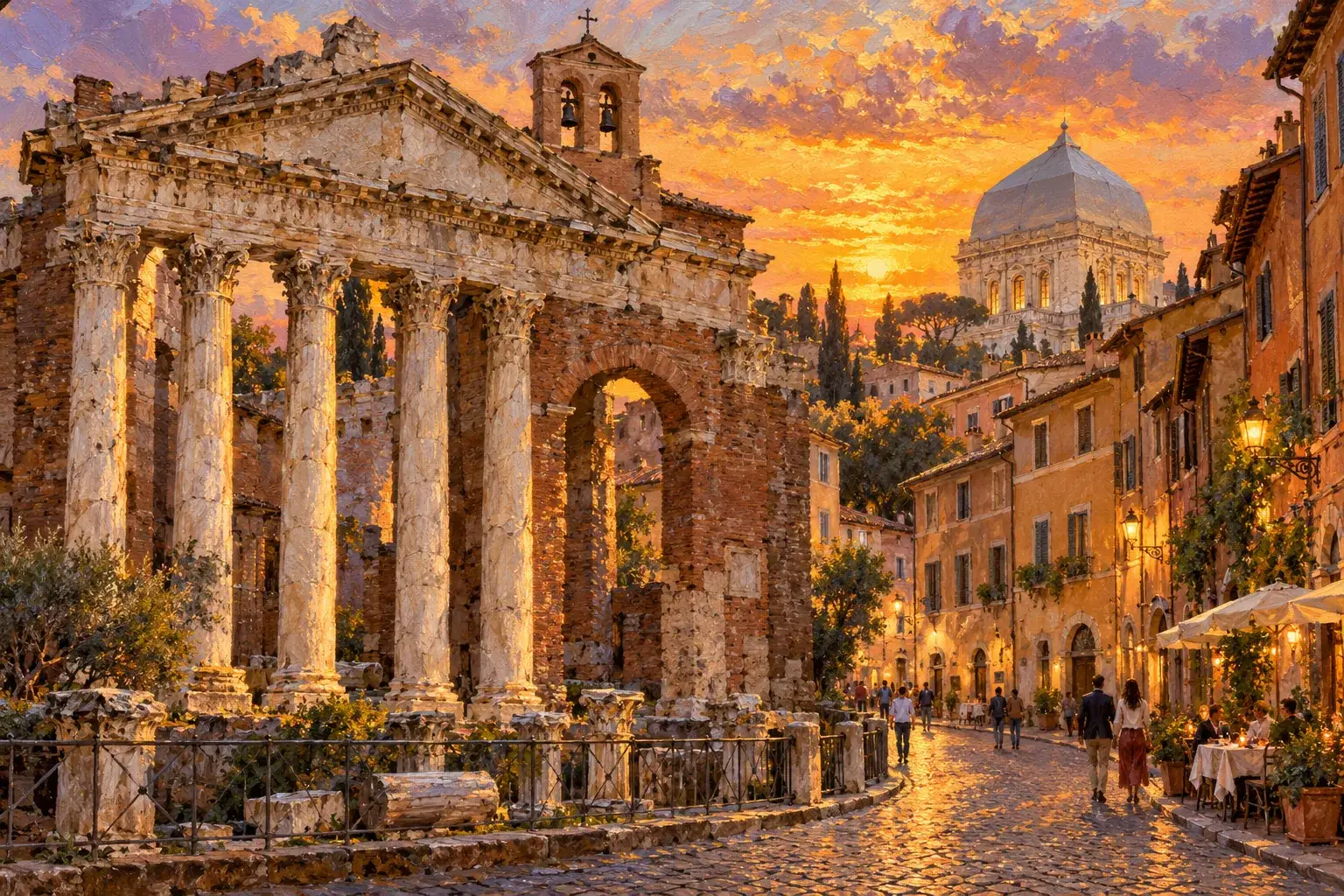
Between the Theatre of Marcellus and the Tiber Island, a single curving street — Via del Portico d'Ottavia — runs past Roman columns, restaurant tables and a synagogue with the only square dome in Rome. For more than three hundred years, from 1555 to 1870, the Jews of Rome were locked behind a wall here every night. Almost none of that ghetto survives. This is how it came to be, and what is left.
A community older than the ghetto by seventeen centuries
The first record of Jews in Rome is from 161 BC, when envoys of Judah Maccabee came to the city. The community grew under the Empire, not least with captives brought to Rome after the destruction of the Temple in Jerusalem in AD 70 — the event shown on the Arch of Titus in the Forum, where Roman soldiers carry the Temple's menorah. It has lived in Rome without a break ever since, one of the oldest Jewish communities in Europe.
In antiquity most Jews lived across the river in Trastevere. Over the Middle Ages more of them settled here, on the left bank, around the city's fish market.
The portico and the fish market
That market was held in and around the Porticus Octaviae, a colonnade first built after 146 BC, rebuilt by Augustus in the name of his sister Octavia, and restored under Septimius Severus in AD 203 — whose inscription is still on the pediment. After an earthquake in 442 a brick arch replaced two columns. A marble plaque nearby orders that the heads of fish longer than the plaque, "up to the first fins", be handed to the city's Conservators: a medieval tax on the biggest catch.
1555: the papal wall
In July 1555, two months after his election, Pope Paul IV issued the bull Cum nimis absurdum, "Since it is utterly absurd". It ordered every Jew in Rome into a walled enclosure of about three hectares on low ground that flooded, with gates opened at dawn and locked at night. Jews could no longer own property, were confined largely to the trade in old clothes and rags, had to wear a distinguishing sign, and were allowed only one synagogue.
The community answered the last rule by putting five congregations — the Cinque Scole — into a single building. Houses rose higher and higher on the cramped ground. From the 1570s Jews were made to attend conversion sermons on their own Sabbath; a bilingual Hebrew and Latin verse from Isaiah, added in 1858, still faces the old ghetto gates from the little church of San Gregorio della Divina Pietà.
The Turtle Fountain in Piazza Mattei was originally planned for the ghetto's market square. In the 1580s the nobleman Muzio Mattei had it moved to the square in front of his own family's houses.
Back and forth, then the end
In 1798 a French-backed Roman Republic declared Jews equal citizens and planted a Tree of Liberty in the ghetto's square; the ghetto returned when papal rule did. The gates came down in 1848; another republic freed the Jews in 1849, and restrictions returned when it fell. The ghetto ended on 20 September 1870, when Italian troops entered Rome at Porta Pia and the Pope's temporal rule over the city ended.
In the 1880s the city demolished most of it for new streets and the Tiber embankments. The row of old houses on the north side of Via del Portico d'Ottavia gives the best idea of how it looked.
A dome built to be seen
On the cleared land the community built the Great Synagogue, the Tempio Maggiore, from 1901 and inaugurated in 1904, by Vincenzo Costa and Osvaldo Armanni, mixing Assyrian, Egyptian and classical motifs under Rome's only square dome. It was meant to be visible from across the city: a statement of freedom. The Jewish Museum of Rome is inside the complex.
16 October 1943
The Fascist racial laws of 1938 shut Jews out of schools, professions and public life. German forces occupied Rome in September 1943. On 26 September the SS commander Herbert Kappler gave the community's leaders 36 hours to hand over 50 kilograms of gold in exchange for their safety; just over 50 kilograms was delivered, with Romans who were not Jewish contributing too.
On Saturday 16 October 1943, before dawn, German police began a roundup with lists of names and addresses. Via del Portico d'Ottavia was its centre, but arrests went on across the city: 1,259 people were taken. After 237 releases, 1,023 were deported from Tiburtina station on 18 October and reached Auschwitz on 22 October. Sixteen came back — fifteen men and one woman, Settimia Spizzichino. No children returned.
The square in front of the portico is now Largo 16 Ottobre 1943. In the pavement along the street are pietre d'inciampo — Stolpersteine, small brass plaques outside the last homes of people who were deported. Rome began laying them in 2010.
Six things almost everyone believes that aren't true
| Claim | Verdict | What is actually the case |
|---|---|---|
| The Rome ghetto was created by the Nazis | False | It was created by a papal bull in 1555 and lasted until 1870 |
| Jews came to Rome after the destruction of Jerusalem | Partly false | The first record is 161 BC, more than two centuries earlier |
| The ghetto walls still stand | False | The gates came down in 1848 and most of the ghetto was demolished in the 1880s |
| The Portico d'Ottavia is a Jewish monument | False | It is a Roman portico of 146 BC, rebuilt in AD 203, that stood at the ghetto's edge and held the fish market |
| The 1943 gold payment saved the community | False | The roundup came three weeks after the gold was delivered |
| Rome's Jews are Sephardi or Ashkenazi | False | They keep their own Roman (Italkim) rite, a distinct tradition that is neither |
How long you need
The old ghetto is a few minutes' walk end to end, about four hundred metres from the Capitoline steps past the Theatre of Marcellus. Allow an hour with the synagogue and museum, longer with a meal: this is the place for carciofi alla giudia, whole fried artichokes, in season.
Hear this one standing in front of it
Wanderlight's Rome guide covers 16 landmarks and runs 3 hr 33 min in total. It plays offline, keeps going with the screen off, and doesn't ask you to make an account.
Get it free on Google Play Android · intro and first three stops free in every cityWhere this comes from
Written from Wanderlight's research dossier for Jewish Ghetto of Rome — the same one the narration is written from. Where the evidence is thin, this page says so rather than rounding the uncertainty up.