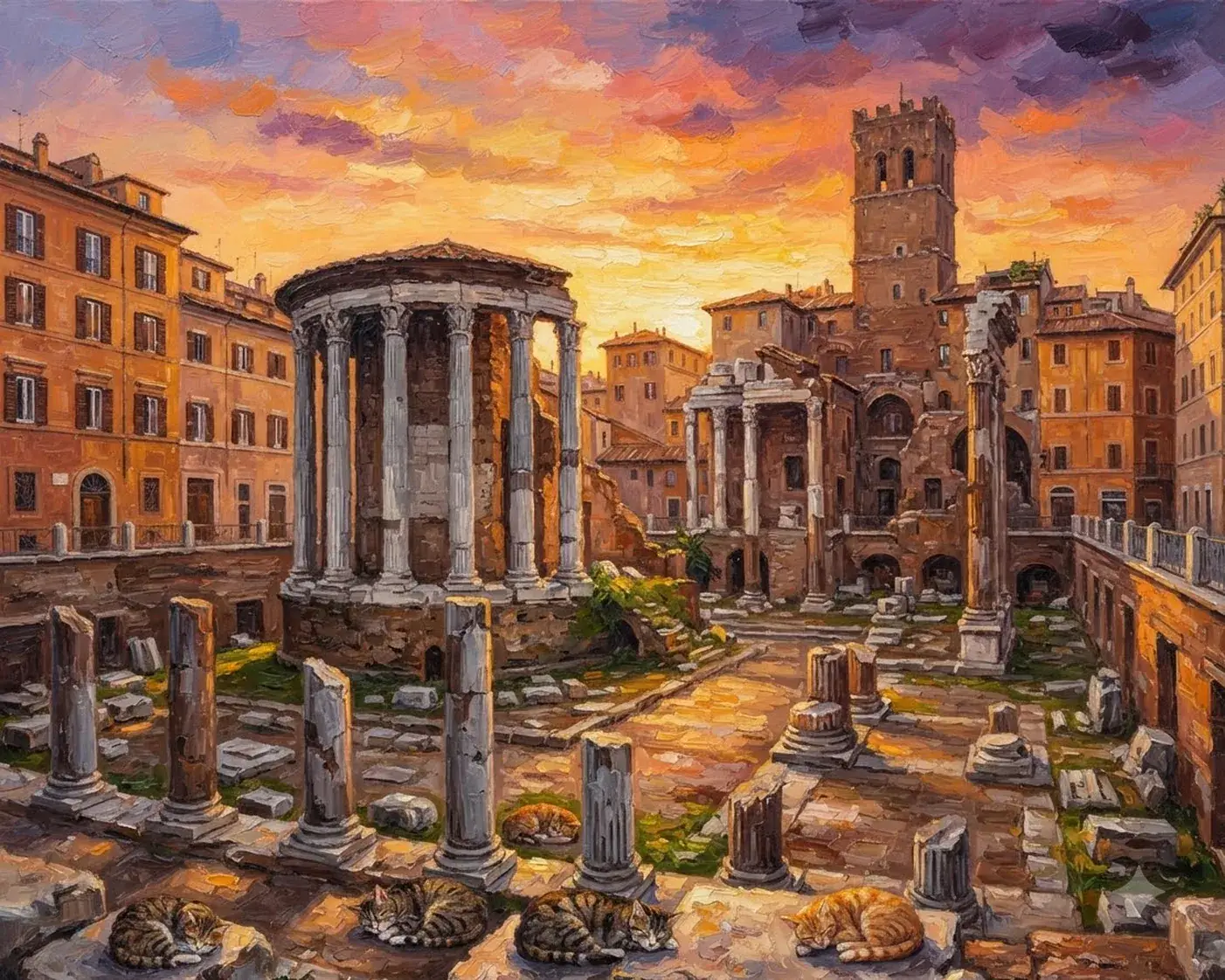
About 300 metres south of the Pantheon, a rectangle of ruins sits six metres below the traffic. These are four temples of the Roman Republic, the oldest from around 300 BC. At the back stood the Curia of Pompey, the hall where the Senate met on 15 March 44 BC and where Julius Caesar was stabbed to death at the foot of Pompey's statue.
Temples A, B, C and D
Scholars still argue over which gods owned three of the four temples, so they go by letters. The round one, Temple B, is the surest: Quintus Lutatius Catulus built it after a victory in 101 BC for Fortuna Huiusce Diei, the Luck of This Day. Each temple was a general's victory vow, paid for from the spoils. A medieval church was later built inside Temple A, and its apse is still there.
The Ides of March
The Senate house in the Forum had burned in 52 BC, so the Senate also met in the hall Pompey had built behind his theatre. Caesar's rival had been dead four years when Caesar walked in on the Ides. The Roman biographer Suetonius counts 23 wounds, and reports that a doctor found only one of them fatal. He says Caesar died without a word, or, as some said, with the Greek kai su, teknon, "you too, child". "Et tu, Brute?" is Shakespeare's line. Augustus later had the hall walled up.
Strasbourg, Mussolini and the cats
The square is named after Strasbourg, whose Latin name was Argentoratum: in 1503 a papal official from that city built his tower here. The temples were uncovered between 1926 and 1929, when the medieval quarter on top was demolished. Street cats moved into the open dig, and a volunteer cat sanctuary has run in one corner since 1993. Since June 2023 a step-free walkway takes ticket holders down into the ruins.
4 things almost everyone believes that aren't true
| Claim | Verdict | What is actually the case |
|---|---|---|
| Caesar was killed in the Roman Forum. | False | He was killed in the Curia of Pompey, at the back of these ruins. His body was later burned in the Forum. |
| His last words were "Et tu, Brute?" | False | That is Shakespeare. Suetonius reports silence, or "kai su, teknon" in Greek. |
| The square is named after Argentina. | False | It is named after Strasbourg, Argentoratum in Latin. |
| You can see the exact spot where Caesar fell. | Unknown | The hall is known, but the room was sealed and built over. A 2012 claim to have found a marker is not accepted by everyone. |
Where to stand
At the railing on the side facing the round temple, looking past it to the long wall of squared stone blocks behind. That wall is thought to belong to the back of Pompey's hall.
Hear this one standing in front of it
Wanderlight's Rome guide covers 16 landmarks and runs 3 hr 33 min in total. It plays offline, keeps going with the screen off, and doesn't ask you to make an account.
Get it free on Google Play Android · intro and first three stops free in every cityWhere this comes from
Written from Wanderlight's research dossier for Largo di Torre Argentina — the same one the narration is written from. Where the evidence is thin, this page says so rather than rounding the uncertainty up.