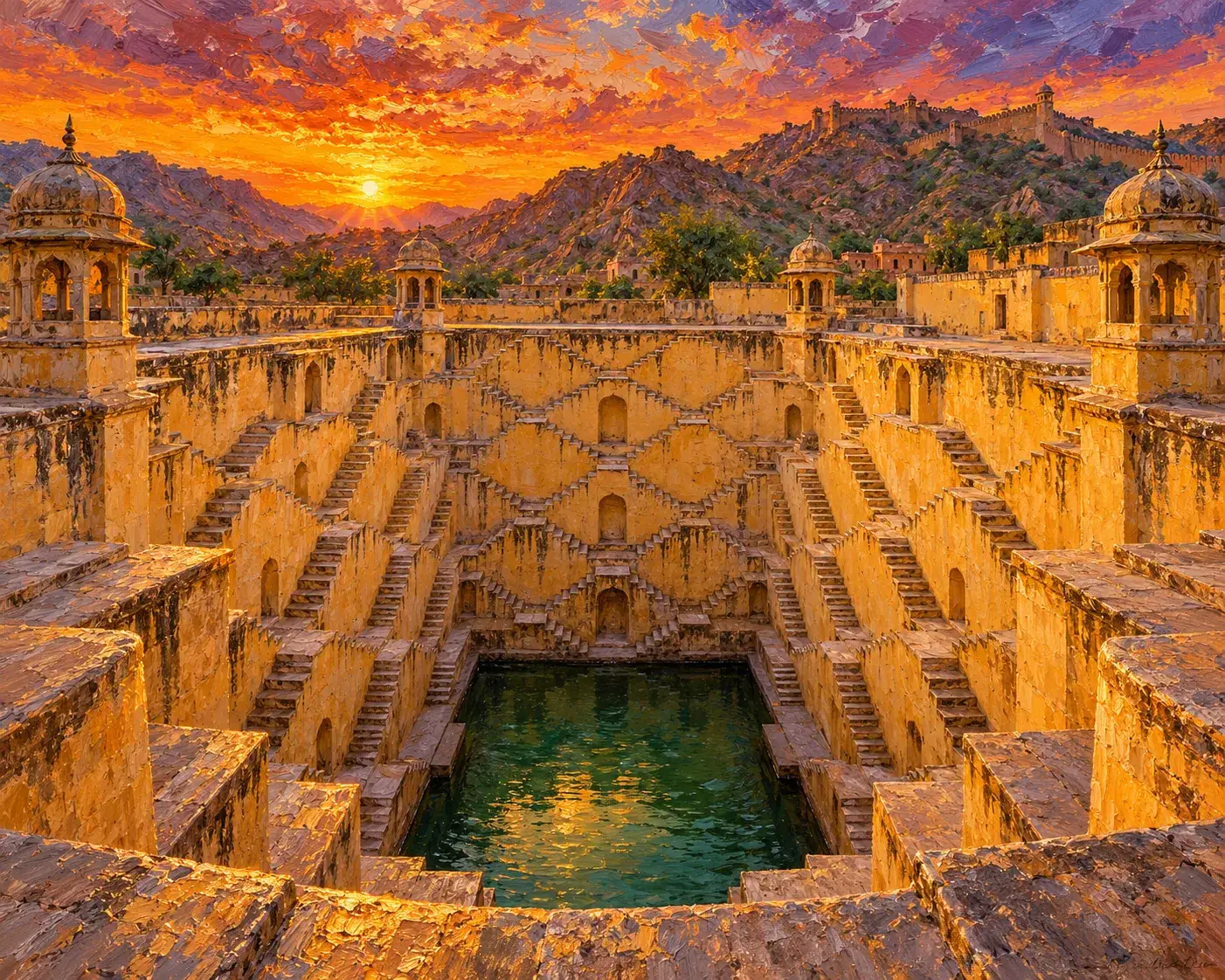
The stairs in this well were built like a maze. Local legend says that if you walk down them, you can never climb back up the same way. It is a short walk from Amber Fort, in the old town of Amer.
A store for the monsoon
Rajasthan gets most of its rain in a few weeks of monsoon. A stepwell caught that rain and kept it, and its stairs let people reach the water at whatever level it stood. The cool steps were also a place to bathe, rest and meet. Shortage of water at Amber was one of the reasons the capital moved to Jaipur in 1727.
Who built it
Nobody knows for certain. It is usually dated to the sixteenth century, without firm records. One story names a court official, Panna Mian; another links the name to the Meena people, who held this land before the Kachhwahas.
What you see
A square well about eight storeys deep, its sides covered in flights of steps that cross each other in a zigzag pattern, with small domed pavilions at the corners. Visitors are usually asked to view it from the edge.
Three things almost everyone believes that aren't true
| Claim | Verdict | What is actually the case |
|---|---|---|
| You can never climb out the way you came in | Legend | The pattern is confusing; locals manage it easily |
| A known king built it | Unknown | There are no firm records |
| It's a bathing pool | False | It's a stepwell for storing rainwater |
Where to stand
At a corner pavilion, in the morning or late afternoon, when the shadows sharpen the zigzag.
Hear this one standing in front of it
Wanderlight's Jaipur guide covers 10 landmarks and runs 1 hr 2 min in total. It plays offline, keeps going with the screen off, and doesn't ask you to make an account.
Get it free on Google Play Android · intro and first three stops free in every cityWhere this comes from
Written from Wanderlight's research dossier for Panna Meena ka Kund — the same one the narration is written from. Where the evidence is thin, this page says so rather than rounding the uncertainty up.