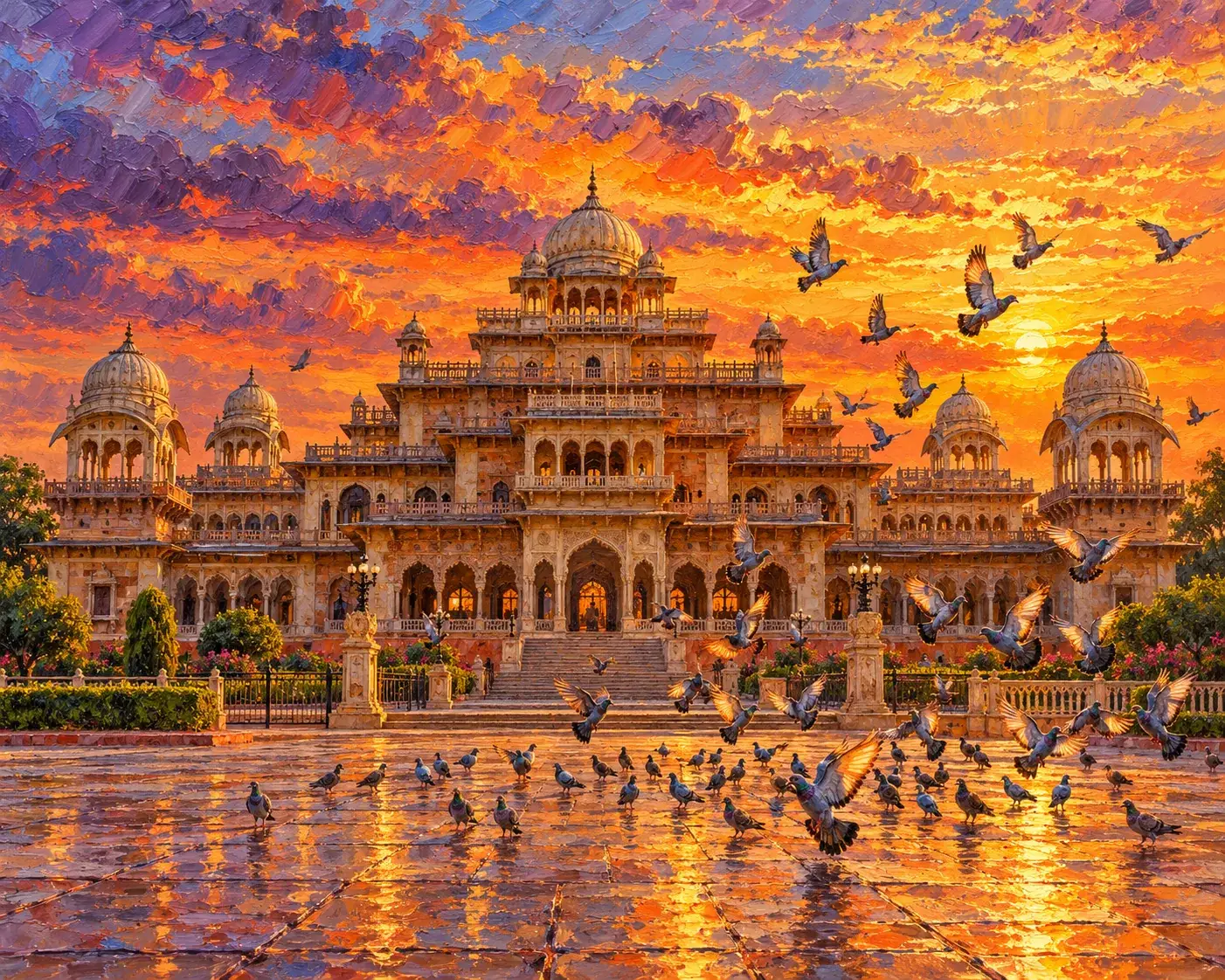
There's a woman from ancient Egypt in the middle of Jaipur, and she has been here for more than a hundred years. She lies in Rajasthan's oldest museum, in Ram Niwas Garden just outside New Gate.
Named for a prince
The foundation stone was laid on 6 February 1876 by Albert Edward, Prince of Wales, later King Edward VII, on the same visit for which, by the usual account, Jaipur was painted pink. It is named for him, not for his father, Prince Albert.
Maharaja Sawai Ram Singh II planned a town hall. His successor Sawai Madho Singh II, the king who took Ganges water to London in silver urns, made it a museum, and it opened in 1887. The architect, Samuel Swinton Jacob, mixed Indian, Islamic and European forms in the style called Indo-Saracenic.
A museum for craftsmen
The collection grew from the 1883 Jaipur Exhibition, organised with the state surgeon Thomas Holbein Hendley, who gathered about 19,000 objects so that local craftsmen could study the best work of the world. The verandah walls are painted with scenes of the world's great civilisations.
Tutu
The museum's most famous resident is Tutu, a woman from Panopolis (Akhmim) on the Nile, from the Ptolemaic period. The museum in Cairo gave her to Jaipur in the 1880s; sources differ on whether it was 1883 or 1887. In August 2020, when flood water reached the lower floor, staff broke open her case to rescue her, and she was unharmed.
Look too for the Jaipur garden carpet, a vast Persian carpet showing a garden of paradise, already in the royal collection by 1632.
Three things almost everyone believes that aren't true
| Claim | Verdict | What is actually the case |
|---|---|---|
| It's named after Prince Albert, Queen Victoria's husband | False | It's named for their son, the Prince of Wales, who laid the stone |
| It was built as a museum | False | Ram Singh II planned a town hall |
| The mummy is a pharaoh | False | Tutu was a woman of the Ptolemaic period from Panopolis |
Where to stand
In the garden in front, at dusk, when the building is lit and the pigeons fill the square.
Hear this one standing in front of it
Wanderlight's Jaipur guide covers 10 landmarks and runs 1 hr 2 min in total. It plays offline, keeps going with the screen off, and doesn't ask you to make an account.
Get it free on Google Play Android · intro and first three stops free in every cityWhere this comes from
Written from Wanderlight's research dossier for Albert Hall Museum — the same one the narration is written from. Where the evidence is thin, this page says so rather than rounding the uncertainty up.