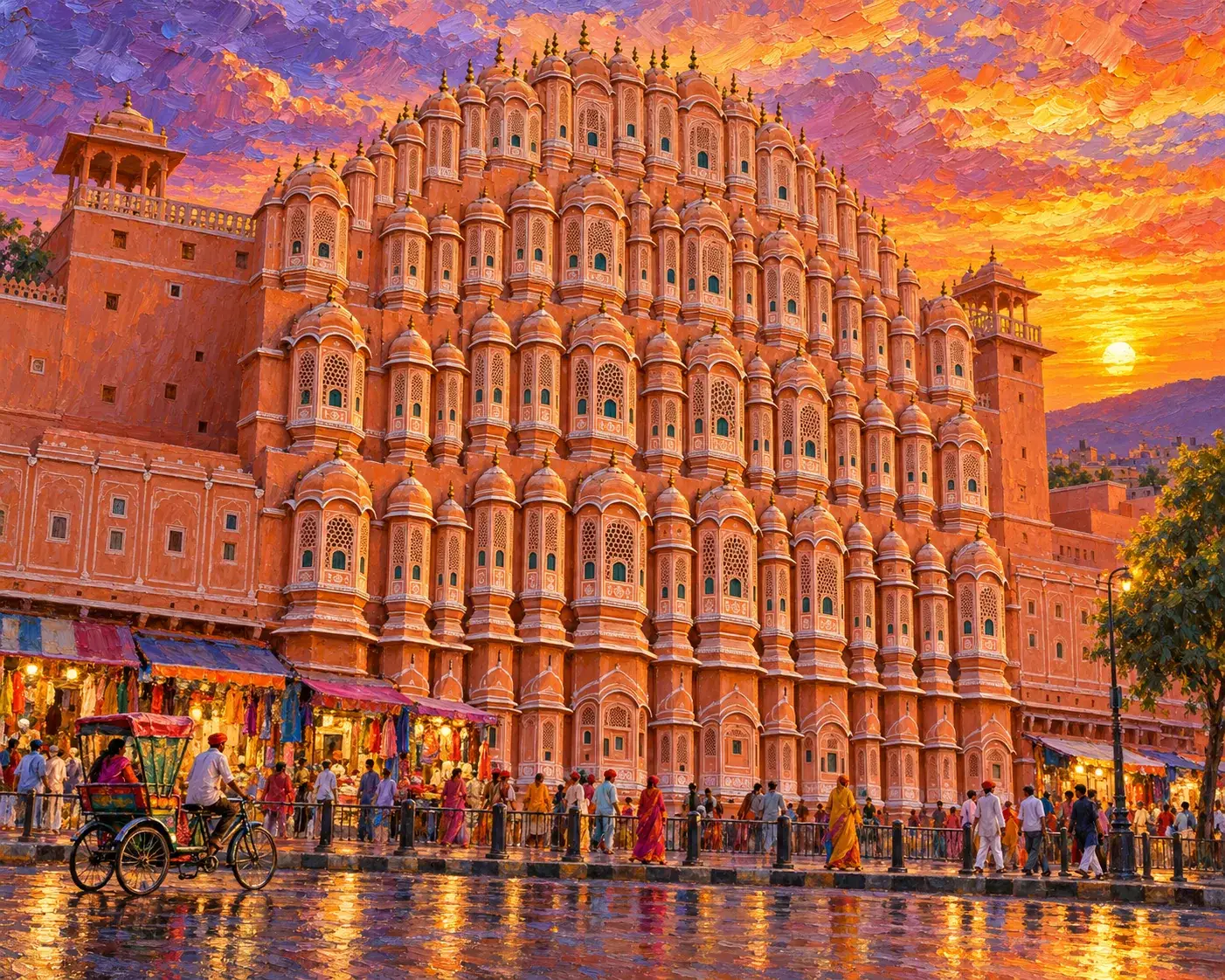
The most photographed palace in Jaipur is the back of a building. The pink honeycomb on the bazaar street is a screen wall, only one room deep on its upper floors, built so the royal women behind it could watch the city without being seen.
Built in 1799
Maharaja Sawai Pratap Singh, grandson of Jaipur's founder, built the Hawa Mahal in 1799. The architect was Lal Chand Ustad. It rises five storeys, about 15 metres, and carries 953 small windows, jharokhas, as they're usually counted, each with carved latticework.
Eyes on the street
Behind the facade were the palace's women's quarters. Royal women lived in purdah, out of public view. From behind the lattices they could watch the markets, processions and festivals of one of the old city's main bazaar streets, near the great crossroads of Badi Chaupar, without being seen. The lattices also let the wind through to cool the rooms: hence the name, the Palace of Winds.
No stairs
The upper floors are reached by ramps, not stairs. The building blends Rajput forms (domed canopies, fluted pillars, lotus patterns) with Mughal arches and stone filigree. It was renovated in 2006 after about fifty years.
Three things almost everyone believes that aren't true
| Claim | Verdict | What is actually the case |
|---|---|---|
| The Hawa Mahal is a whole palace | False | It is a screen wall at the back of a palace wing |
| You're looking at its front | False | The street side is the back; the entrance is from the City Palace side |
| Its shape is Krishna's crown | Unproven | A popular explanation, not a record |
Where to stand
Across the street, early in the morning, when the sun lights the windows. Then go in and climb the ramps to the top.
Hear this one standing in front of it
Wanderlight's Jaipur guide covers 10 landmarks and runs 1 hr 2 min in total. It plays offline, keeps going with the screen off, and doesn't ask you to make an account.
Get it free on Google Play Android · intro and first three stops free in every cityWhere this comes from
Written from Wanderlight's research dossier for Hawa Mahal — the same one the narration is written from. Where the evidence is thin, this page says so rather than rounding the uncertainty up.