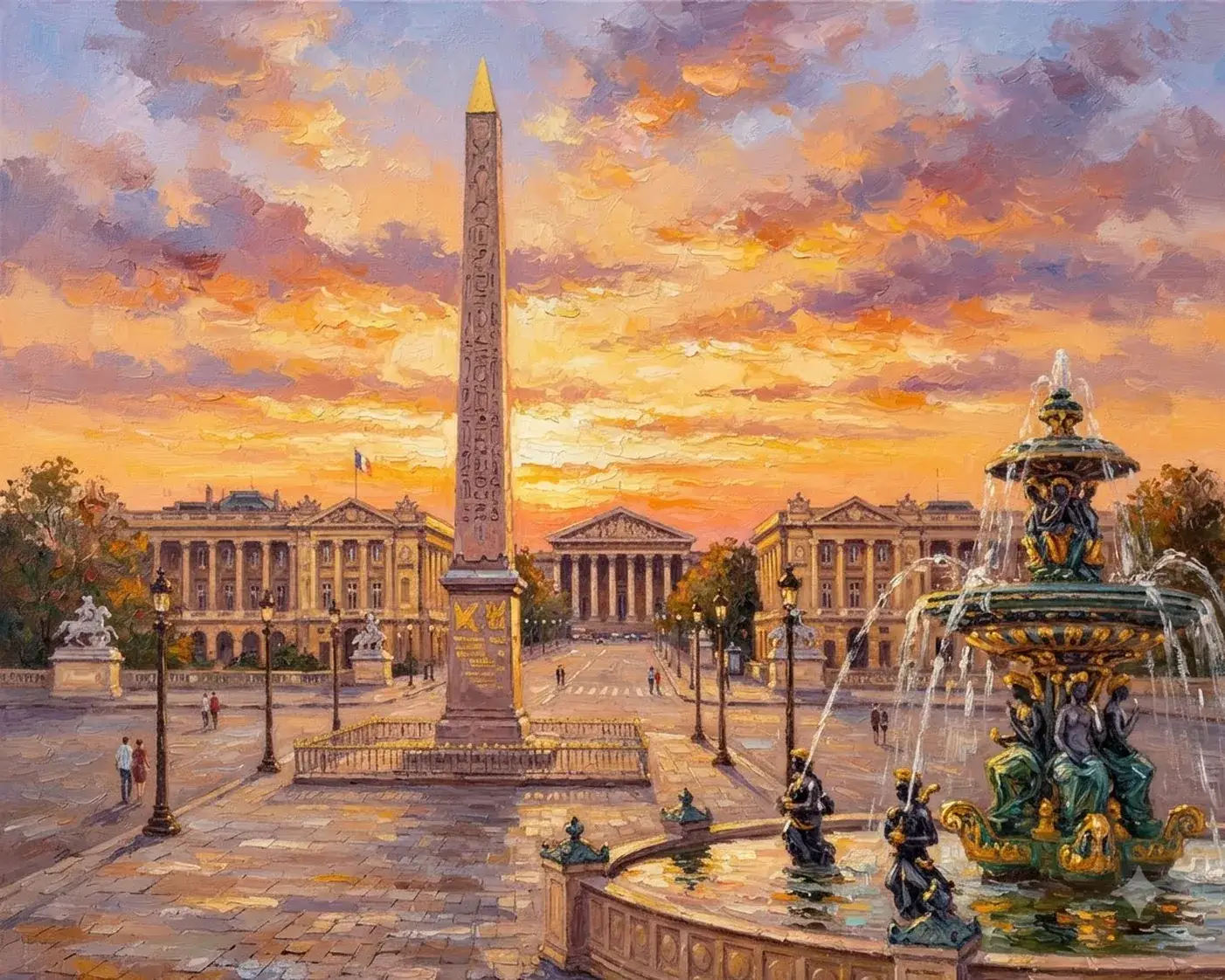
The largest square in Paris, at the foot of the Champs-Élysées, was laid out between 1757 and 1772 by Ange-Jacques Gabriel around a statue of Louis XV. As the Place de la Révolution it held the guillotine: Louis XVI died here on 21 January 1793 and Marie Antoinette on 16 October 1793. In 1795 it was renamed Concorde, harmony. At its centre stands the Luxor Obelisk, about 3,300 years old, raised here in 1836.
A king's square
The city commissioned a bronze equestrian statue of Louis XV in 1748, and Gabriel framed it with an octagon of moats and balustrades and two colonnaded palaces on the north side, now the Hôtel de la Marine and the Hôtel de Crillon. Gabriel also designed the Petit Trianon at Versailles. Crowds pulled the statue down on 11 August 1792.
The guillotine
Historians count about 1,119 of the roughly 2,500 people guillotined in Paris during the Revolution as dying on this square. Besides the king and queen, they included Charlotte Corday, Danton, Camille Desmoulins, the chemist Antoine Lavoisier, and finally Robespierre, in July 1794. The scaffold did not stand where the obelisk is. For the king's execution it stood off to one side, towards the Champs-Élysées. Tradition places it near today's statue of Brest.
Six names and an obelisk
Place Louis XV, Place de la Révolution, Concorde (1795), Place Louis XV again (1814), Place Louis XVI (1826), and Concorde for good in 1830. For the centre, King Louis-Philippe chose a monument no side could object to: the obelisk, carved for Ramesses II at Luxor and given to France by Egypt's ruler Muhammad Ali. Gilded diagrams on its pedestal show how it was lowered, shipped and raised. The gold cap was added in 1998.
4 things almost everyone believes that aren't true
| Claim | Verdict | What is actually the case |
|---|---|---|
| The obelisk marks the spot where Louis XVI was guillotined. | False | The obelisk replaced Louis XV's statue at the centre. The guillotine stood off to one side. |
| The obelisk was taken by Napoleon. | False | It was a gift from Muhammad Ali in 1830, and arrived in 1833. |
| The Terror's victims were mostly aristocrats. | False | Most of those guillotined were not nobles. |
| Marie Antoinette said "Let them eat cake". | False | No contemporary source records it, and the line is older than her time in France. |
Where to stand
At the foot of the obelisk, reading the gilded diagrams on its pedestal, then turn east to see the Tuileries and the Louvre along the same straight line.
Hear this one standing in front of it
Wanderlight's Paris guide covers 16 landmarks and runs 4 hr 31 min in total. It plays offline, keeps going with the screen off, and doesn't ask you to make an account.
Get it free on Google Play Android · intro and first three stops free in every cityWhere this comes from
Written from Wanderlight's research dossier for Place de la Concorde — the same one the narration is written from. Where the evidence is thin, this page says so rather than rounding the uncertainty up.