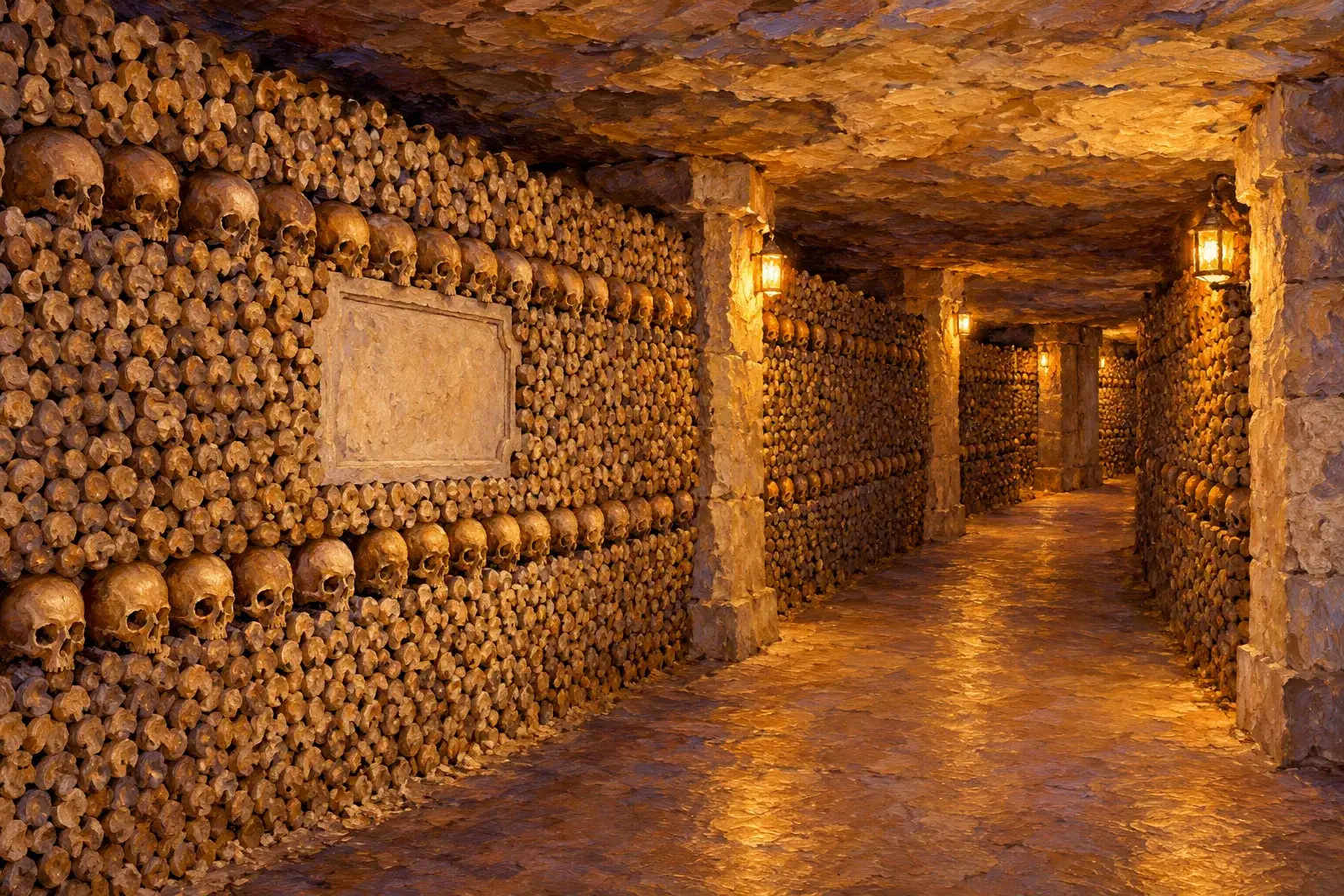
A hundred and thirty steps under Place Denfert-Rochereau lie the bones of several million Parisians — usually put at about six million, though nobody ever counted. Not one of them was buried here. They were buried all over Paris, sometimes centuries earlier, and then the city dug them up and carried them down. The reason is two disasters that happened to fit together.
First disaster: Paris was standing on its own quarries
Much of the Left Bank sits on Lutetian limestone, the pale, fossil-flecked stone that built a great deal of old Paris. From around the twelfth century it was quarried underground: miners sank wells to the bed, worked sideways, and left pillars to hold the roof. Exhausted workings were abandoned and often never recorded, and the city kept growing over the top of them.
In the 1770s the ground began to give way. In 1774 a house collapsed on the old rue d'Enfer, and on 4 April 1777 Louis XVI created a quarry inspection service under the architect Charles-Axel Guillaumot. His men mapped the voids under the public roads and built walls and pillars to hold them up — and carved the name of each street above onto the tunnel wall, a second map of Paris underneath the first. You walk past those plaques on the way in.
Second disaster: the cemetery that rose above the street
On the Right Bank, beside the market of Les Halles, the Holy Innocents' Cemetery had taken the dead of a large part of the city for more than six hundred years. Most were buried in shared pits; old pits were reopened and their bones moved into charnel galleries along the walls. By the late eighteenth century the ground inside stood more than two metres above the street.
In 1780 the wall of a cellar on the rue de la Lingerie, next to the cemetery, gave way under the weight of a mass grave. The cellar was filled with quicklime and walled up, and the cemetery was closed for good. Millions of bones now needed somewhere to go — and a few kilometres south, just outside the city gate, Guillaumot had a large, empty, freshly reinforced space.
How you move a cemetery
A royal decree of 9 November 1785 ordered the Innocents emptied. Transfers began that winter. Accounts describe closed carts draped in black leaving at dusk, with priests chanting the office of the dead, and ending at a shaft above the quarries. The bones went down the shaft; workmen below moved them into the galleries. The ossuary was consecrated on 7 April 1786.
The Innocents took about fifteen months to empty. Other cemeteries followed in waves — to 1814, again around 1840, and again during Haussmann's rebuilding of Paris in 1859–1860. Each consignment sits behind a plaque naming the cemetery it came from and the date it arrived.
The name "catacombs" was borrowed from Rome in the 1780s because it sounded right. Rome's catacombs were dug to bury the dead. This is an ossuary: a place for bones that had already been buried somewhere else.
The man who turned a bone store into a monument
The walls you see are mostly the work of Louis-Étienne Héricart de Thury, the mining engineer who took over the quarry service in 1809. He set out to make the ossuary a monument to the dead: bones stacked into façades of thigh and shin bones laid end-on, with bands of skulls across them; stone plaques of scripture and poetry about death and time; a fountain, an altar and a lamp — some of the "monuments" being, it is thought, quarry supports dressed up as tombs.
The neat walls are fronts. Behind each one, the rest of the bones are heaped loose.
Over the door into the ossuary he left a line from Jacques Delille's French translation of Virgil: "Arrête ! C'est ici l'empire de la Mort" — "Stop! Here is the empire of Death."
Who is down here
Among the cemeteries emptied into the ossuary were those that took the dead of the Revolution, such as the Madeleine and the Errancis. Danton, Robespierre and Lavoisier were buried in those cemeteries, and their bones are believed to have come here with the rest. No one could ever pick them out.
Guillaumot himself died in 1807 and was buried in an ordinary parish cemetery that was later emptied into the ossuary — so the man who built this place is very probably in it, without a name.
Six things almost everyone believes that aren't true
| Claim | Verdict | What is actually the case |
|---|---|---|
| The catacombs are ancient Roman | False | The ossuary was created in 1785–1786 in quarries worked from the Middle Ages on. The name was borrowed from Rome |
| People were buried here | False | Bones were exhumed from Paris cemeteries and transferred. It is an ossuary, not a burial ground |
| Exactly six million people lie here | Misleading | Six million is the usual estimate. Nobody counted; official sources say "several million" |
| The catacombs run under the whole city | False | The ossuary is a walled section of about 11,000 m². The wider quarry network is far larger, but it is closed and is not the ossuary |
| You can get lost on the visit | False | The public route runs one way. The stories of getting lost belong to the closed network |
| Famous writers such as Pascal or Racine are definitely here | Unproven | Lists of famous names are traditional. Some remains may never have left their churches |
Above the stairs
The entrance is in one of the two pavilions of the Barrière d'Enfer, built by Claude-Nicolas Ledoux in the 1780s as a customs post to tax goods coming into Paris. In August 1944, Colonel Henri Rol-Tanguy directed the insurrection that helped liberate Paris from a command post beneath the same square.
How long you need
The route is about 1.5 kilometres: 130 steps down, 112 back up, about 20 metres underground, at around 14 °C all year. Entry is timed and booked ahead. There is no phone signal down there, which is exactly the situation a downloaded audio guide is for — and it pairs naturally with Père Lachaise, the cemetery Paris opened once its old churchyards were gone.
Hear this one standing in front of it
Wanderlight's Paris guide covers 16 landmarks and runs 4 hr 31 min in total. It plays offline, keeps going with the screen off, and doesn't ask you to make an account.
Get it free on Google Play Android · intro and first three stops free in every cityWhere this comes from
Written from Wanderlight's research dossier for Catacombs of Paris — the same one the narration is written from. Where the evidence is thin, this page says so rather than rounding the uncertainty up.