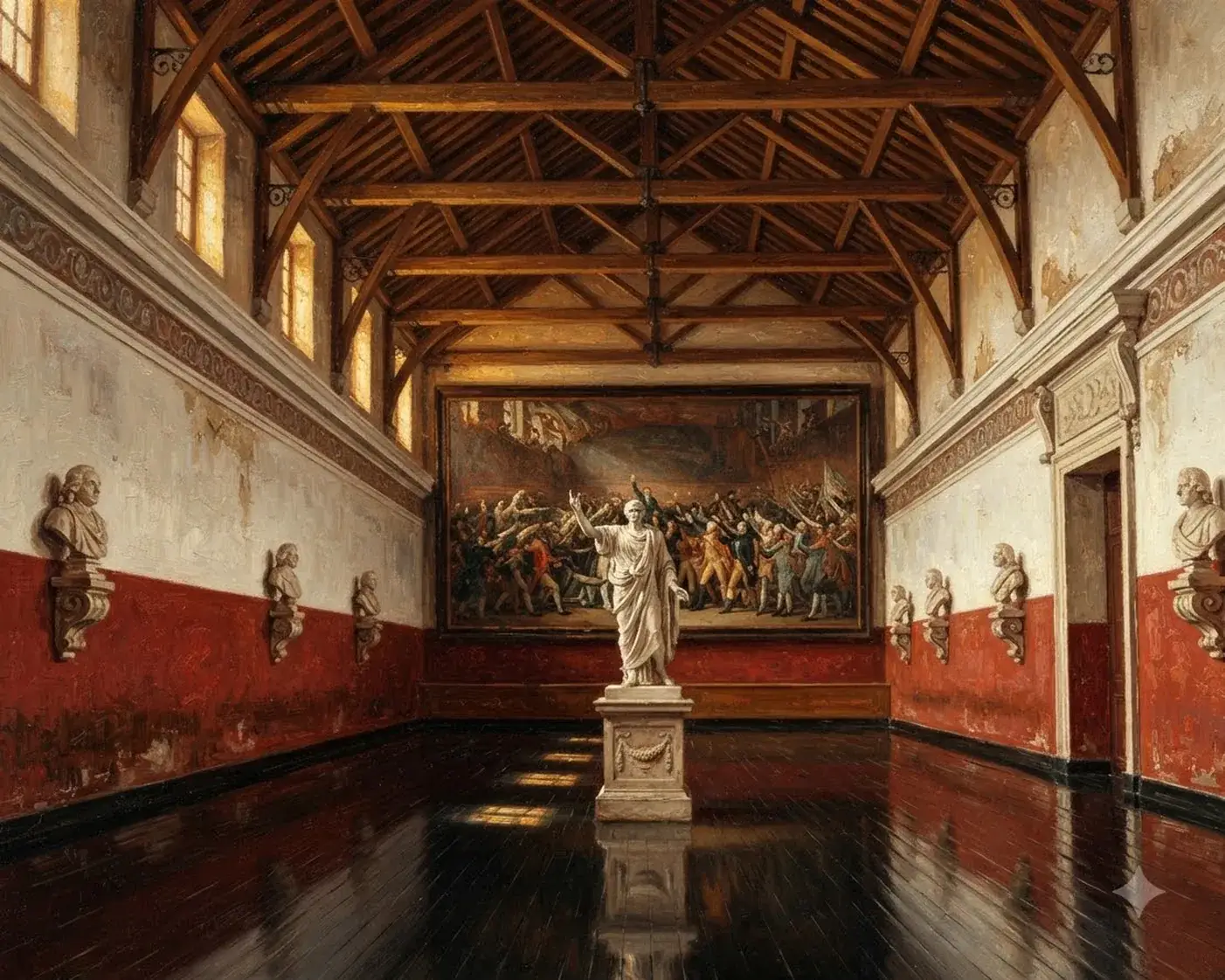
Ten minutes from the palace, at 1 rue du Jeu de Paume, is a tall, plain hall built in 1686 for jeu de paume, real tennis, the ancestor of the modern game. On 20 June 1789 the deputies of the Third Estate, locked out of their meeting hall, crowded in here and swore never to separate until France had a constitution.
Locked out
The Estates-General, called to approve new taxes, opened in Versailles on 5 May 1789. It had not met since 1614. On 17 June the Third Estate declared itself the National Assembly. Three days later its deputies found their hall closed and guarded, officially for carpenters preparing a royal session. The deputy Dr Joseph-Ignace Guillotin suggested the empty tennis court.
The oath, and one "no"
Their president, the astronomer Jean-Sylvain Bailly, read the oath standing on a table. Hundreds signed. One deputy, Joseph Martin-Dauch, signed as opposant. Within a week the king told the clergy and nobles to join the Assembly. The Bastille fell on 14 July, and on 6 October the royal family left Versailles for Paris.
The room since
It was a memorial, then a storeroom, a workshop and a painters' studio. On 20 June 1883 it reopened as a museum of the Revolution, with a statue of Bailly, busts of deputies and a huge canvas copied from Jacques-Louis David's unfinished design. It was restored to that look in 2021–2022.
4 things almost everyone believes that aren't true
| Claim | Verdict | What is actually the case |
|---|---|---|
| The oath was taken inside the palace. | False | The tennis court is in the town, about ten minutes from the palace. |
| The oath declared a republic. | False | It demanded a constitution. France remained a monarchy until 1792. |
| Everyone signed. | False | Joseph Martin-Dauch signed as opposed. |
| Dr Guillotin invented the guillotine. | False | He proposed a uniform, quick method of execution. Others designed and built the machine, and it was named after him against his wishes. |
Where to stand
By the statue of Bailly in the middle of the room, facing the painting on the end wall.
Hear this one standing in front of it
Wanderlight's Versailles guide covers 10 landmarks and runs 1 hr 43 min in total. It plays offline, keeps going with the screen off, and doesn't ask you to make an account.
Get it free on Google Play Android · intro and first three stops free in every cityWhere this comes from
Written from Wanderlight's research dossier for Royal Tennis Court (Salle du Jeu de Paume) — the same one the narration is written from. Where the evidence is thin, this page says so rather than rounding the uncertainty up.