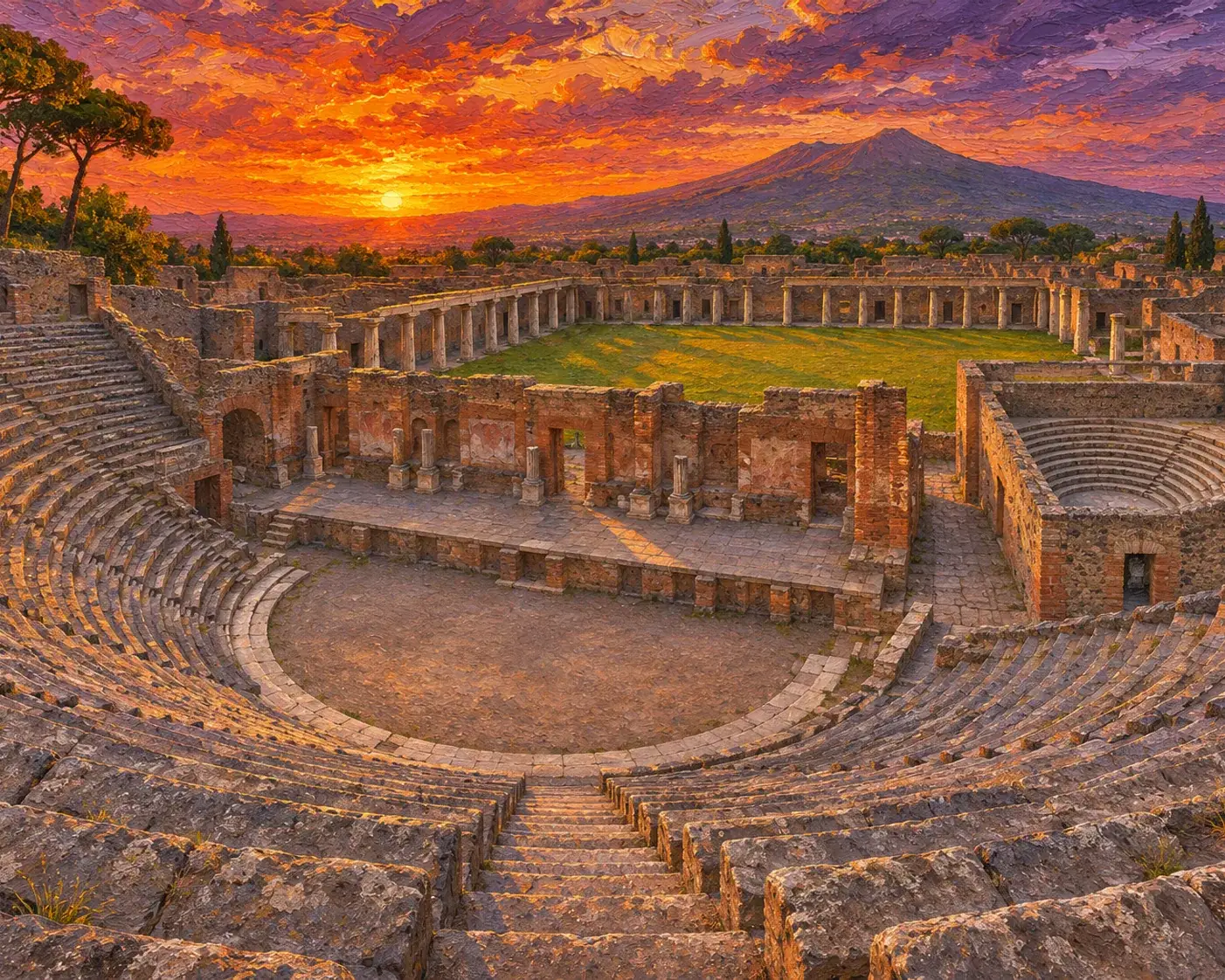
Two theatres stand side by side at the bottom of Pompeii's hill. The Large Theatre, set into the slope in the Greek way in the 2nd century BC, seated about 5,000. Next to it the Odeion, built around 80 BC, probably had a timber roof and seated about 1,500. Pompeii had its stone theatre long before Rome got its first permanent one, in 55 BC.
Seats by rank
The seats come in three bands: the front rows for magistrates and leading families, the middle, and the top for ordinary people. Around 2 BC two men of the Holconius family paid to remodel the Large Theatre, and an inscription in the theatre records the gift. The Odeion was paid for by Gaius Quinctius Valgus and Marcus Porcius, the same two magistrates who built the amphitheatre. Its rows end in carved kneeling figures holding up the stone.
From portico to barracks
Behind the stage is the Quadriporticus, a square of columns built for theatregoers to stroll in. After the earthquake of AD 62 it became barracks for gladiators. Their bronze helmets and armour were dug up here in the 1760s, along with the remains of around eighteen people.
The corridor
A passage about 27 metres long joins the two theatres, and people waiting for shows wrote on its walls. Using raking light and 3D imaging, a Sorbonne and Montreal team found 79 graffiti nobody had recorded, nearly 300 in all, published in 2026. One new fragment reads Erato amat…, "Erato loves…". The plaster has fallen where the name was.
3 things almost everyone believes that aren't true
| Claim | Verdict | What is actually the case |
|---|---|---|
| The woman in gold found in the gladiators' barracks was visiting her gladiator lover. | Unproven | Most historians think she was one of a group sheltering there from the eruption. |
| The square behind the stage was built as a gladiator school. | False | It was built as a portico for the audience and converted after AD 62. |
| Every graffito in Pompeii was read long ago. | False | 79 in the theatre corridor were first identified in the 2020s. |
Where to stand
High in the Large Theatre's top rows, where you can see the stage, the Odeion and the Quadriporticus at once.
Hear this one standing in front of it
Wanderlight's Pompeii guide covers 11 landmarks and runs 1 hr 40 min in total. It plays offline, keeps going with the screen off, and doesn't ask you to make an account.
Get it free on Google Play Android · intro and first three stops free in every cityWhere this comes from
Written from Wanderlight's research dossier for Theatres of Pompeii — the same one the narration is written from. Where the evidence is thin, this page says so rather than rounding the uncertainty up.